Intel Core Ultra 7 255H
vs
Intel Core Ultra 7 356H
CPU Comparison Result
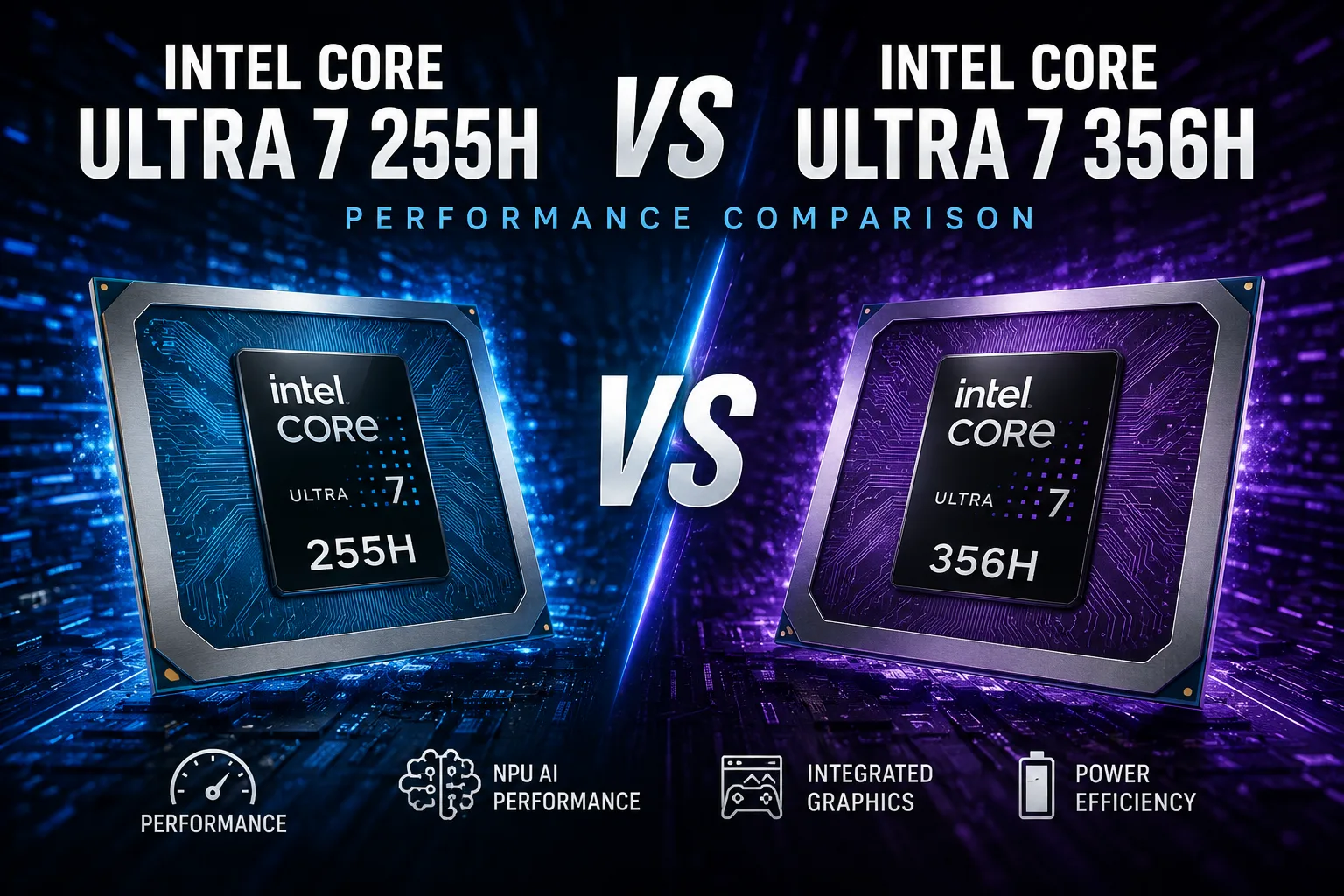
Intel Core Ultra 7 255H vs Core Ultra 7 356H: Panther Lake is Not Always Faster
The Core Ultra 7 356H is newer and has a much more powerful NPU, but in terms of regular CPU performance, the Core Ultra 7 255H hardly lags behind. The 255H has more P-cores, a higher clock speed, and significantly stronger integrated graphics. In a laptop with high power limits, the 255H can even outperform the 356H in multi-threaded tests.
Key Differences
| Characteristic | Core Ultra 7 255H | Core Ultra 7 356H |
|---|---|---|
| Generation | Arrow Lake-H | Panther Lake |
| Cores / Threads | 16 / 16 | 16 / 16 |
| Configuration | 6P + 8E + 2 LP-E | 4P + 8E + 4 LP-E |
| Max P-core Frequency | 5.1 GHz | 4.7 GHz |
| L3 Cache | 24 MB | 18 MB |
| Base Power | 28 W | 25 W |
| Maximum Turbo Power | 115 W | 80 W |
| NPU | 13 TOPS | 50 TOPS |
| Integrated Graphics | Intel Arc 140T, 8 Xe cores | Intel Graphics, 4 Xe3 cores |
The Core Ultra 7 255H features six P-cores compared to four in the 356H, and it has a higher maximum clock speed and more L3 cache.
The 356H has four LP-E cores instead of two and an NPU with 50 TOPS instead of 13 TOPS. The maximum specified power limit has been reduced from 115 to 80 W.
CPU Performance
In Geekbench 6, the Core Ultra 7 356H averages around 2776 points in single-core and 15,933 in multi-core tests. The Core Ultra 7 255H achieves approximately 2640 and 14,716 points.
The increase is about 5% in Single-Core and 8% in Multi-Core, although the 356H has a lower maximum clock speed and four P-cores instead of six.
Power limits and the cooling system of a specific laptop can affect the results more than the differences between these processors.
Geekbench 6.7 in Specific Laptops
| Processor | Laptop | Single-Core | Multi-Core |
|---|---|---|---|
| Core Ultra 7 356H | Samsung Galaxy Book6 Ultra | 2851 | 16,676 |
| Core Ultra 7 356H | Samsung Galaxy Book6 Pro | 2839 | 16,587 |
| Core Ultra 7 255H | Xiaomi RedmiBook Pro 14 2025 | 2923 | 17,489 |
| Core Ultra 7 255H | HP ZBook 8 G1i 14 | 2873 | 15,934 |
| Core Ultra 7 255H | Lenovo ThinkBook 14 Gen 8 | 2925 | 14,990 |
The RedmiBook Pro 14 with the Core Ultra 7 255H scores around 17.5 thousand points in Multi-Core, while the ThinkBook 14 with the same processor scores less than 15 thousand. The first outpaces the tested Galaxy Book6 models with the Core Ultra 7 356H.
The difference between two laptops with the same CPU here turns out to be greater than between the 255H and 356H themselves.
Power Consumption and Sustained Load
The Core Ultra 7 356H has a base power of 25 W and Maximum Turbo Power of 80 W. For the Core Ultra 7 255H, Intel specifies 28 and 115 W, respectively.
These figures do not reflect the actual power consumption of a specific laptop: manufacturers set the power limits themselves.
The MTP for the 356H is limited to 80 W compared to 115 W for the 255H, which is a noticeable difference for thin cases with limited cooling.
Integrated Graphics
The Core Ultra 7 255H is equipped with an Arc 140T with eight Xe cores, while the Core Ultra 7 356H features Intel Graphics with four Xe3 cores.
In 3DMark Time Spy, Intel Graphics with 4 Xe3 shows an average score of around 3210 points, while the Arc 140T scores approximately 4118. These results come from different laptops, so a direct comparison of the two GPUs cannot be made. Nevertheless, the Arc 140T scores about 28% higher in this selection.
At the same time, the 356H does not feature the top graphics configuration of Panther Lake. Arc B370 and B390 are used in other models of the family, so their results are not applicable to the Core Ultra 7 356H.
For laptops without a discrete graphics card, the 255H is more advantageous if integrated graphics performance is essential.
NPU: Nearly Fourfold Advantage of the 356H
The Core Ultra 7 255H offers an NPU performance of 13 TOPS. The Core Ultra 7 356H achieves 50 TOPS.
In web browsing, office applications, and most games, this difference has little impact on speed. It becomes apparent in applications that use the NPU for local AI computations.
When to Choose 255H vs. 356H
The Core Ultra 7 356H is better suited for thin laptops where a lower maximum power limit and a high-performance NPU are important.
The Core Ultra 7 255H is more advantageous in models without a discrete graphics card if integrated GPU performance is crucial. In high-performance laptops, its results can also rival or exceed those of the 356H under high power limits.
Therefore, in this pair, it is especially important to look at benchmarks of specific laptops rather than just the processor names.
Conclusion
The Core Ultra 7 356H does not surpass the 255H in all parameters. It is slightly faster on average in CPU performance, has an MTP of 80 W compared to 115 W, and an NPU with 50 TOPS versus 13 TOPS.
However, the 356H has four P-cores instead of six, 18 MB of L3 cache instead of 24 MB, and half as many Xe cores in the iGPU.
At equal prices and comparable specifications, the advantage lies with the Core Ultra 7 356H: the CPU is slightly faster on average, and the NPU is nearly four times more powerful.
But it's not worth overpaying for the 356H solely for CPU performance. A laptop with the 255H can be faster under high power limits, and its Arc 140T is better suited for configurations without discrete graphics.
The difference between specific laptops can be greater than between the Core Ultra 7 255H and 356H themselves.
Advantages
- Higher Performance-core Max Turbo Frequency: 5.1 GHz (5.1 GHz vs 4.7 GHz)
- Larger L3 Cache: 24 MB shared (24 MB shared vs 18 MB shared)
- Higher Technology: 2 nm (3 nm vs 2 nm)
- Newer Launch Date: January 2026 (January 2025 vs January 2026)
Basic
CPU Specifications
Memory Specifications
GPU Specifications
Interfaces and Ports
Benchmarks
Related CPU Comparisons






Share in social media
Or Link To Us
<a href="https://cputronic.com/cpu/compare/intel-core-ultra-7-255h-vs-intel-core-ultra-7-356h" target="_blank">Intel Core Ultra 7 255H vs Intel Core Ultra 7 356H</a>