AMD Ryzen 9 8940HX
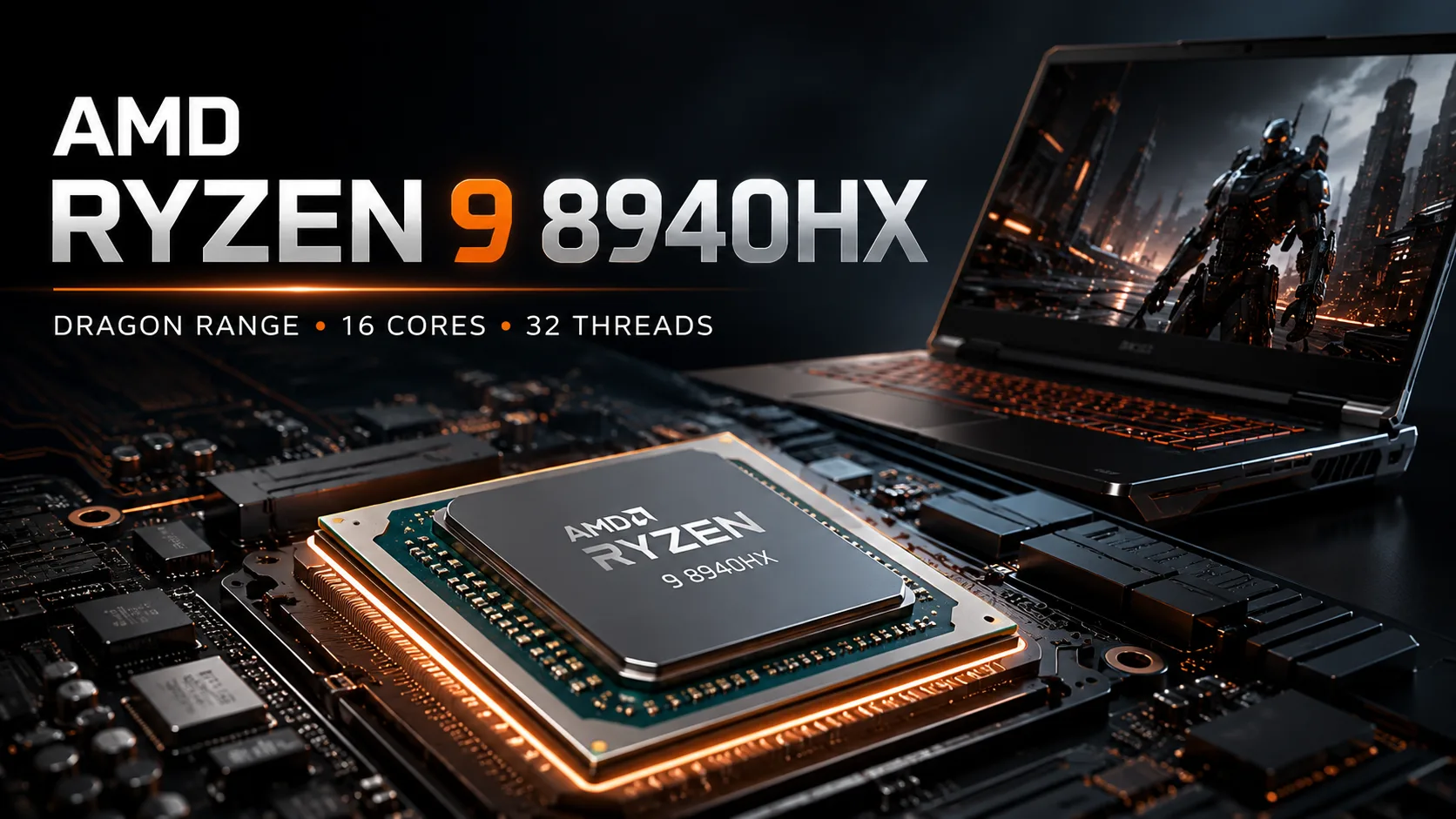
AMD Ryzen 9 8940HX: 16-Core Dragon Range Between 7940HX and 7945HX
The Ryzen 9 8940HX is not a new generation of AMD mobile processors but yet another model from the Dragon Range family based on the Zen 4 architecture. Its clock speeds are positioned between the Ryzen 9 7940HX and 7945HX, retaining the same 16 cores, 32 threads, and 64 MB of L3 cache. When choosing such a processor, it's more important to look at the price, cooling, and the specific graphics card of the laptop rather than the Ryzen 8000 index.
The direct predecessor of the Ryzen 9 8940HX is the Ryzen 9 7940HX. The base clock remains at 2.4 GHz, while the maximum has increased from 5.2 to 5.3 GHz. The Ryzen 9 7945HX is formally faster, with its base and maximum clock speeds being 100 MHz higher at 2.5 and 5.4 GHz, respectively.
How the Ryzen 9 8940HX Differs from Neighboring Models
| Processor | Architecture | Cores / Threads | Base Clock | Max Clock | Main Distinction |
|---|---|---|---|---|---|
| Ryzen 9 7940HX | Zen 4 | 16 / 32 | 2.4 GHz | 5.2 GHz | Direct predecessor |
| Ryzen 9 8940HX | Zen 4 | 16 / 32 | 2.4 GHz | 5.3 GHz | Clock speed higher by 100 MHz |
| Ryzen 9 7945HX | Zen 4 | 16 / 32 | 2.5 GHz | 5.4 GHz | Another 100 MHz higher |
| Ryzen 9 9955HX | Zen 5 | 16 / 32 | 2.5 GHz | 5.4 GHz | New architecture |
The Ryzen 9 8940HX is distinguished from the 7940HX only by its maximum clock speed, which is increased by 100 MHz. The architecture, core configuration, cache, memory controller, and integrated graphics remain unchanged. The transition to Zen 5 occurred only with the Ryzen 9 9955HX.
Performance in Specific Laptops
The table contains individual Geekbench 6 results rather than averaged metrics. The test versions, memory configurations, and power profiles vary. The results show a range of performance but do not allow for direct ranking of laptops.
| Laptop | Test Conditions | Geekbench 6 Single-Core | Geekbench 6 Multi-Core |
|---|---|---|---|
| ASUS TUF Gaming A16 FA608PP | Windows 11, Turbo, 32 GB DDR5 | 2873 | 16 416 |
| ASUS ROG Strix G16 G614PR | Windows 11, Performance, 64 GB DDR5 | 2767 | 16 188 |
| MECHREVO JIAOLONG Series | Windows 11, 64 GB DDR5 | 2708 | 15 317 |
| Lenovo Legion Pro 5 16ADR10 | Windows 11, Balanced, 32 GB DDR5 | 2603 | 14 925 |
In performance profiles, the ASUS TUF Gaming A16 and ROG Strix G16 scored around 16,000 points in multi-core Geekbench 6. Lenovo was tested in balanced mode and ran at a lower maximum clock speed, so its result cannot be directly compared to ASUS's scores.
The variance is primarily defined by the power profile, power limits, and cooling efficiency of the specific chassis. The same Ryzen 9 8940HX can operate differently even in laptops of a similar class.
For What Tasks 16 Cores are Needed
The advantage of the Ryzen 9 8940HX is most noticeable in prolonged multi-threaded workloads:
- rendering and video encoding;
- compiling large projects;
- working with multiple virtual machines;
- concurrent usage of several resource-intensive applications;
- gaming while simultaneously streaming and recording video.
In short tasks and programs that use only a few threads, the benefit over more affordable eight-core models diminishes. The premium is justified only with regular multi-threaded workloads; for some games, such a processor is excessive.
Gaming Performance
Most games do not receive noticeable benefits from all 16 cores. Frame rates are more affected by the graphics card, its TGP, and the cooling of the laptop under combined CPU and GPU loads.
A laptop with a Ryzen 9 8940HX and GeForce RTX 5060 may lag behind models with an eight-core processor and RTX 5070 in games. Therefore, in a gaming configuration, it's more important to first evaluate the graphics card and its power limit before considering the processor.
The Radeon 610M with two compute units is needed for outputting images and running the laptop when the discrete graphics are off. For modern games, a separate graphics card is essential. The processor does not feature a hardware NPU.
Power Consumption and Cooling
The nominal TDP is 55 W, and the adjustable range is 55-75 W. Under short-term load, consumption can be higher: specific limits are set by the laptop manufacturer.
The Ryzen 9 8940HX requires a large chassis and an effective cooling system. In a thin laptop, the advantage of 16 cores will disappear if the processor quickly reaches thermal or power limits.
Conclusion
The Ryzen 9 8940HX retains the high multi-threaded performance of the Dragon Range but makes almost no changes compared to the Ryzen 7000HX series. It is situated between the Ryzen 9 7940HX and 7945HX in terms of clock speeds.
There is no sense in overpaying just for the number 8 in the name. It is worth choosing the 8940HX as part of a well-chosen laptop-one with effective cooling, an appropriate graphics card, and a price below similar configurations with Ryzen 9 7945HX, 8945HX, or 9955HX.
CPU Comparison
Compare Ryzen 9 8940HX with other CPUs
Basic
CPU Specifications
Memory Specifications
GPU Specifications
Miscellaneous
Benchmarks
Compared to Other CPU
Related CPU Comparisons


Share in social media
Or Link To Us
<a href="https://cputronic.com/cpu/amd-ryzen-9-8940hx" target="_blank">AMD Ryzen 9 8940HX</a>