Unisoc Tiger T616

Unisoc Tiger T616: Why a High AnTuTu Score Does Not Make It Fast
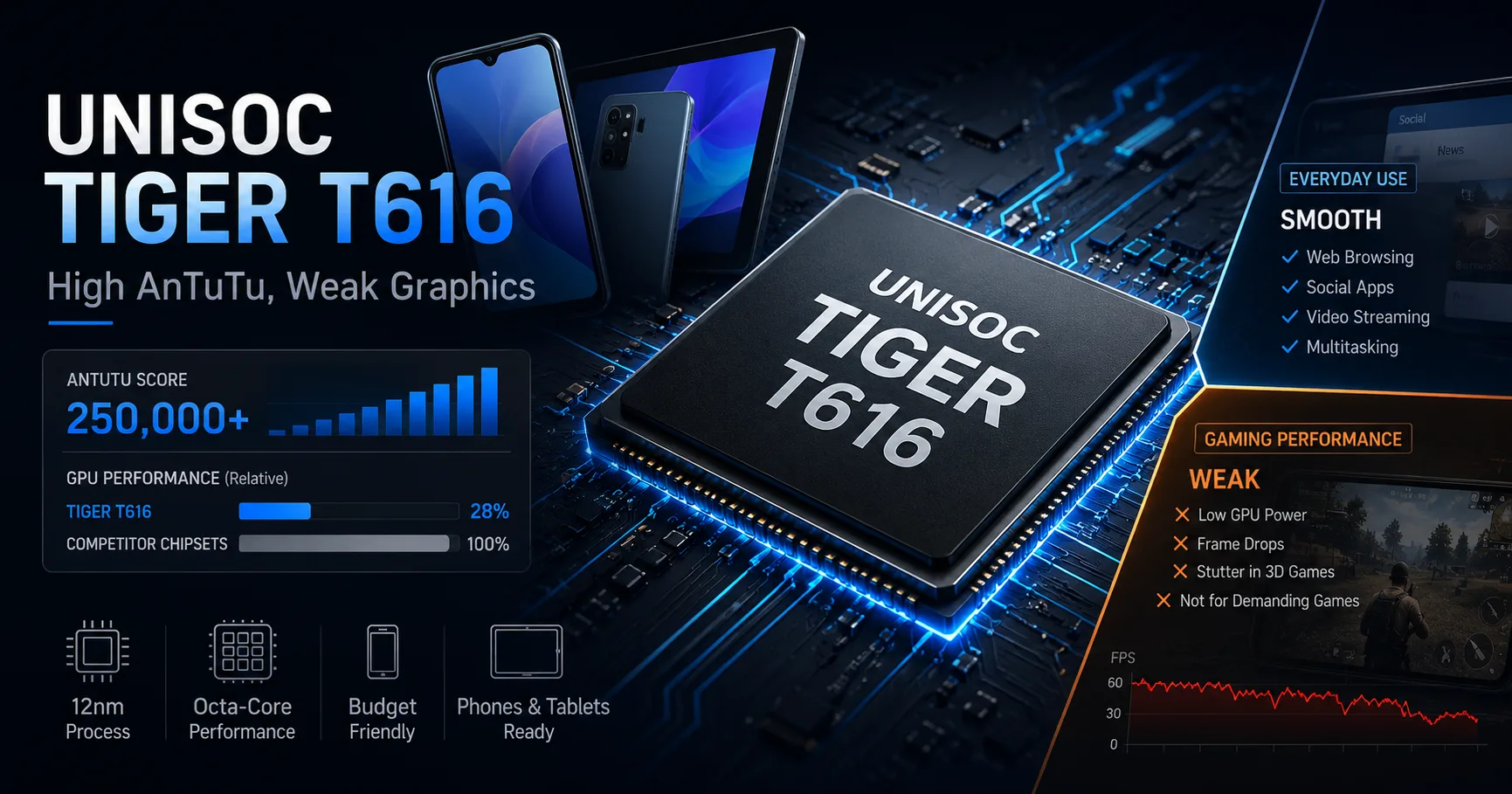
The Tiger T616 is still found in cheap smartphones and tablets, but for gaming and heavy applications, this chip is already distinctly weak. Two Cortex-A75 cores keep CPU performance at an acceptable level, while the overall AnTuTu score masks the weaknesses of the other components. In gaming, the illusion quickly disappears: the Mali-G57 MP1 does not provide stable FPS or headroom for new projects.
For browsing, video, navigation, and messaging, its capabilities are still sufficient. However, heavy applications and active multitasking are already beyond its comfortable limits.
What the Tiger T616 Is
The CPU consists of two high-performance Cortex-A75 cores clocked up to 2.0 GHz and six Cortex-A55 cores clocked up to 1.8 GHz. The chip is manufactured using a 12nm process, and graphics are handled by the Mali-G57 MP1 with a single graphics core.
In some recent models, manufacturers indicate a related chip called Unisoc T7255. This new designation does not change the essence: the architecture, manufacturing process, and weak graphics remain the same.
For basic tasks, two Cortex-A75 cores are currently sufficient. Therefore, the Tiger T616 is more responsive than models using the T606, where all eight cores belong to the energy-efficient class. However, the Mali-G57 MP1 quickly hits its limits when launching games, graphics-intensive web pages, and applications on Full HD screens.
The chip supports only 4G networks and lacks a dedicated NPU found in modern mobile processors. Some image processing tasks are handled by an integrated DSP, but its power is insufficient for generative models and other heavy local AI tasks.
Examples of Results in Geekbench 6
The table summarizes results from individual user tests. These are benchmarks and not official specifications: the final result depends on the firmware, temperature, and background load.
| Device | Type | RAM | Geekbench 6 Single-Core | Geekbench 6 Multi-Core |
|---|---|---|---|---|
| Motorola Moto G14 | Smartphone | 4 GB | 450 | 1514 |
| realme C35 | Smartphone | 4 GB | 446 | 1576 |
| Blackview Tab 16 | Tablet | 8 GB | 445 | 1497 |
| Teclast M50 Pro | Tablet | 8 GB | 433 | 1499 |
Most devices score between 430-450 points in single-core tests and 1470-1580 points in multi-core tests. This level still provides acceptable speed in basic applications.
However, Geekbench does not reflect the weaknesses of the GPU and delays caused by cheap eMMC storage and poorly tuned firmware.
In the tested Moto G14 and Teclast M50 Pro, there was no significant drop in speed under prolonged load. But cheap devices using the same chip may perform worse due to inadequate cooling and subpar software.
Why AnTuTu Overstates the Chip's Capabilities
According to available results from AnTuTu 11, devices powered by the Tiger T616 score approximately 370-390 thousand points. For a budget processor, this number seems convincing-and this is why it can be misleading.
The overall score includes not just the CPU and GPU but also memory, storage, and system responsiveness. As a result, a decent processor section and a fast UFS storage drive can boost the final score, even though gaming performance remains low.
Individual results in Geekbench Compute cannot be directly compared: they are influenced by APIs, drivers, and firmware. However, in terms of graphics performance, the Tiger T616 is weaker than the Helio G85 and noticeably lags behind the Helio G99.
The chip can run undemanding 2D games and older mobile hits without serious issues. In PUBG Mobile and similar games, low settings, unstable FPS, and long loading times are the norm.
Purchasing a device powered by the T616 for gaming is pointless, even if the seller boasts an AnTuTu score.
UFS Is More Important than Virtual Memory
Two devices using the Tiger T616 can vary significantly in operating speed. The reason is often not the processor but the storage.
The Moto G14 and realme C35 use UFS 2.2. Such storage loads the system faster, installs apps quicker, and retrieves data promptly. Cheap tablets with eMMC 5.1 take longer to launch programs and often stutter during multitasking.
Therefore, eight gigabytes of RAM alone do not guarantee anything. A slow storage drive affects everyday speed more than the difference between six and eight gigabytes of RAM. Virtual memory from the storage does not replace true physical RAM.
A smartphone should have at least 4 GB of physical RAM and UFS storage; 6 GB is preferable. A tablet is better off with 6-8 GB, although additional memory won’t fix poor optimization.
On a Full HD screen, a weak GPU has to handle more pixels, so animations and games may run less smoothly than on an HD model.
For What Tasks the Tiger T616 Is Still Suitable
The chip handles the following tasks:
- Messengers, calls, and social media;
- Video playback and reading;
- Navigation;
- Browsing with a few open tabs;
- Simple office applications;
- Undemanding games.
For video editing, processing large photos, modern gaming, and heavy multitasking, its capabilities are already insufficient.
How to Compare the Tiger T616
The Unisoc T606 is slower as it lacks two high-performance Cortex-A75 cores.
The Helio G85 is similar in CPU level, but its GPU is usually faster.
The Helio G99 belongs to a different class: it has a 6nm manufacturing process, more powerful graphics, and better energy efficiency. Devices equipped with it are noticeably faster in games and generate less heat under load.
The Snapdragon 680 doesn’t provide a huge CPU boost, but its 6nm process reduces power consumption and heating.
Conclusion
The Unisoc Tiger T616 is suitable for basic tasks but quickly falters under heavy loads. A device featuring this chip makes sense only as a budget model with UFS storage.
With a slight additional cost for the Helio G99, it's not worth saving: the speed difference is more significant than the price difference.
SOC Comparison
Compare Tiger T616 with other SOCs
Basic
6x 1.8 GHz – Cortex-A55
GPU Specifications
Connectivity
Memory Specifications
Miscellaneous
Benchmarks
Phones with Tiger T616
Tablets with Tiger T616
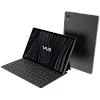


Comparison of Devices with Tiger T616
Compared to Other SoC
Related SoC Comparisons



Share in social media
Or Link To Us
<a href="https://cputronic.com/soc/unisoc-tiger-t616" target="_blank">Unisoc Tiger T616</a>