Unisoc T9300

Unisoc T9300: New Frequencies for Old Cortex-A78 and Mali-G57
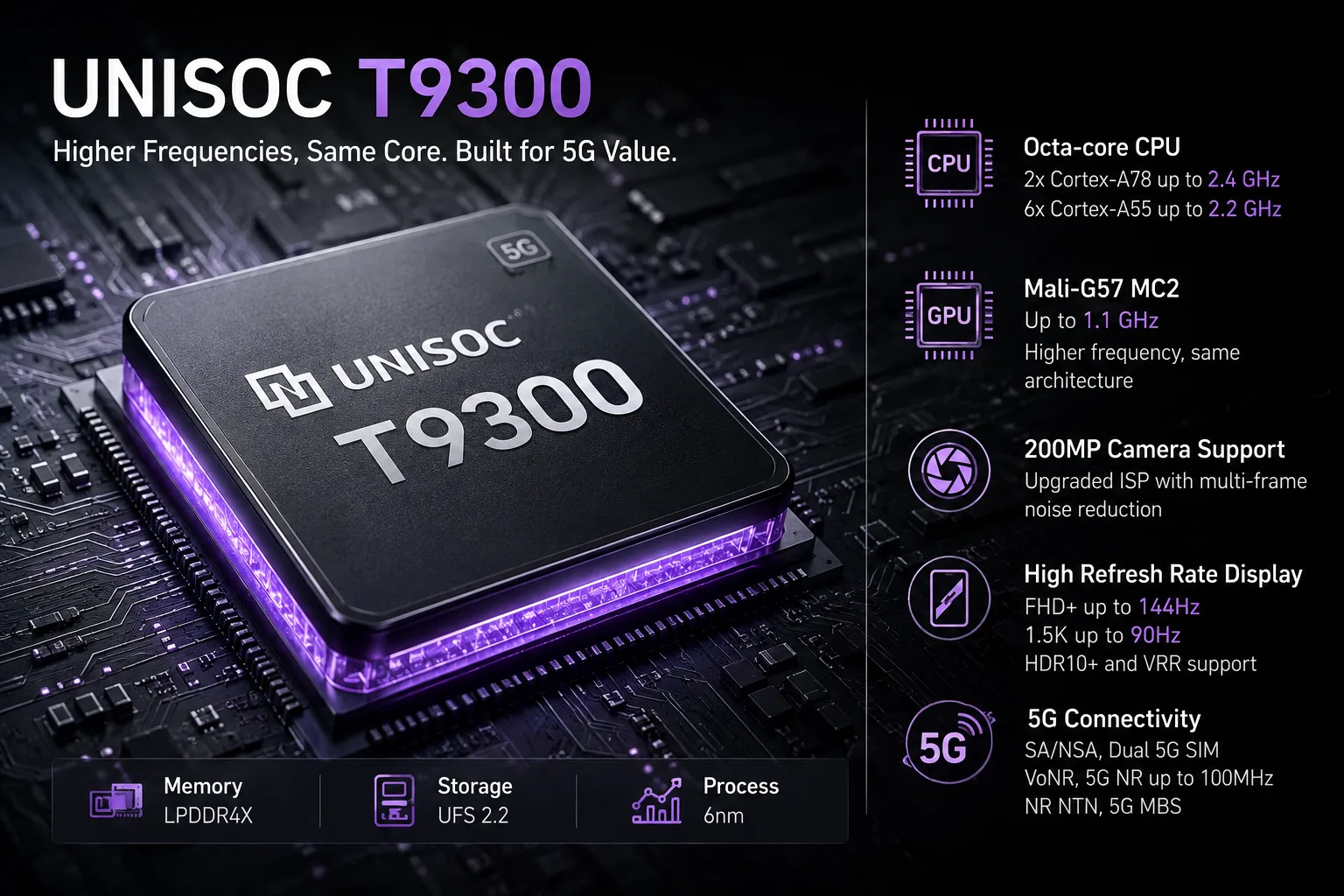
The Unisoc T9300 almost repeats the T8300: two Cortex-A78, six Cortex-A55, and Mali-G57 MC2. The main difference is the increased frequencies for the CPU and GPU. Meanwhile, the ISP, display controller, and modem have significantly improved.
T9300 - Accelerated T8300
In terms of CPU and GPU configuration, the chips are nearly identical. The T8300 uses two Cortex-A78 up to 2.2 GHz, six Cortex-A55 up to 2.0 GHz, and a Mali-G57 MC2 at approximately 950 MHz. In the T9300, the frequencies have been increased to 2.4 GHz for Cortex-A78, 2.2 GHz for Cortex-A55, and approximately 1.1 GHz for the GPU.
The manufacturing process remains the same at 6 nm. The CPU architecture and GPU configuration have also not changed. The main gains here come from the increased frequencies. The T9300 does not feature new CPU cores.
The ISP now supports cameras up to 200 MP instead of 108 MP. For FHD+, the maximum screen refresh rate has increased from 120 Hz to 144 Hz, while 1.5K panels can operate at 90 Hz.
Memory support remains at LPDDR4X, and storage is UFS 2.2. These parameters immediately indicate the platform class: the T9300 is intended for budget 5G smartphones rather than sub-flagships.
T9300 Results in Geekbench and AnTuTu
There are currently almost no commercial smartphones with the T9300. Therefore, real results must primarily be assessed based on the nubia Neo 5 5G, where the processor is also referred to as T9300 Ultimate.
Given the specifications of the CPU and GPU, the T9300 Ultimate does not differ from the standard T9300 at the chip level.
| Device | AnTuTu | Geekbench 6 Single | Geekbench 6 Multi |
|---|---|---|---|
| nubia Neo 5 5G, 8/256 GB | 704 510, v11 | 942 | 2 133 |
| nubia Neo 5 5G, another test | 698 227, v11 | 943 | 2 000 |
| UNISOC Reference Device, 6 GB, UFS 2.2 | - | 985 | 2 354 |
The retail nubia Neo 5 5G scores around 940 points in Geekbench 6 single-core and 2,000-2,150 in multi-core mode. On the reference device, the results are higher: 985 and 2354 points.
In a commercial smartphone, performance is influenced by cooling, power limits, and firmware, so the numbers from the reference board should not be taken as a benchmark for any device.
CPU performance is already above the level of the cheapest 5G platforms, but the two Cortex-A78 cores limit future potential.
Confusion with AnTuTu
The official AnTuTu figures for the T9300 contradict each other. In some materials, the processor is reported to score around 550,000 points in AnTuTu V10, while the weaker T8300 achieves results above 725,000 in the same version of the test. In newer materials, the T9300 is already claimed to exceed 760,000 points in AnTuTu V11.
The real nubia Neo 5 5G scores approximately 698-705,000 points in AnTuTu V11. For a commercial device, it is more reasonable to rely on these results.
AnTuTu V10 and V11 cannot be compared: the version of the test must be specified alongside the T9300 score.
Graphics: Mali-G57 MC2 Boosted to 1.1 GHz
The main weak point of the T9300 is the Mali-G57 MC2. The GPU frequency has increased from approximately 950 MHz on the T8300 to 1.1 GHz, but the architecture and configuration of the MC2 have not changed.
In the nubia Neo 5 5G, the graphics performance is approximately:
- 1787 points in Geekbench 6 OpenCL;
- 1844 points in Vulkan;
- 1425 points in 3DMark Wild Life.
Overclocking helps in less demanding games, but two clusters of Mali-G57 are inadequate for heavy modern titles. In Wuthering Waves, it is necessary to lower the graphics quality, and even after that, frame drops are possible.
The claimed 90 FPS are achievable primarily in less demanding and well-optimized games. The screen at 120-144 Hz should not be confused with gaming performance: in heavy projects, such frame rates should not be expected from the T9300.
Cameras and Displays
The quad-core ISP supports cameras up to 200 MP, multi-frame noise reduction, and night photo processing.
For displays, FHD+ up to 144 Hz and 1.5K up to 90 Hz are available, along with HDR10+ and variable refresh rates.
Support for a 200 MP sensor sets merely a technical limit for the ISP and does not indicate the quality of the specific smartphone's camera.
Connectivity
The built-in modem supports SA and NSA 5G, two 5G SIMs, VoNR, and 5G NR with a bandwidth of up to 100 MHz.
The T9300 also supports NR NTN and 5G MBS. NR NTN allows the manufacturer to add satellite communication, but support from the SoC alone is insufficient: corresponding radio parts, antennas, firmware, and network are needed.
Conclusion
The real nubia Neo 5 5G scores around 700,000 points in AnTuTu V11 and approximately 940/2100 points in Geekbench 6. In terms of CPU, this is no longer the lowest level in the 5G segment.
However, the main limitation of the T9300 comes from the older Cortex-A78 cores and especially the Mali-G57 MC2. The increased frequencies make them faster, but do not eliminate the gap from newer architectures.
The essence of the T9300 lies in its price: the smartphone manufacturer obtains 5G, a screen up to 144 Hz, and a CPU significantly faster than the cheapest solutions without transitioning to a more expensive platform. This comes at the cost of old Mali-G57 MC2 graphics and a small margin for performance.
SOC Comparison
Compare T9300 with other SOCs
Basic
GPU Specifications
Connectivity
Memory Specifications
Miscellaneous
Benchmarks
Compared to Other SoC
Related SoC Comparisons



Share in social media
Or Link To Us
<a href="https://cputronic.com/soc/unisoc-t9300" target="_blank">Unisoc T9300</a>