MediaTek Dimensity 6300
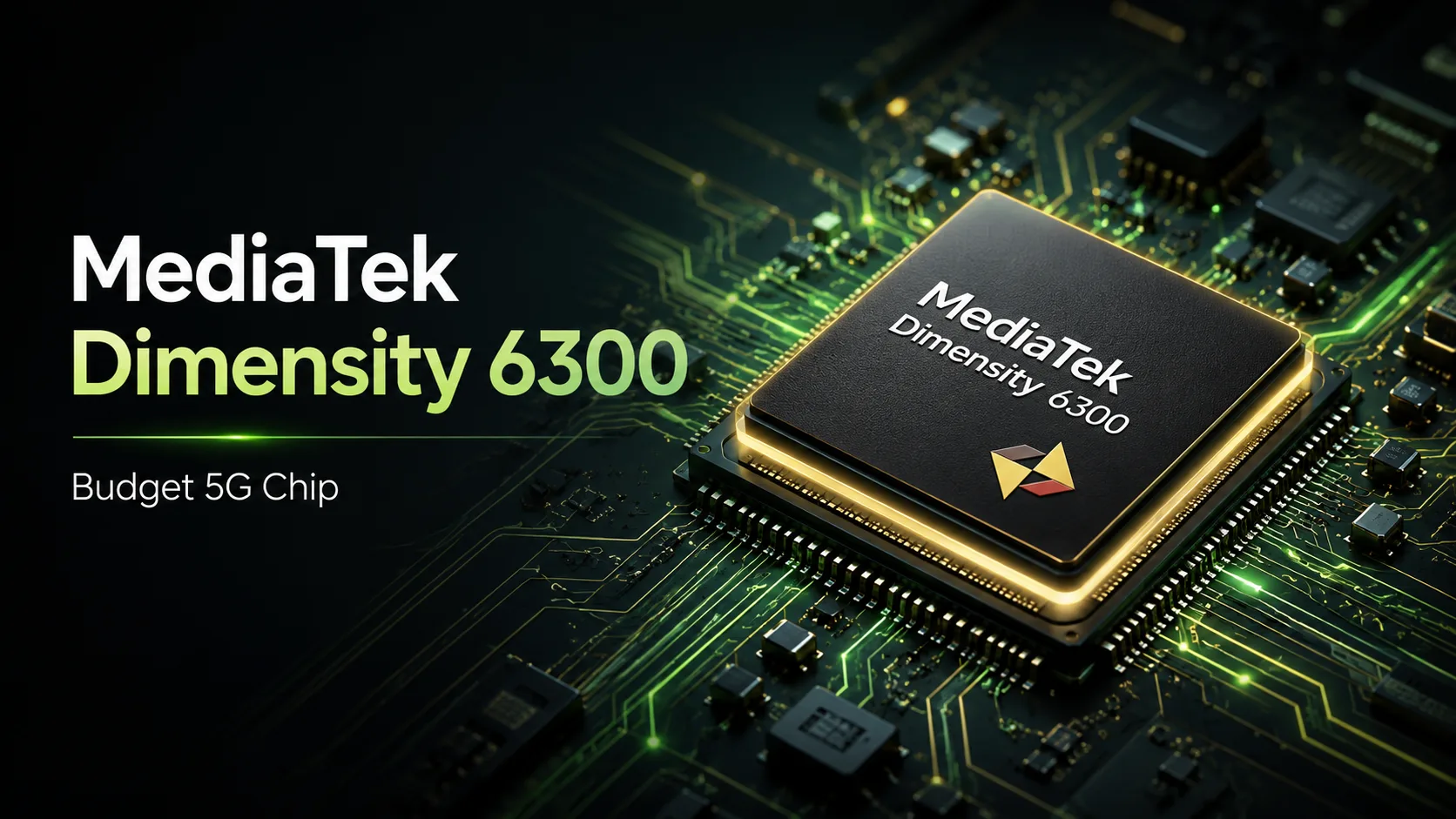
MediaTek Dimensity 6300: Budget 5G Chip with Minimal Changes
MediaTek Dimensity 6300 is a budget 5G platform, closely resembling the specs of the Dimensity 6100+. It features the same Cortex-A76 and Cortex-A55 cores, the same Mali-G57 MC2 graphics, the same LPDDR4x memory, and UFS 2.2 storage. The main difference lies in the increased frequency of the two Cortex-A76 cores, boosted from 2.2 GHz to 2.4 GHz.
The practical conclusion is simple: the Dimensity 6300 is suitable for inexpensive 5G smartphones with a 90-120 Hz display and a large battery, but it doesn’t elevate the device beyond the entry-level 5G segment. Paying a premium for the 6300 index makes no sense if more powerful platforms are available.
Architecture and Specifications
The Dimensity 6300 employs an octa-core 2 + 6 configuration. Two Cortex-A76 cores operate at frequencies of up to 2.4 GHz and handle the primary load. Six Cortex-A55 cores running at up to 2.0 GHz manage background and low-load tasks.
Graphics are handled by the Mali-G57 MC2. This is an entry-level GPU designed for simple games, user interfaces, video, and basic 3D loads. In demanding games, it is the graphics unit that becomes the main limiting factor, not the CPU.
The platform supports LPDDR4x memory up to 2133 MHz, UFS 2.2 storage, displays up to 2520 × 1080 pixels at up to 120 Hz, cameras up to 108 MP, 5G SA/NSA, and peak download speeds of up to 3.3 Gbit/s. This configuration fits the entry-level 5G segment: a modern modem, but lacking LPDDR5, UFS 3.x, Wi-Fi 6, and more powerful graphics.
Differences from Dimensity 6100+
The main context for the Dimensity 6300 is its comparison with the Dimensity 6100+. Without this, the scale of the update can be easily overstated.
| Parameter | Dimensity 6300 | Dimensity 6100+ | Difference |
|---|---|---|---|
| Performance Cores | 2 × Cortex-A76 up to 2.4 GHz | 2 × Cortex-A76 up to 2.2 GHz | Slight CPU boost |
| Efficiency Cores | 6 × Cortex-A55 up to 2.0 GHz | 6 × Cortex-A55 up to 2.0 GHz | No changes |
| Graphics | Mali-G57 MC2 | Mali-G57 MC2 | No changes |
| Memory | LPDDR4x | LPDDR4x | No changes |
| Storage | UFS 2.2 | UFS 2.2 | No changes |
| Display | up to FHD+ 120 Hz | up to FHD+ 120 Hz | No changes |
| Camera | up to 108 MP | up to 108 MP | No changes |
| 5G | up to 3.3 Gbit/s | up to 3.3 Gbit/s | No changes |
MediaTek has increased the frequency of the two Cortex-A76 cores while leaving the rest of the platform unchanged. Therefore, the Dimensity 6300 is not a new generation but rather a frequency revision of the Dimensity 6100+.
In practice, the performance boost over the Dimensity 6100+ will be limited to CPU-related tasks. The interface may be slightly more responsive, and specific tests may show gains, but the graphics, memory, storage, and modem remain in the same class.
Benchmarks and Everyday Speed
In Geekbench 6, the Dimensity 6300 typically scores around 770 points in single-core and about 1980 points in multi-core tests. This is the level of an inexpensive 5G smartphone: web browsing, messaging, YouTube, maps, banking apps, and basic multitasking do not demand high CPU and GPU performance.
In AnTuTu, results vary depending on the test version, memory, cooling, and specific smartphone model. In different devices, the Dimensity 6300 can score around 400,000 to 520,000 points. Even at the upper end, it remains in the entry-level 5G segment.
| Test | Estimated Result |
|---|---|
| Geekbench 6 Single-Core | around 770 |
| Geekbench 6 Multi-Core | around 1980 |
| AnTuTu 10/11 | approximately 400-520 thousand |
For everyday tasks, this level is sufficient. The limitation lies elsewhere: the Cortex-A76 and Cortex-A55 are no longer considered fresh CPU cores, and LPDDR4x and UFS 2.2 place the platform below the modern mid-range.
Gaming: GPU Limitation
In gaming, the Dimensity 6300 is limited not by the CPU but by the Mali-G57 MC2. Simple projects, casual games, and older titles run without a high load on the GPU, especially if the smartphone uses an HD+ display: lower resolution means lower graphical load.
In demanding games, the limitations become more apparent. Titles like Genshin Impact, Honkai: Star Rail, Wuthering Waves, and similar projects require low settings. Even with reduced graphics, stability of the FPS depends on the phone's casing, cooling, power limits, and firmware of the specific smartphone.
The Dimensity 6300 is not a suitable choice as a gaming platform. It works for occasional gaming and moderate use, but not for scenarios where a smartphone is purchased primarily for heavy titles. The slight increase in CPU frequency does not compensate for the weak GPU.
Display, Cameras, and Modem
According to specifications, the Dimensity 6300 supports FHD+ displays with refresh rates up to 120 Hz. This enables the release of affordable smartphones with a smooth interface but does not guarantee a quality matrix. In real-world models with this chip, HD+ panels are often encountered: manufacturers keep 120 Hz as a notable specification but cut costs on resolution and display quality.
Support for cameras up to 108 MP also does not guarantee shooting quality. The final photo's quality depends on the sensor, optics, stabilization, processing algorithms, and firmware. The Dimensity 6300 offers the technical capability to use a large sensor but does not determine the camera's level on its own.
The strongest part of the platform is the modem. It features 5G SA/NSA, support for two 5G SIM cards, VoNR, and peak download speeds of up to 3.3 Gbit/s. Thus, connectivity remains the main selling point of the Dimensity 6300 in the budget segment.
The limitation regarding wireless interfaces is noticeable: Wi-Fi is only available in the Wi-Fi 5 version. For a budget smartphone, this is acceptable, but the absence of Wi-Fi 6 highlights the platform's class.
Battery Life
The Dimensity 6300 does not belong to power-hungry platforms. Its 6nm process technology, moderate frequencies, and entry-level graphics help keep energy consumption under control. In smartphones with a battery capacity of 5000-6000 mAh, this SoC appears logical.
The processor provides a good foundation for battery life, but the final outcome depends on the display, battery, network quality, Android interface, and background processes. The difference between the Dimensity 6100+ and Dimensity 6300 here will be less important than the specific settings of the smartphone.
In Which Smartphones It Is Justified
The Dimensity 6300 is justified in inexpensive 5G smartphones, where price is more critical than performance margin. The optimal scenario is a device with a battery of at least 5000 mAh, a 90-120 Hz display, 4-8 GB of RAM, and UFS 2.2 storage.
In such a smartphone, the chip fulfills its role: it provides 5G, decent interface speed, support for modern basic features, and does not require expensive cooling. The weaknesses become noticeable when a model with the Dimensity 6300 is sold alongside smartphones with more powerful SoCs. In this case, the premium is not backed by a significant performance increase.
Conclusion
MediaTek Dimensity 6300 is a frequency upgrade of the Dimensity 6100+, not a new step in the budget segment. The main change is the Cortex-A76 cores reaching 2.4 GHz. All other key parameters remain the same: Mali-G57 MC2, LPDDR4x, UFS 2.2, Wi-Fi 5, and 5G modem up to 3.3 Gbit/s.
For a budget 5G smartphone, this is a standard platform. It handles everyday tasks, supports displays up to 120 Hz, provides modern mobile connectivity, and should not significantly compromise battery life.
Buying a smartphone with the Dimensity 6300 makes sense if the price is low. If the device is priced close to models with more powerful SoCs, the 6300 index does not justify the premium: the performance gain over the Dimensity 6100+ is minimal, and the main limitation continues to be the graphics.
SOC Comparison
Compare Dimensity 6300 with other SOCs
Basic
GPU Specifications
Connectivity
Memory Specifications
Miscellaneous
Benchmarks
Phones with Dimensity 6300
















Tablets with Dimensity 6300
Comparison of Devices with Dimensity 6300
Compared to Other SoC
Related SoC Comparisons





Share in social media
Or Link To Us
<a href="https://cputronic.com/soc/mediatek-dimensity-6300" target="_blank">MediaTek Dimensity 6300</a>