Samsung Exynos 2600
vs
MediaTek Dimensity 8500
SoC Comparison Result
Samsung Exynos 2600 vs MediaTek Dimensity 8500: How Much Faster is Exynos
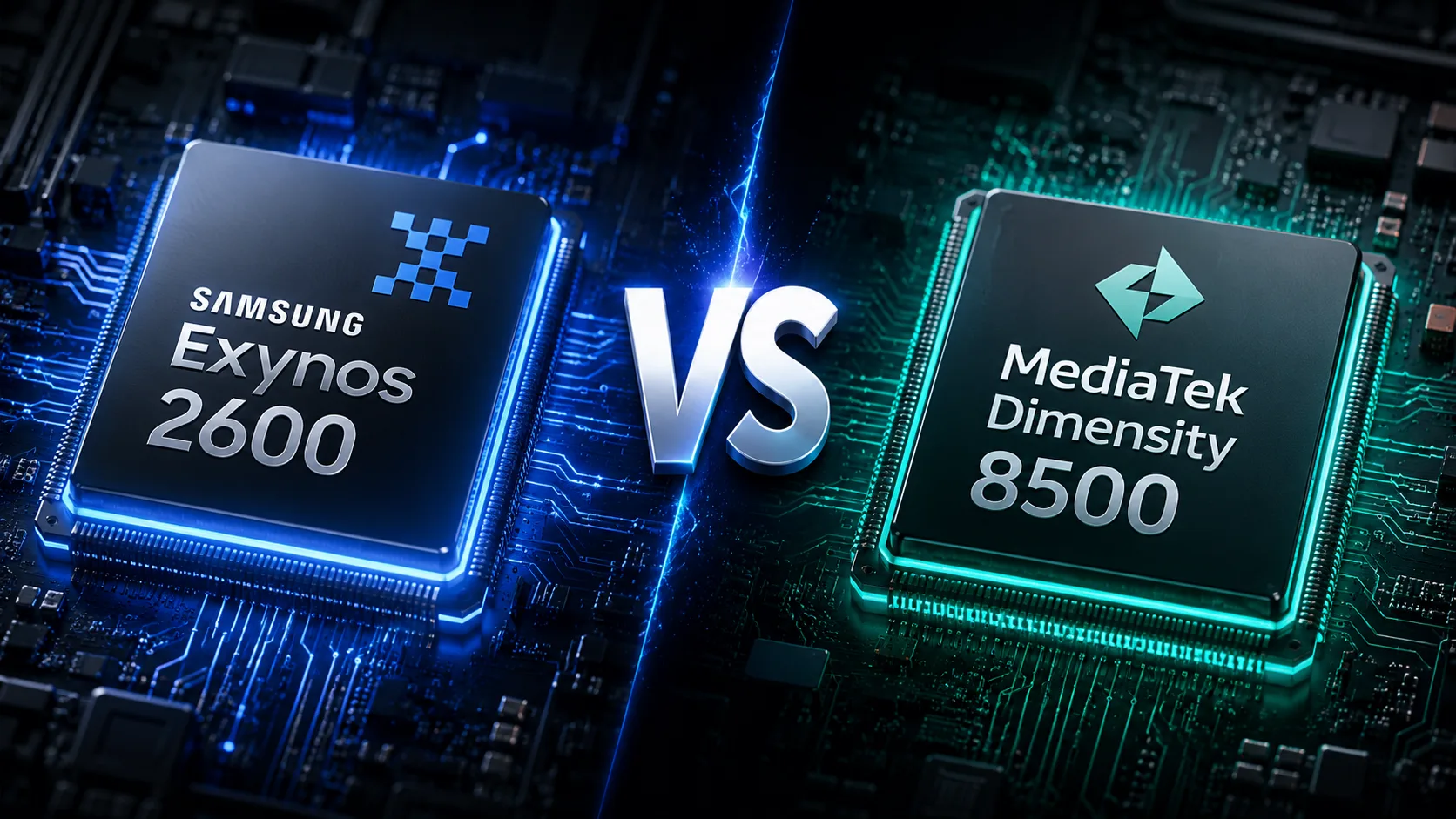
The Exynos 2600 is a significantly faster SoC, especially excelling in Single-Core and graphics tests. The Dimensity 8500 is a class below and is found in cheaper smartphones. Therefore, the question is not which processor is faster, but rather how large the difference is between devices on these platforms.
| Difference | Samsung Exynos 2600 | MediaTek Dimensity 8500 |
|---|---|---|
| Class | flagship | sub-flagship |
| Process technology | Samsung 2 nm GAA | 4 nm |
| CPU | 10 cores | 8 Cortex-A725 cores |
| Maximum frequency | up to 3.8 GHz | up to 3.4 GHz |
| GPU | Xclipse 960 | Mali-G720 MC8 |
| Memory | LPDDR5X | LPDDR5X-9600 |
The Exynos 2600 is produced using Samsung's 2-nm GAA technology and features a 10-core Armv9.3 CPU architecture. The Dimensity 8500 is manufactured on a 4-nm process and uses eight Cortex-A725 cores clocked at up to 3.4 GHz. Both processors lack separate power-efficient Cortex-A5xx cores.
CPU Performance
In Geekbench 6, the Exynos 2600 shows significant speed improvements. The Galaxy S26 and S26+ score approximately 3060-3210 points in Single-Core and 10,400-11,000 points in Multi-Core. Devices equipped with the Dimensity 8500 score roughly between 1560-1680 and 6480-6640 points, respectively.
| Smartphone | Processor | Geekbench 6 Single-Core | Geekbench 6 Multi-Core |
|---|---|---|---|
| Samsung Galaxy S26+ | Exynos 2600 | 3209 | 11 034 |
| Samsung Galaxy S26 | Exynos 2600 | 3060 | 10 388 |
| Motorola Edge 70 Pro | Dimensity 8500 | 1675 | 6642 |
| POCO X8 Pro | Dimensity 8500 | 1564 | 6478 |
The table lists the results of commercial smartphones in Geekbench 6. The Galaxy S26 outperforms the POCO X8 Pro by approximately 96% in Single-Core and 60% in Multi-Core.
The most significant performance gap is observed in Single-Core results. In Multi-Core, the advantage is smaller, but the Exynos 2600 is still around 60% faster.
In terms of speed, the Dimensity 8500 cannot compete with the Exynos 2600 - these processors belong to different classes.
Graphics and Gaming
The Exynos 2600 features the Xclipse 960 with hardware ray tracing. ENSS handles neural network upscaling and frame generation. The Dimensity 8500 is equipped with a Mali-G720 MC8, incorporating MediaTek HyperEngine technologies.
The performance advantage of the Xclipse 960 is further highlighted in 3DMark:
| Smartphone | GPU | 3DMark Wild Life Extreme | Steel Nomad Light |
|---|---|---|---|
| Samsung Galaxy S26+ | Xclipse 960 | 7206 | 3265 |
| Samsung Galaxy S26 | Xclipse 960 | 7122 | 3211 |
| POCO X8 Pro | Mali-G720 MC8 | 4311 | 1563 |
| Motorola Edge 70 Pro | Mali-G720 MC8 | 4011 | 1624 |
In Wild Life Extreme, the Xclipse 960 is approximately 65-80% faster, and in Steel Nomad Light, it is nearly double the performance. All four smartphones were tested under identical 3DMark tests, so this comparison is more accurate than cross-referencing results from different versions of AnTuTu.
In demanding games, the Exynos 2600 enables higher settings or a more stable frame rate. The Dimensity 8500 is notably weaker in terms of GPU power, though its performance is sufficient for most mobile games.
Heating and Stability Under Load
Under prolonged load, the dynamics change. In the 3DMark Wild Life Extreme Stress Test, the POCO X8 Pro maintained 74.4% of its initial performance. The Galaxy S26 recorded 48.8%, the Galaxy S26+ about 59.6%, and the Motorola Edge 70 Pro around 48.9%.
Even after throttling, the Xclipse 960 may remain faster due to its significantly higher initial performance. However, under extended gaming stress, the gap narrows.
The stress test results are influenced not only by the SoC but also by cooling, chassis design, and manufacturer settings.
Samsung has specifically redesigned heat dissipation in the Exynos 2600. The chip’s body features a Heat Path Block for more efficient thermal management.
The process technology alone does not determine smartphone heating. The 2-nm process gives the Exynos 2600 a technological edge, but frequency stability depends on the cooling system of the specific device.
AI and Additional Features
The Exynos 2600 features an updated NPU for local AI tasks, including image processing and computer vision.
The Dimensity 8500 includes an NPU 880 that supports local generative models.
Currently, there is insufficient comparable NPU testing for a reliable percentage comparison. Therefore, the advantages of the Exynos in CPU and GPU performance should not be automatically assumed to extend to AI capabilities.
Conclusion
The Exynos 2600 is significantly faster than the Dimensity 8500 in CPU and especially in graphics performance, but there is an important practical difference: the Exynos 2600 is only used in Samsung smartphones, while the Dimensity 8500 is found in models from various brands and price categories.
As a result, the choice is determined not only by processor performance. If considering a Galaxy with the Exynos 2600, the buyer is getting a more powerful platform but is effectively choosing a Samsung smartphone. The Dimensity 8500 offers a wider selection of devices, which are usually less expensive.
At a similar price point, the advantages of the Exynos 2600 are evident. If the Galaxy is significantly more expensive, it is advisable to compare specific smartphones as a whole - considering the display, cameras, battery life, memory, and cooling, not just SoC performance results.
Advantages
- Higher Technology: 2 nm (2 nm vs 4 nm)
- Higher Frequency: 3400 MHz (3.8 GHz vs 3400 MHz)
Basic
GPU Specifications
Connectivity
Memory Specifications
Miscellaneous
Benchmarks
Comparison of Devices
Related SoC Comparisons




Share in social media
Or Link To Us
<a href="https://cputronic.com/soc/compare/samsung-exynos-2600-vs-mediatek-dimensity-8500" target="_blank">Samsung Exynos 2600 vs MediaTek Dimensity 8500</a>