MediaTek Dimensity 8350
vs
MediaTek Dimensity 8500
SoC Comparison Result
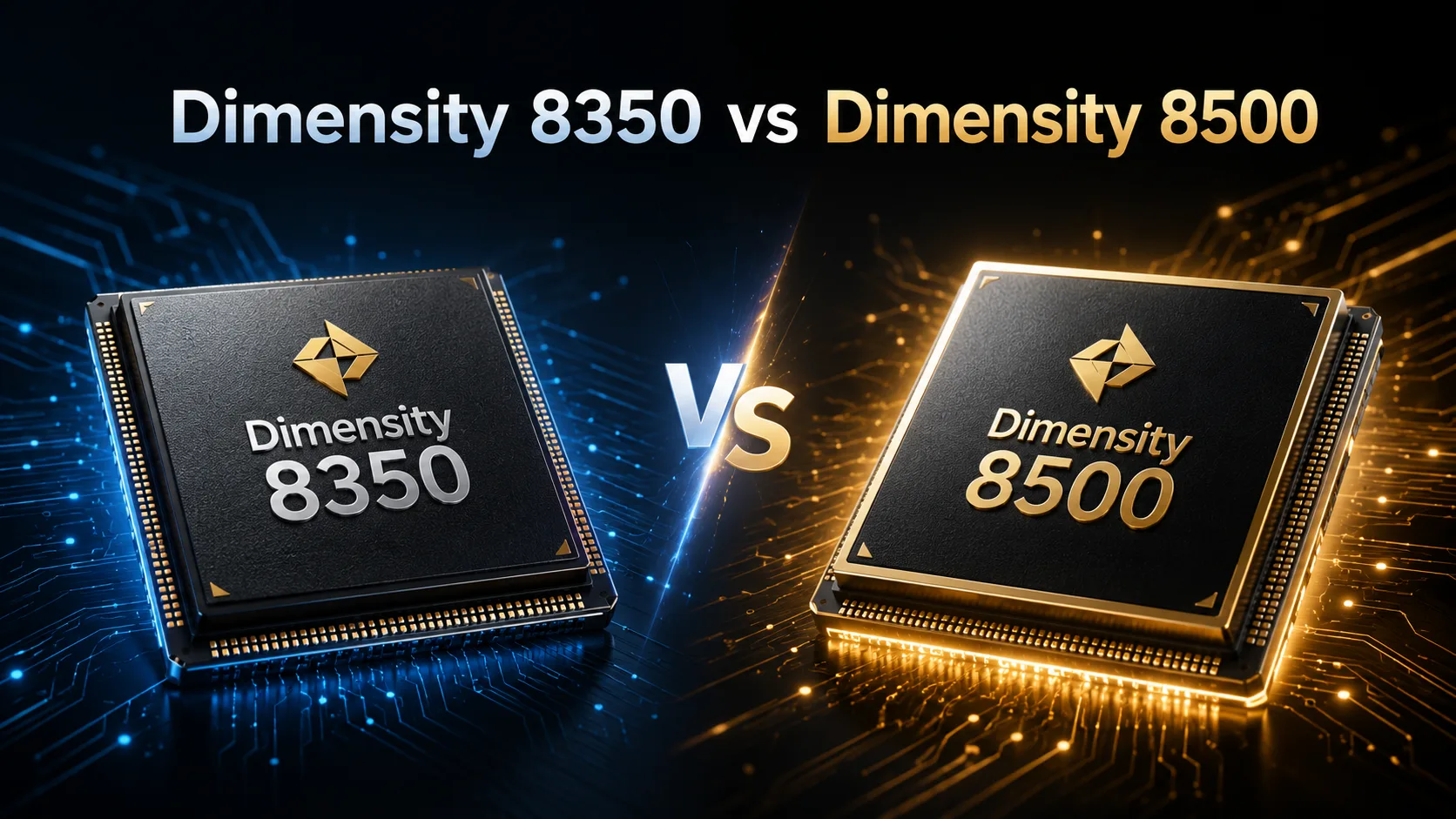
MediaTek Dimensity 8350 vs Dimensity 8500: the difference is more than just frequency
By their names, MediaTek Dimensity 8350 and Dimensity 8500 may seem like neighbors, but there is a noticeable gap in architecture and performance. The Dimensity 8500 transitions to a stronger CPU configuration, gets a Mali-G720 MC8 GPU, increased cache, LPDDR5X 9600 memory, and an 880 NPU. The Dimensity 8350 remains a fast chip for the upper mid-range segment, but when directly compared to the 8500, it is a lower class.
The main difference is not in maximum frequency. The Dimensity 8350 CPU boosts up to 3.35 GHz, while the Dimensity 8500 reaches up to 3.4 GHz. The frequency difference is minimal. However, the Dimensity 8350 utilizes a configuration of 4× Cortex-A715 + 4× Cortex-A510, whereas the Dimensity 8500 is built on eight Cortex-A725 cores. This configuration gives the 8500 an advantage in multi-threaded workloads and gaming.
Main Differences
| Characteristic | Dimensity 8350 | Dimensity 8500 |
|---|---|---|
| CPU | 4× Cortex-A715 + 4× Cortex-A510 | 8× Cortex-A725 |
| Max Frequency | up to 3.35 GHz | up to 3.4 GHz |
| Cache | 4 MB L3 | 6 MB L3 + 5 MB SLC |
| GPU | Mali-G615 MC6 | Mali-G720 MC8 |
| Memory | LPDDR5X up to 8533 Mbps | LPDDR5X up to 9600 Mbps |
| NPU | NPU 780 | NPU 880 |
| Display | FHD+ 180 Hz / WQHD+ 120 Hz | WQHD+ up to 144 Hz |
| Connectivity | 5G | 5G-Advanced |
The Dimensity 8500 has stronger key performance units: CPU, GPU, cache, memory, and NPU. In basic features, the differences are smaller: both chips support UFS 4, Wi-Fi 6E, Bluetooth 5.4, cameras up to 320 MP, and 4K video.
CPU: Dimensity 8500 Wins with Architecture
In this case, frequencies do not explain the performance difference. Comparing only in gigahertz can be misleading. What matters more is the core composition.
The Dimensity 8350 has four powerful Cortex-A715 cores and four energy-efficient Cortex-A510 cores. This configuration is suitable for a fast mid-range smartphone: the interface, browser, social media, camera, and ordinary apps do not max out the CPU. However, under heavy load, the four Cortex-A510 cores limit multi-threaded performance.
The Dimensity 8500 uses a different configuration: all eight cores are Cortex-A725. One core operates at frequencies up to 3.4 GHz, three at up to 3.2 GHz, and the other four at up to 2.2 GHz. There is no Cortex-X here, but for this segment, the architecture is strong: it is noticeably more powerful than a configuration of 4 big + 4 small cores.
In practice, the difference is most evident when multiple threads are loaded: gaming, photo processing, app installation and updates, background processes, and heavy multitasking. In simple tasks like opening a messenger or browser, both chips will perform quickly, but under prolonged load, the Dimensity 8500 maintains a better pace.
GPU and Gaming: Dimensity 8500 is Significantly Stronger
In gaming, the gap between the chips is more noticeable. The Dimensity 8350 uses a Mali-G615 MC6, while the Dimensity 8500 features a Mali-G720 MC8. The Mali-G720 MC8 is a higher class and better suited for heavy games, high settings, and stable FPS.
The Dimensity 8350 cannot be called a weak gaming chip. Its performance is sufficient for popular online games and medium settings. However, in a direct comparison with the Dimensity 8500, it falls short in GPU performance reserves. This is particularly important for smartphones with 120-144 Hz displays: the chip needs to not just launch the game, but also maintain a stable frame rate.
The resulting FPS depends not only on the SoC. The Dimensity 8500 is faster in hardware, while FPS stability will be determined by cooling, power limits, and manufacturer settings. In a thin case, some of the advantage may be lost under prolonged load.
Memory, Camera, and Connectivity
In terms of memory, the Dimensity 8500 has the advantage: LPDDR5X up to 9600 Mbps versus 8533 Mbps for the Dimensity 8350. In interface differences, this is almost insignificant, but in gaming and graphics tasks, it reduces the risk of hitting memory bandwidth limits. There is no major gap in storage: both chips work with UFS 4 / UFS 4.0 and MCQ.
For the AI block, the Dimensity 8500 also has the upper hand: NPU 880 versus NPU 780. This aids local AI functions: photo processing, noise reduction, and generative tools. In practice, the benefit of the NPU depends on the firmware and the feature set of the specific model.
Regarding camera and connectivity, the gap is smaller. Both chips support sensors up to 320 MP, 4K video, Wi-Fi 6E, Bluetooth 5.4, and peak loads up to 5.17 Gbps. The Dimensity 8500 has a newer ISP and modem with support for 5G-Advanced, but the SoC itself does not determine camera quality, and the network differences in regular use will be less noticeable than the differences in CPU and graphics.
Benchmarks
In benchmarks, the Dimensity 8500 significantly outperforms the Dimensity 8350. The main gap is in multi-core and GPU performance. Here, the eight Cortex-A725 cores, increased cache, fast memory, and Mali-G720 MC8 matter more.
| Test | Dimensity 8350 | Dimensity 8500 | Advantage |
|---|---|---|---|
| AnTuTu | ~1.7 million | ~2.1 million | about +20-25% |
| Geekbench Single-Core | ~1350-1400 | ~1550-1700 | about +15-25% |
| Geekbench Multi-Core | ~4200-4300 | ~6400-6700 | about +50% |
| Geekbench GPU Compute | ~9100 | ~13400 | about +45-50% |
The difference in single-core performance is moderate, so both chips will be fast in simple tasks. In multi-core and graphics, the gap is substantial. Therefore, the Dimensity 8500 is better suited for gaming, heavy applications, and smartphones that will be used for several years.
What to Choose
At a similar price, it is better to choose a smartphone with the Dimensity 8500. It is faster in CPU performance, significantly stronger in graphics, supports faster memory, and has a more powerful NPU. This is a better option for gaming, heavy multitasking, and long-term use without a quick performance bottleneck.
The Dimensity 8350 is justified at a significantly lower price or if the smartphone itself excels with its display, camera, battery life, charging, or build quality. In terms of speed for regular tasks, the 8350 is still sufficient, but in direct comparison with the Dimensity 8500, it lags behind in key performance parameters.
Conclusion
The Dimensity 8350 is a strong chip for the upper mid-range segment. It is adequate for daily tasks, fast interfaces, mid-range smartphones focusing on camera quality, and moderate gaming.
The Dimensity 8500 is stronger in key areas: all-big-core CPU on Cortex-A725, Mali-G720 MC8, increased cache, LPDDR5X 9600, and NPU 880. At the same or similar price, it is more rational to choose the Dimensity 8500. The Dimensity 8350 is only justified when the specific smartphone is cheaper or excels in display, camera, battery life, or charging.
Advantages
- Higher Frequency: 3400 MHz (3350 MHz vs 3400 MHz)
- Newer Launch Date: January 2026 (November 2024 vs January 2026)
Basic
GPU Specifications
Connectivity
Memory Specifications
Miscellaneous
- FLAC
- HE-AACv1
- HE-AACv2
- MP3
- H.265
- AV1
- VP9
Benchmarks
Comparison of Devices
Related SoC Comparisons



Share in social media
Or Link To Us
<a href="https://cputronic.com/soc/compare/mediatek-dimensity-8350-vs-mediatek-dimensity-8500" target="_blank">MediaTek Dimensity 8350 vs MediaTek Dimensity 8500</a>