Qualcomm Snapdragon 6 Gen 5
vs
MediaTek Dimensity 7300

SoC Comparison Result
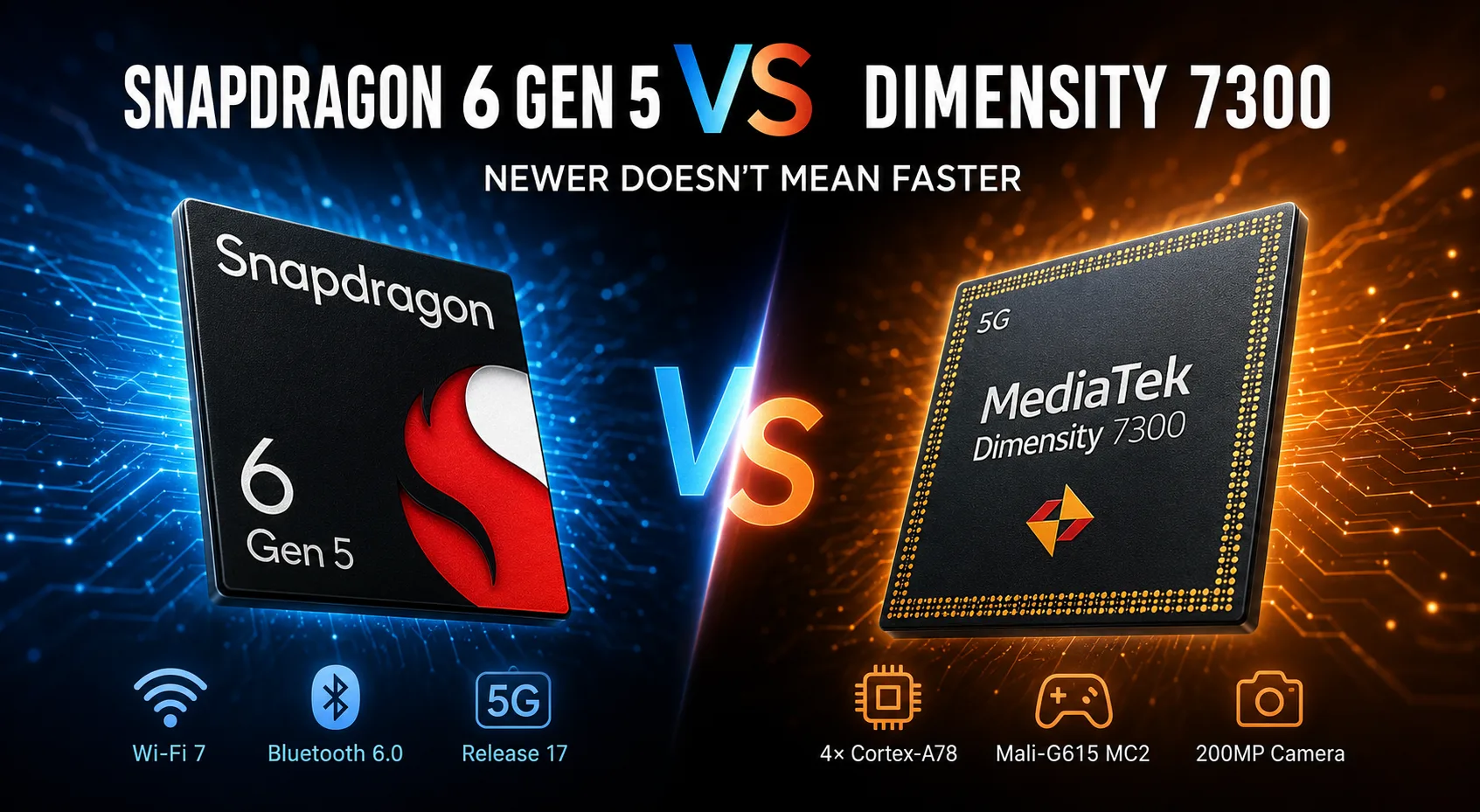
Snapdragon 6 Gen 5 vs Dimensity 7300: newer doesn't mean faster
The Snapdragon 6 Gen 5 was released almost two years later than the Dimensity 7300, but age alone isn't enough to call it faster. Qualcomm offers more modern Wi-Fi and Bluetooth, while the MediaTek processor still has four powerful Cortex-A78 cores. The key question is whether the new Snapdragon will provide a noticeable speed boost or if its advantage will be limited to more up-to-date features.
Key Differences
| Characteristic | Snapdragon 6 Gen 5 | Dimensity 7300 |
|---|---|---|
| Process Technology | 4 nm | 4 nm |
| Processor | 4 performance cores up to 2.6 GHz + 4 efficiency cores up to 2.0 GHz | 4× Cortex-A78 up to 2.5 GHz + 4× Cortex-A55 |
| Graphics | Adreno, model not specified | Mali-G615 MC2 |
| RAM | LPDDR4X, LPDDR5 up to 6400 Mbps | LPDDR4X, LPDDR5 up to 6400 Mbps |
| Storage | UFS 3.1 | UFS 3.1 |
| Display | FHD+ up to 144 Hz | FHD+ up to 144 Hz, WFHD+ up to 120 Hz |
| Camera | Up to 200 MP | Up to 200 MP |
| Video Recording | 4K HDR at 30 frames/sec | 4K HDR at 30 frames/sec |
| Peak 5G Speed | Up to 2.8 Gbps | Up to 3.27 Gbps |
| Wi-Fi | Wi-Fi 7 | Wi-Fi 6E |
| Bluetooth | 6.0 | 5.4 |
Both platforms support LPDDR4X or LPDDR5 memory, UFS 3.1 storage, cameras up to 200 MP, and displays with refresh rates of up to 144 Hz. The real difference boils down to the CPU, graphics, and wireless interfaces.
Processor: a 100 MHz difference says little
The Snapdragon 6 Gen 5 features four performance cores clocked up to 2.6 GHz and four efficiency cores up to 2.0 GHz. Qualcomm uses the Kryo name but does not specify which Arm cores are in the processor, so just the frequencies are not sufficient for a direct comparison.
MediaTek reveals the CPU composition: four Cortex-A78 cores at up to 2.5 GHz and four Cortex-A55 cores. While the Cortex-A78 can no longer be termed a new architecture, four such cores do not inherently make the Dimensity 7300 weak in multi-threaded tasks. The final speed is also determined by the cache, power limits, and the smartphone's cooling.
In one of the first Geekbench 6 results, the Snapdragon 6 Gen 5 scored about 1095 points in single-core tests and 3355 in multi-core tests. This test was performed on a yet-to-be-announced device, so the result cannot be considered final. Even these early figures do not show a significant increase compared to the Snapdragon 6 Gen 4.
The Dimensity 7300 is already in use in commercial smartphones with various cooling systems and power limits. For the Snapdragon 6 Gen 5, there are currently no comparable results, so both processors can reasonably be considered solutions of the same class.
Graphics: Adreno's advantage is not yet confirmed
According to Qualcomm, the new Adreno is 21% faster than the graphics in the Snapdragon 6 Gen 4. However, the company does not disclose the GPU's name, its clock speed, or the configuration of the compute units.
Snapdragon also supports Game Super Resolution scaling and tools for frame rate stabilization. These features can improve smoothness or reduce GPU load, but they do not work in all games and depend on the smartphone's settings.
The Dimensity 7300 utilizes the Mali-G615 MC2 - a compact GPU configuration tailored for medium settings in demanding games. The platform also supports HyperEngine - a suite of resources distribution and network management tools during gameplay.
The alleged increase gives Adreno an advantage on paper, but only direct tests in 3DMark, GFXBench, and real games can confirm it.
Cameras and Displays: Basic capabilities are almost identical
Both platforms support cameras with a resolution of up to 200 MP and 4K HDR recording at 30 frames per second.
Snapdragon uses a dual 12-bit ISP Spectra with multi-frame noise reduction and night shooting algorithms. The Dimensity 7300 features a 12-bit ISP Imagiq 950, which supports noise reduction, electronic stabilization, and simultaneous recording from two cameras.
The quality of photographs will largely be determined by the sensor, optics, and image processing in the specific smartphone. Support for 200 MP only indicates the maximum sensor resolution and says nothing about the quality of the final camera.
Regarding displays, the platforms are also close. Both support FHD+ panels with refresh rates of up to 144 Hz, but the Dimensity 7300 additionally supports wider WFHD+ screens at 120 Hz.
Connectivity: Snapdragon is significantly more modern
The most noticeable difference between the chips is the supported Wi-Fi and Bluetooth standards. The Snapdragon 6 Gen 5 operates with Wi-Fi 7 and Bluetooth 6.0, including Channel Sounding. This technology allows for more accurate distance measurement to compatible headphones, tags, and other accessories.
The Dimensity 7300 supports Wi-Fi 6E and Bluetooth 5.4. For most smartphones, this is sufficient, but in terms of the available standards, the MediaTek platform falls short.
However, chip support does not guarantee that Wi-Fi 7 and Bluetooth 6.0 will appear in every smartphone. The device manufacturer may opt for a simpler radio module.
With regard to 5G, Snapdragon does not hold as clear an advantage. It utilizes the newer 3GPP Release 17 standard, but its claimed download speed is capped at 2.8 Gbps. The Dimensity 7300 pertains to Release 16, supports the aggregation of three carriers, and achieves 3.27 Gbps.
In practice, the difference between 2.8 and 3.27 Gbps is hard to notice: speed is more heavily reliant on the carrier, coverage, and network load. For long-term smartphone use, Wi-Fi 7 and Bluetooth 6.0 are more beneficial than the additional 470 Mbps of theoretical 5G speed.
What to Choose
At a comparable price, a smartphone with the Snapdragon 6 Gen 5 appears to be the preferable choice. It supports Wi-Fi 7, Bluetooth 6.0, and the newer 5G Release 17 standard.
However, the significant advantage of the Kryo processor and the new Adreno has yet to be confirmed by independent tests. In terms of memory, storage, displays, and video recording, the Dimensity 7300 does not fundamentally fall behind.
If the model with the Dimensity 7300 is significantly cheaper, it is probably not worth paying extra just for Qualcomm's fresher name. At a similar price, it's better to choose the Snapdragon 6 Gen 5, while if there's a substantial price difference, a smartphone with the Dimensity 7300 would be the wiser choice.
Advantages
- Newer Launch Date: May 2026 (May 2026 vs June 2024)
- Higher Frequency: 2500 MHz (2.6 GHz vs 2500 MHz)
Basic
GPU Specifications
Connectivity
Memory Specifications
Miscellaneous
Benchmarks
Comparison of Devices
Related SoC Comparisons




Share in social media
Or Link To Us
<a href="https://cputronic.com/soc/compare/qualcomm-snapdragon-6-gen-5-vs-mediatek-dimensity-7300" target="_blank">Qualcomm Snapdragon 6 Gen 5 vs MediaTek Dimensity 7300</a>