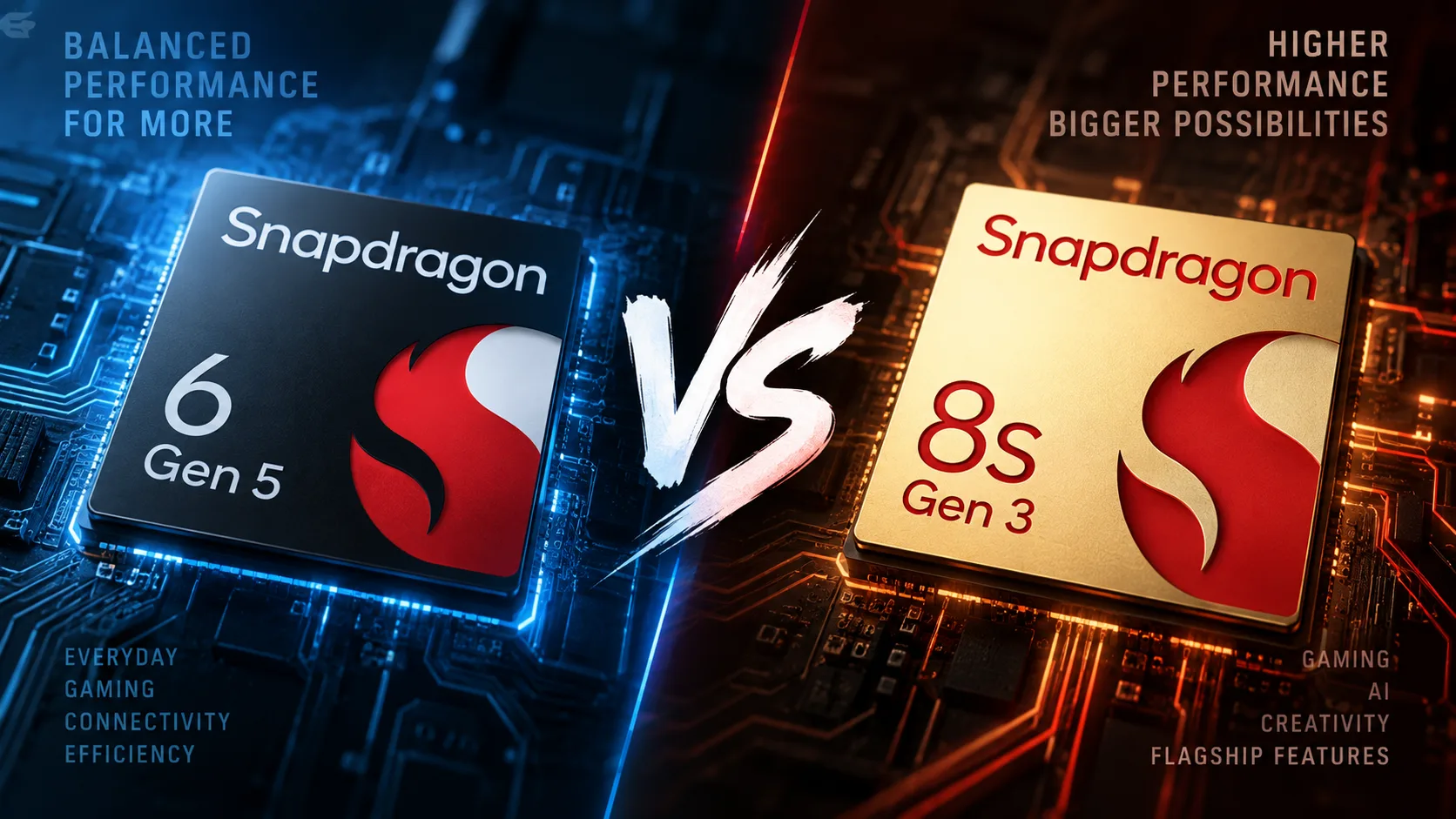
Qualcomm Snapdragon 6 Gen 5
vs
Qualcomm Snapdragon 8s Gen 3

SoC Comparison Result
Snapdragon 6 Gen 5 vs Snapdragon 8s Gen 3: How Much Faster is the Higher-End Chip
Snapdragon 6 Gen 5 was released more than two years after Snapdragon 8s Gen 3, yet it significantly lags behind in benchmarks. In 3DMark Wild Life Extreme, smartphones with Snapdragon 8s Gen 3 achieve approximately 2.5 times higher scores. These SoCs are originally designed for different categories: Snapdragon 6 Gen 5 targets the mid-range segment, while Snapdragon 8s Gen 3 is aimed at more powerful smartphones.
Key Differences
| Snapdragon 6 Gen 5 | Snapdragon 8s Gen 3 | |
|---|---|---|
| Announcement | May 2026 | March 2024 |
| Class | Mid-range | High-end |
| CPU | 4x Cortex-A78 2.6 GHz + 4x Cortex-A55 2.0 GHz | 1x Cortex-X4 3.0 GHz + 4x Cortex-A720 2.8 GHz + 3x Cortex-A520 2.0 GHz |
| Process Technology | 4 nm TSMC | 4 nm TSMC |
| GPU | Adreno 812 | Adreno 735 |
| Max 5G Speed | 2.8 Gbps | 6.5 Gbps |
| Platform-Level Wi-Fi | Wi-Fi 7 | Wi-Fi 7 |
| Platform-Level Bluetooth | 6.0 | 5.4 |
The identical 4-nm TSMC process does not make these chips close in performance. Snapdragon 6 Gen 5 uses older Cortex-A78 and Cortex-A55 cores, while Snapdragon 8s Gen 3 features Cortex-X4, Cortex-A720, and Cortex-A520.
Snapdragon 8s Gen 3 belongs to the higher-end Snapdragon 8 series. The platform is equipped with the Snapdragon X70 modem with download speeds up to 6.5 Gbps, FastConnect 7800 with Wi-Fi 7, and hardware-accelerated ray tracing. (qualcomm.com)
Benchmarks in Real Smartphones
Geekbench 6 and AnTuTu results for all four models are taken from a single database.
| Smartphone | Processor | Geekbench 6 Single | Geekbench 6 Multi | AnTuTu 11 | Price |
|---|---|---|---|---|---|
| Honor X80 Pro Max | Snapdragon 6 Gen 5 | 1,177 | 3,498 | 1,012,134 | from $431, import |
| Redmi Note 17 Pro Max | Snapdragon 6 Gen 5 | 1,099 | 3,481 | 1,010,104 | from $499, global starting price |
| POCO F6 | Snapdragon 8s Gen 3 | 1,892 | 4,769 | 1,784,363 | from $338 |
| realme GT 6 | Snapdragon 8s Gen 3 | 1,944 | 4,865 | 1,809,566 | from $455 |
Honor X80 Pro Max and Redmi Note 17 Pro Max show similar results: around 1.01 million in AnTuTu 11 and 1,100-1,180 in Geekbench 6 Single-Core. (nanoreview.net)
POCO F6 and realme GT 6 score around 1.8 million in AnTuTu 11 and approximately 1,900 in Geekbench 6 Single-Core. (nanoreview.net)
On average, the Snapdragon 8s Gen 3 is faster by:
- 69% in Geekbench 6 Single-Core;
- 38% in Geekbench 6 Multi-Core;
- 78% in AnTuTu 11.
Smartphone Prices
Prices are provided as a reference since models were released at different times and sold in different markets.
Honor X80 Pro Max was launched in China with a starting price of 1,999 yuan, about $295 at the time of announcement, but import offers start around $431. Redmi Note 17 Pro Max was released on the global market with a starting price of $499. (honor.com)
POCO F6 is significantly older and dropped to about $338 by September 2026, while the realme GT 6 can be found starting at around $455. Therefore, the prices of specific models do not directly reflect the value of the Snapdragon 6 Gen 5 and Snapdragon 8s Gen 3 platforms. (kimovil.com)
3DMark: The Advantage of Snapdragon 8s Gen 3
In 3DMark Wild Life Extreme, the difference between the platforms is even more pronounced. A reliable result for Honor X80 Pro Max in this test is not available, so it is not included in the table.
| Smartphone | Processor | 3DMark Wild Life Extreme |
|---|---|---|
| Redmi Note 17 Pro Max | Snapdragon 6 Gen 5 | 1,190 |
| POCO F6 | Snapdragon 8s Gen 3 | 2,947 |
| realme GT 6 | Snapdragon 8s Gen 3 | 3,176 |
In these devices, Adreno 735 shows approximately 2.5 times higher performance than Adreno 812.
A higher number for Adreno 812 does not imply higher performance compared to Adreno 735. The advantage of Snapdragon 8s Gen 3 is more pronounced in gaming than in CPU tests. Qualcomm also claims hardware-accelerated ray tracing and a set of Snapdragon Elite Gaming features for this platform. (qualcomm.com)
Snapdragon 6 Gen 5 significantly underperforms in demanding 3D graphics. In less demanding games, its performance is sufficient, but in heavy projects, settings often need to be reduced.
CPU: Snapdragon 8s Gen 3 is Faster by 38-69%
The main core of Snapdragon 8s Gen 3 is the Cortex-X4 with a frequency of up to 3.0 GHz. Additionally, four performance cores Cortex-A720 operate at frequencies of up to 2.8 GHz.
Snapdragon 6 Gen 5 has four performance cores Cortex-A78 that run at up to 2.6 GHz. The older Cortex-A78 cores significantly lag behind in performance compared to Cortex-X4 and Cortex-A720, which means that the later release of Snapdragon 6 Gen 5 does not provide it with a computational speed advantage.
In Geekbench 6 Single-Core, the difference reaches approximately 69%. High single-threaded performance is especially important for applications and games that heavily rely on the speed of individual cores.
In Multi-Core, the advantage of Snapdragon 8s Gen 3 narrows to 38%, but it remains substantial.
Connectivity and Wireless Interfaces
Snapdragon 6 Gen 5 supports the newer Bluetooth 6.0, Wi-Fi 7, and 5G Release 17. The maximum download speed over the mobile network is 2.8 Gbps. (qualcomm.com)
Snapdragon 8s Gen 3 features Bluetooth 5.4, but its Snapdragon X70 modem supports downloads of up to 6.5 Gbps compared to 2.8 Gbps for Snapdragon 6 Gen 5. Both platforms support Wi-Fi 7. (docs.qualcomm.com)
However, support for a feature by the SoC does not guarantee its presence in a smartphone. For example, Snapdragon 6 Gen 5 is capable of working with Wi-Fi 7, but Honor X80 Pro Max is equipped with Wi-Fi 6. The manufacturer may not utilize all capabilities of the platform. (fonearena.com)
Conclusion
Snapdragon 8s Gen 3 is significantly faster than Snapdragon 6 Gen 5, despite being released earlier. The gap is particularly large in graphics performance, while the CPU advantage reaches 69%.
Snapdragon 6 Gen 5 supports the newer Bluetooth 6.0 and is aimed at mid-range smartphones, but it noticeably lags behind Snapdragon 8s Gen 3 in performance.
A smartphone powered by Snapdragon 6 Gen 5 should be considered if it outperforms competitors in price, battery life, display, or camera. At a similar price, Snapdragon 8s Gen 3 is preferable for gaming and heavy applications.
Advantages
- Newer Launch Date: May 2026 (May 2026 vs March 2024)
- Higher Frequency: 3000 MHz (2.6 GHz vs 3000 MHz)
Basic
4x 2.8 GHz – Cortex-A720
3x 2.0 GHz – Cortex-A520
GPU Specifications
Connectivity
Memory Specifications
Miscellaneous
Benchmarks
Comparison of Devices
Related SoC Comparisons


Share in social media
Or Link To Us
<a href="https://cputronic.com/soc/compare/qualcomm-snapdragon-6-gen-5-vs-qualcomm-snapdragon-8s-gen-3" target="_blank">Qualcomm Snapdragon 6 Gen 5 vs Qualcomm Snapdragon 8s Gen 3</a>