Qualcomm Snapdragon 6 Gen 5
vs
Qualcomm Snapdragon 7 Gen 3


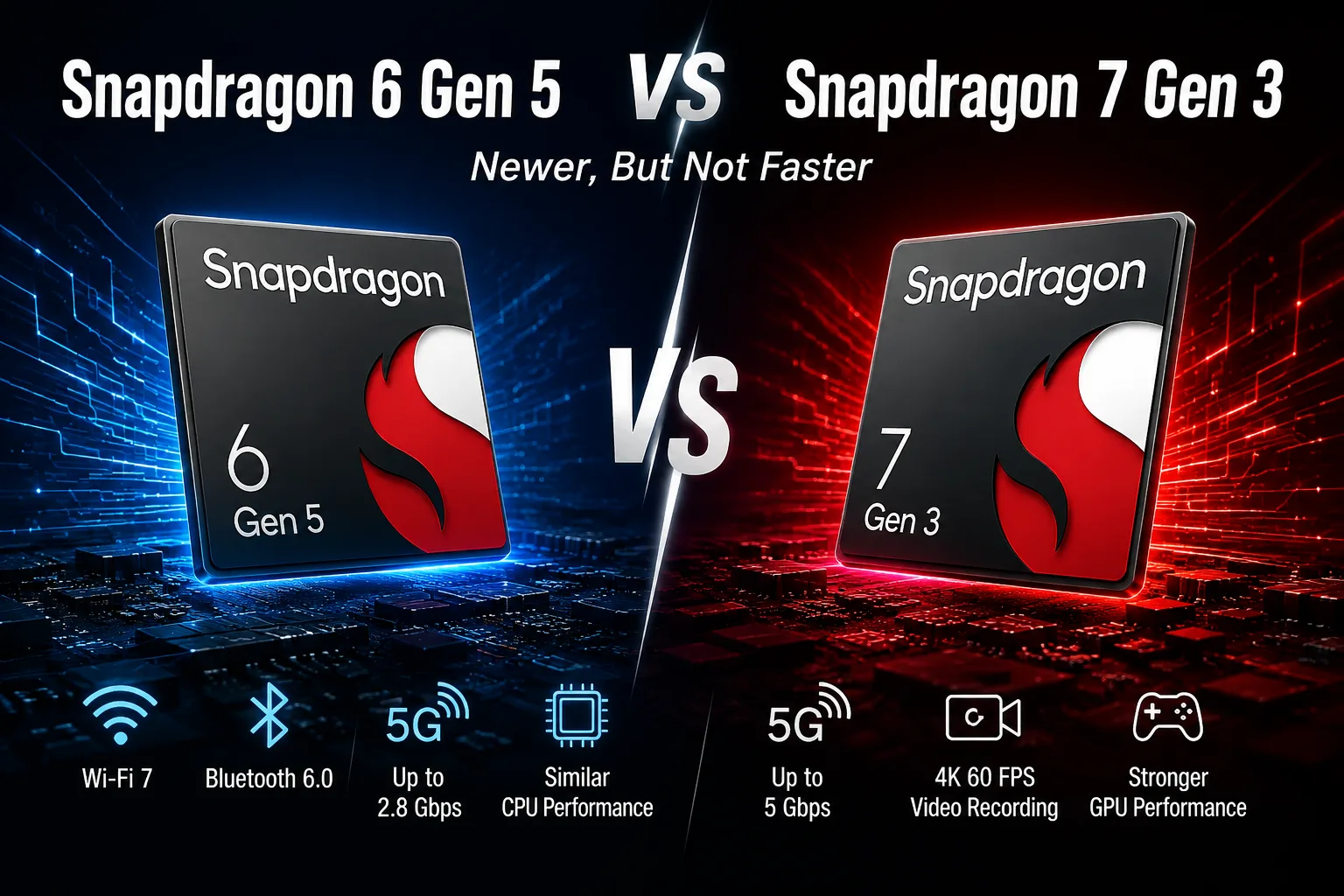
SoC Comparison Result
Snapdragon 6 Gen 5 vs Snapdragon 7 Gen 3: Newer, But Not Faster
Snapdragon 6 Gen 5 appeared almost two and a half years after Snapdragon 7 Gen 3, but it is not a direct replacement. In terms of CPU performance, the new chip has nearly matched Snapdragon 7 Gen 3, while the older model maintains a noticeable advantage in graphics. The 6 Gen 5 has its strengths with more modern wireless interfaces and is featured in new smartphones with larger batteries.
The Main Difference Between the Two Platforms
Both chips are manufactured using a 4nm process technology, but they utilize different generations of CPU cores and significantly differ in platform capabilities.
| Characteristic | Snapdragon 6 Gen 5 | Snapdragon 7 Gen 3 |
|---|---|---|
| CPU | 4x Cortex-A78 up to 2.6 GHz + 4x Cortex-A55 up to 2.0 GHz | 1x Cortex-A715 up to 2.63 GHz + 3x Cortex-A715 up to 2.4 GHz + 4x Cortex-A510 up to 1.8 GHz |
| GPU | Adreno 812 | Adreno 720 |
| Process Technology | 4 nm | 4 nm |
| Memory | LPDDR5 | LPDDR5 |
| Storage | UFS 3.1 | UFS 3.1 |
| Wi-Fi | Up to Wi-Fi 7 | Up to Wi-Fi 6E |
| Bluetooth | 6.0 | 5.4 |
| Max 5G Speed | Up to 2.8 Gbps | Up to 5 Gbps |
| Video Recording | Up to 4K 30 FPS | Up to 4K 60 FPS |
In terms of wireless interfaces, Snapdragon 6 Gen 5 is more modern, but Snapdragon 7 Gen 3 remains a more functional platform for cameras and video. The specific feature set depends on the smartphone manufacturer. The presence of Wi-Fi 7 in the SoC, for example, does not necessarily mean that the final device will support it.
Real-World Performance in Smartphones
According to Geekbench 6, the gap between the processors is small. In graphical tests, the difference is more noticeable.
| Smartphone | Processor | Geekbench 6 Single | Geekbench 6 Multi | AnTuTu 11 | 3DMark Wild Life Extreme |
|---|---|---|---|---|---|
| Honor X80 Pro Max | Snapdragon 6 Gen 5 | 1177 | 3498 | 1 012 134 | around 1214 |
| Honor 400 | Snapdragon 7 Gen 3 | 1165 | 3166 | 1 087 525 | 1487 |
| Motorola Edge 50 Pro | Snapdragon 7 Gen 3 | 1131 | 2967 | 1 090 709 | 1474 |
| OnePlus Nord CE4 | Snapdragon 7 Gen 3 | 1144 | 3069 | 1 051 702 | 1494 |
The results for specific smartphones depend on cooling, memory, and firmware, so a few percentage points difference in Geekbench should not be seen as a real advantage of one chip over the other. In terms of CPU, they are virtually in the same class.
For Snapdragon 6 Gen 5, there are significantly fewer results available, so the metrics from the Honor X80 Pro Max should be viewed as a guideline rather than the ultimate performance ceiling for the platform.
In 3DMark Wild Life Extreme, the difference is substantial: smartphones on Snapdragon 7 Gen 3 score around 1470-1490 points compared to about 1210 for Snapdragon 6 Gen 5. The difference amounts to about 20-23% in favor of the older chip. The name Adreno 812 on the new platform here should not be misleading-Adreno 720 in Snapdragon 7 Gen 3 is more powerful.
Redmi Note 17 Pro Max also uses Snapdragon 6 Gen 5, but the first available results relate to Geekbench 7. Mixing these with Geekbench 6 in the same table is inappropriate, so the device is not included here.
What This Means for Gaming
Both processors handle regular mobile games without issues, but in more demanding projects, Snapdragon 7 Gen 3 is noticeably more favorable. The more powerful graphics allow for less frequent lowering of settings and provide a greater buffer for new games.
Snapdragon 6 Gen 5 remains a more mainstream class chip. Its GPU is notably faster than the previous generation of the 6 series, but it does not reach the level of Snapdragon 7 Gen 3.
If gaming is one of the main requirements for the smartphone, the newer name Snapdragon 6 Gen 5 should not be a deciding factor.
Where Snapdragon 6 Gen 5 Is More Modern
Outside of benchmarks, Snapdragon 6 Gen 5 has several more modern features. Qualcomm added Wi-Fi 7, Bluetooth 6.0, and support for 5G Release 17.
Snapdragon 7 Gen 3 has a faster 5G modem, supports 4K 60 FPS recording, and has more powerful graphics. So, the age of Snapdragon 7 Gen 3 is currently only a disadvantage on paper.
The Price of the Smartphone Is More Important Than the Processor Name
Honor X80 Pro Max with Snapdragon 6 Gen 5 started at around $295 in China. Honor 400 with Snapdragon 7 Gen 3 can be found for about $315, meaning the price difference between devices in this class can be quite small.
Redmi Note 17 Pro Max with Snapdragon 6 Gen 5 enters the global market at around $499. Justifying the purchase based on processor performance is difficult since smartphones with Snapdragon 7 Gen 3 and more powerful graphics are available at significantly lower prices. In the case of Redmi, the premium primarily goes for the battery, display, and other characteristics of the smartphone, rather than for a faster SoC.
Therefore, choosing between these processors separately from the smartphone is meaningless. With similar prices and comparable specifications, Snapdragon 7 Gen 3 appears more preferable due to its more powerful graphics.
Conclusion
Snapdragon 6 Gen 5 has approached Snapdragon 7 Gen 3 in terms of CPU, but its graphics are approximately 20% slower. However, the new chip offers Wi-Fi 7, Bluetooth 6.0, and is used in newer smartphones.
At comparable prices, Snapdragon 7 Gen 3 is preferable, especially for gaming. Snapdragon 6 Gen 5 should be chosen not for the generation number but only if the smartphone itself offers advantages in price, battery life, display, or other characteristics.
Advantages
- Newer Launch Date: May 2026 (May 2026 vs November 2023)
- Higher Frequency: 2630 MHz (2.6 GHz vs 2630 MHz)
Basic
3x 2.4 GHz – Cortex-A715
4x 1.8 GHz – Cortex-A510
GPU Specifications
Connectivity
Memory Specifications
Miscellaneous
Benchmarks
Comparison of Devices
Related SoC Comparisons



Share in social media
Or Link To Us
<a href="https://cputronic.com/soc/compare/qualcomm-snapdragon-6-gen-5-vs-qualcomm-snapdragon-7-gen-3" target="_blank">Qualcomm Snapdragon 6 Gen 5 vs Qualcomm Snapdragon 7 Gen 3</a>