Qualcomm Snapdragon 6 Gen 5
vs
MediaTek Dimensity 9500s
SoC Comparison Result
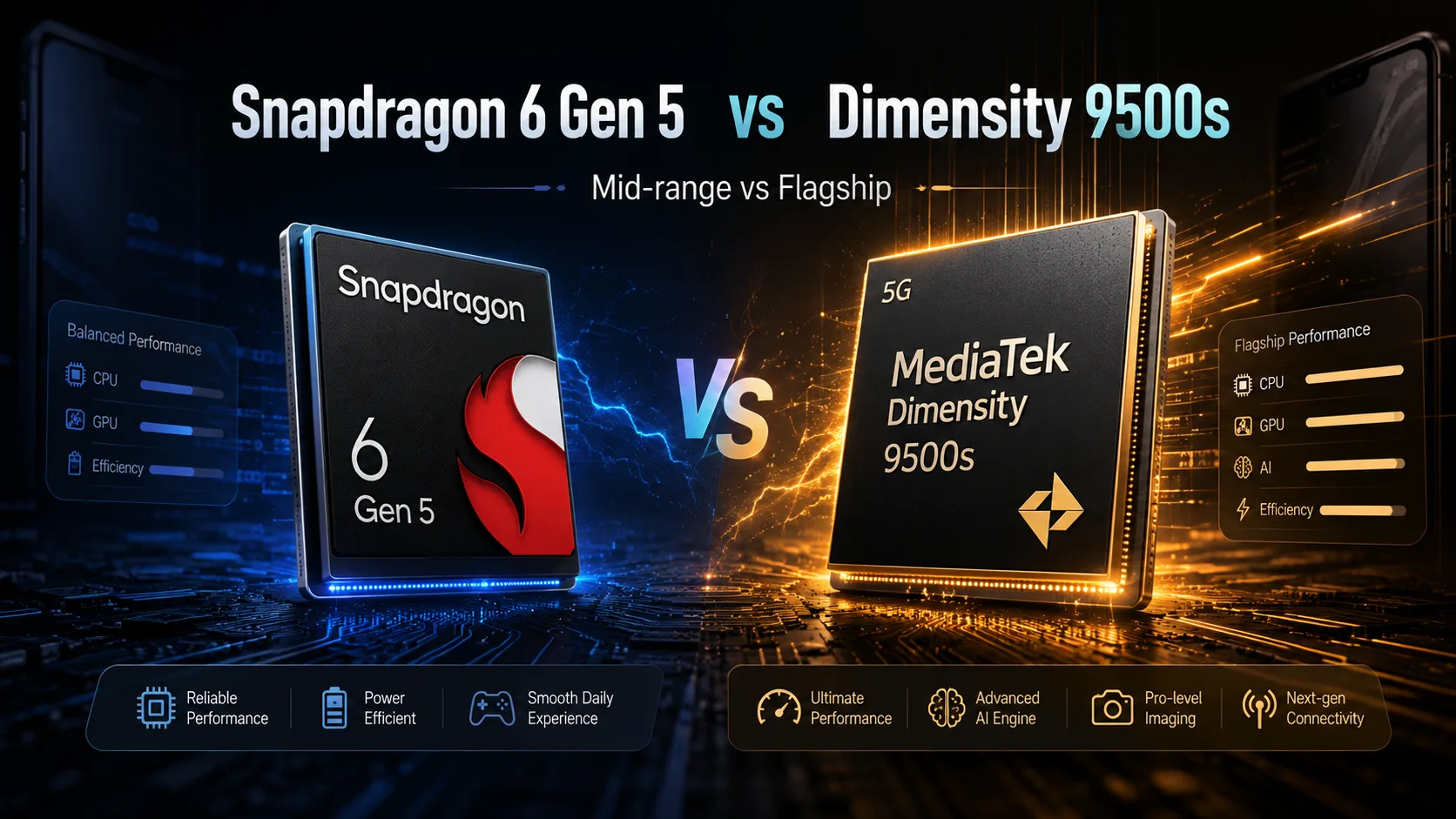
Snapdragon 6 Gen 5 vs Dimensity 9500s: Mid-Range vs Flagship SoC
Snapdragon 6 Gen 5 is a 4nm mid-range SoC, while Dimensity 9500s features Cortex-X925, Cortex-X4, and flagship graphics Immortalis-G925. In Geekbench 6, Dimensity 9500s is approximately twice as fast, and in AnTuTu, the gap can approach threefold. However, the main point comes down to prices: smartphones using these SoCs sometimes fall into the same price range.
Key Differences
| Snapdragon 6 Gen 5 | Dimensity 9500s | |
|---|---|---|
| Class | Mid-Range | Flagship |
| Process Technology | 4 nm | 3 nm |
| CPU | 4x Performance up to 2.6 GHz + 4x Efficiency up to 2.0 GHz | 1x Cortex-X925 up to 3.73 GHz + 3x Cortex-X4 + 4x Cortex-A720 |
| GPU | Adreno | Immortalis-G925 |
| Max Video | 4K HDR 30 FPS | 8K 60 FPS |
| Display | FHD+ up to 144 Hz | WQHD+ up to 180 Hz |
Qualcomm claims that the Snapdragon 6 Gen 5 offers a 21% improvement in graphics performance compared to its predecessor. The improvement for the Snapdragon 6 series is noticeable, but it still lags behind the Dimensity 9500s platform.
Hidden Context of Dimensity 9500s
In terms of architecture, the Dimensity 9500s is closer to the Dimensity 9400+ than to the regular Dimensity 9500.
Both platforms utilize a CPU scheme of 1+3+4 with one Cortex-X925, three Cortex-X4, and four Cortex-A720. The maximum frequency reaches 3.73 GHz, with the graphics handled by Immortalis-G925.
The Dimensity 9500s features options for Immortalis-G925 with 11 or 12 graphics cores. For example, the POCO X8 Pro Max uses MC11. Therefore, the variability in graphical performance among smartphones using the Dimensity 9500s can be more pronounced than in CPU performance.
Benchmarks in Real Smartphones
| Device | SoC | Geekbench 6 Single | Geekbench 6 Multi | AnTuTu 11 |
|---|---|---|---|---|
| Honor X80 Pro Max | Snapdragon 6 Gen 5 | 1177 | 3498 | ~1,012,000 |
| Redmi Turbo 5 Max | Dimensity 9500s | 2877 | 9236 | ~3,100,000 |
| POCO X8 Pro Max | Dimensity 9500s | 2725 | 8932 | ~3,032,000 |
| OPPO Reno16 Pro 5G | Dimensity 9500s | 2623 | 8359 | ~3,079,000 |
| OPPO Find X9s | Dimensity 9500s | 2463 | 7370 | ~2,885,000 |
The results for specific smartphones depend on cooling, memory, firmware, and power limits. The numbers tend to vary significantly in AnTuTu, so the values in the table primarily relate to the mentioned models.
The Honor X80 Pro Max scores around 3500 points in Geekbench 6 Multi, while smartphones using Dimensity 9500s show approximately 7400-9200 points. In AnTuTu, Snapdragon 6 Gen 5 is around the 1 million mark, while Dimensity 9500s can exceed 3 million.
CPU and GPU
In Geekbench 6, Dimensity 9500s is about twice as fast in single-threaded mode and more than twice as fast in multi-threaded. The difference is even greater in GPU performance: Snapdragon 6 Gen 5 is aimed at the mid-range segment, while Immortalis-G925 is significantly faster in demanding games, emulators, and computational tasks.
Real gaming performance also depends on cooling, screen resolution, and the settings of the specific smartphone.
Performance Under Sustained Load
The high peak performance of Dimensity 9500s requires good cooling. In stress tests, the GPU performance of the POCO X8 Pro Max may drop to about 60% of its initial level after prolonged load.
This is significant throttling, so the cooling solution of a specific smartphone greatly affects sustained gaming performance. Peak results from Dimensity 9500s don't imply that the device will maintain the same speed after extended use.
Price Changes the Comparison Perspective
The Honor X80 Pro Max started in China at around $300, making Snapdragon 6 Gen 5 seem justified at that price point. However, this MSRP cannot be directly compared to European prices.
In Europe, the situation is more interesting. The Redmi Note 17 Pro Max with Snapdragon 6 Gen 5 appeared at about €600. Meanwhile, the POCO X8 Pro Max with Dimensity 9500s started at around €530, and it was available for even cheaper during initial promotions.
As a result, a smartphone with Snapdragon 6 Gen 5 could end up being more expensive than a model with Dimensity 9500s.
SoC is not the only price factor in a smartphone: cameras, display, battery, build quality, and memory capacity are also important. However, if performance is among the main selection criteria, Snapdragon 6 Gen 5 finds itself in a weak position at that price.
What to Choose
Snapdragon 6 Gen 5 is justified if the smartphone is significantly cheaper. For the mid-range, its performance is adequate, but comparing it directly to Dimensity 9500s in speed is difficult.
Dimensity 9500s is more than twice as fast in heavy CPU tasks and significantly more powerful in graphics. If smartphone prices are close, the performance difference becomes decisive.
Conclusion: Snapdragon 6 Gen 5 is justified in a cheaper smartphone. With similar pricing, the choice based on performance is clear - Dimensity 9500s.
Advantages
- Newer Launch Date: May 2026 (May 2026 vs January 2026)
- Higher Technology: 3 nm (4 nm vs 3 nm)
- Higher Frequency: 3730 MHz (2.6 GHz vs 3730 MHz)
Basic
3x 3.3 GHz – Cortex-X4
4x 2.4 GHz – Cortex-A720
GPU Specifications
Connectivity
Memory Specifications
Miscellaneous
- FLAC
- HE-AACv1
- HE-AACv2
- MP3
- H.265
- AV1
- VP9
Benchmarks
Comparison of Devices
Related SoC Comparisons




Share in social media
Or Link To Us
<a href="https://cputronic.com/soc/compare/qualcomm-snapdragon-6-gen-5-vs-mediatek-dimensity-9500s" target="_blank">Qualcomm Snapdragon 6 Gen 5 vs MediaTek Dimensity 9500s</a>