Qualcomm Snapdragon 695

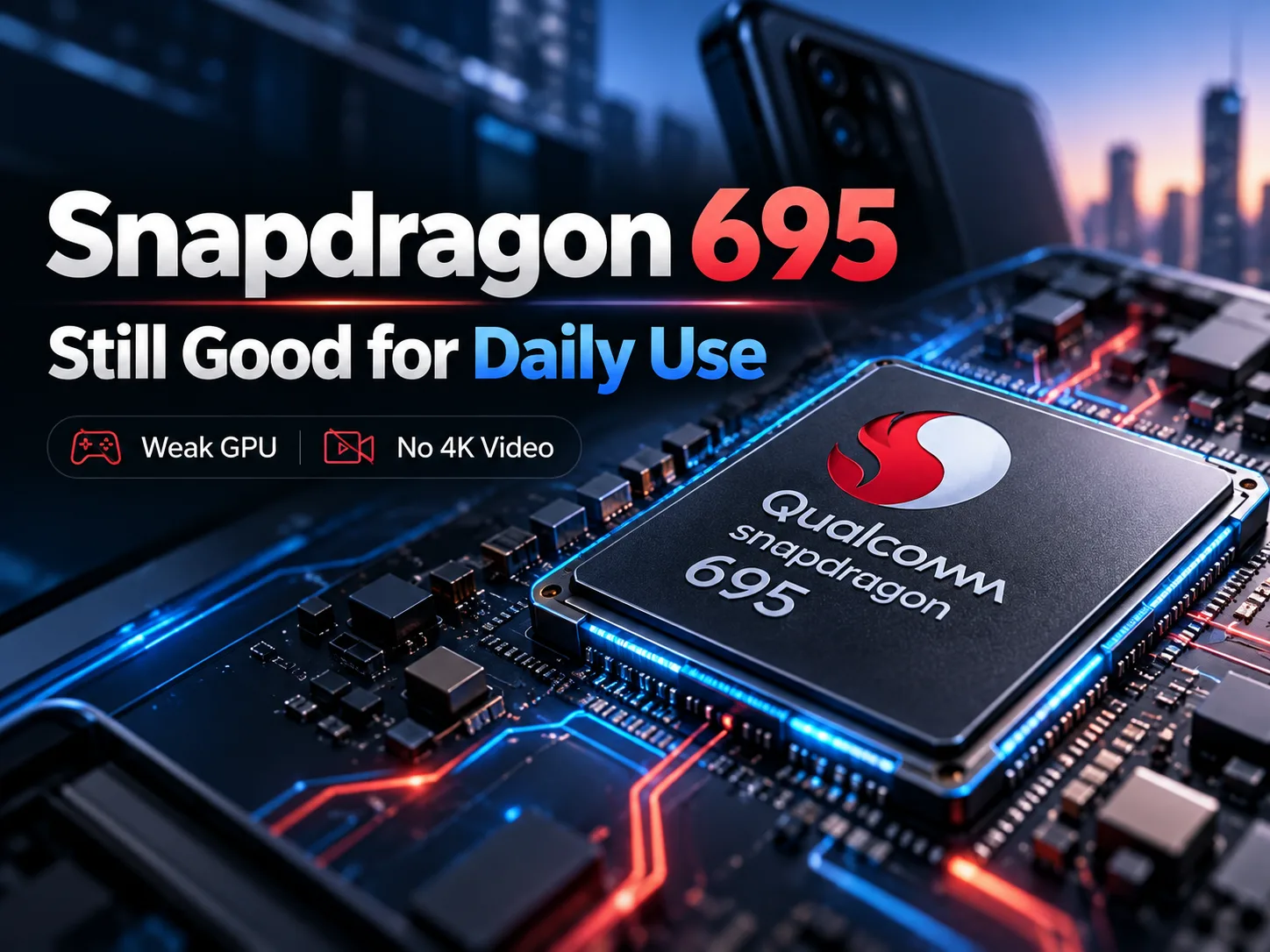
Qualcomm Snapdragon 695: How a 2021 Processor Got a Sequel in the Snapdragon 6s Gen 3
The Snapdragon 695 was released in 2021, but almost three years later Qualcomm introduced the very similar Snapdragon 6s Gen 3. Its architecture with two Cortex-A78 cores remained virtually unchanged, as did its limitations: the weak Adreno 619 graphics and the lack of 4K video recording. This is a telling example of a processor with a newer name adding almost nothing in terms of speed.
The Snapdragon 695 was used in the Xiaomi Redmi Note 11 Pro 5G, Poco X4 Pro 5G, Motorola Moto G82, and Samsung Galaxy A23 5G. Even the OnePlus Nord CE4 Lite, released in 2024, received the same chip. Let’s examine why Qualcomm used this architecture for so long and what the Snapdragon 695 is capable of in 2026.
Architecture: Two Cortex-A78 Cores and Six Efficiency Cores
The Snapdragon 695 is built on the octa-core Kryo 660 architecture:
- 2 high-performance Kryo 660 Gold cores (Cortex-A78) clocked at up to 2.2 GHz.
- 6 power-efficient Kryo 660 Silver cores (Cortex-A55) clocked at up to 1.8 GHz.
The two Cortex-A78 cores provide reasonable system responsiveness but limit multithreaded performance. Compared with processors featuring four high-performance cores, the Snapdragon 695 falls noticeably behind when executing demanding tasks in parallel.
The chip is manufactured using TSMC’s 6nm process and supports dual-channel LPDDR4X memory at up to 2133 MHz, as well as UFS 2.2 or eMMC 5.1 storage. Combined with six Cortex-A55 cores, this configuration helps reduce power consumption under light loads. Heat and sustained clock speeds depend on the cooling system of the particular smartphone.
Snapdragon 695 Benchmarks: Four Smartphones
Geekbench 6 and AnTuTu 11 results make it possible to compare the Snapdragon 695’s performance in devices from different manufacturers.
| Smartphone | Geekbench 6 Single | Geekbench 6 Multi | AnTuTu 11 |
|---|---|---|---|
| Motorola Moto G82 5G | 910 | 2105 | 612 321 |
| Xiaomi Poco X4 Pro 5G | 916 | 2122 | 597 281 |
| Samsung Galaxy A23 5G | 896 | 2092 | 593 086 |
| Xiaomi Redmi Note 11 Pro 5G | 894 | 2030 | 593 037 |
The difference between the devices is around 5% in Geekbench 6 Multi-Core and 3% in AnTuTu 11. The average result across the four smartphones is approximately 599 thousand points in AnTuTu 11.
Even the Motorola Moto G82, which achieved the best AnTuTu result, does not have a significant advantage over the Poco X4 Pro. Power settings, memory, and cooling affect the scores, but the processor’s capabilities remain the main limitation.
Snapdragon 6s Gen 3: A New Model with a Familiar Architecture
In June 2024, Qualcomm introduced the Snapdragon 6s Gen 3. It retained the configuration of two Cortex-A78 and six Cortex-A55 cores, the 6nm process, and a similar graphics architecture.
The Snapdragon 6s Gen 3’s high-performance cores received a clock-speed increase from 2.2 to 2.3 GHz, while the efficiency cores went from 1.8 to 2.0 GHz. Both platforms belong to the SM6375 family: the Snapdragon 695 is known as the SM6375, while one version of the Snapdragon 6s Gen 3 carries the SM6375-AC designation.
At the same time, the Snapdragon 6 Gen 1, released back in 2022, received four Cortex-A78 cores, Adreno 710 graphics, and a 4nm process. The difference is clearly visible in the tests.
Snapdragon 695 vs. 6s Gen 3 vs. 6 Gen 1
| Parameter | Snapdragon 695 | Snapdragon 6s Gen 3 | Snapdragon 6 Gen 1 |
|---|---|---|---|
| Process | 6nm | 6nm | 4nm |
| Cortex-A78 | 2 × 2.2 GHz | 2 × 2.3 GHz | 4 × 2.2 GHz |
| Cortex-A55 | 6 × 1.8 GHz | 6 × 2.0 GHz | 4 × 1.8 GHz |
| GPU | Adreno 619 | Adreno 619 | Adreno 710 |
| Geekbench 6 Single | 905 | 938 | 930 |
| Geekbench 6 Multi | 2101 | 2183 | 2700 |
| AnTuTu 11 | 592 015 | 617 626 | 737 054 |
The Snapdragon 6s Gen 3 leads the Snapdragon 695 by approximately 4% in Geekbench 6 Multi-Core and AnTuTu 11. In everyday applications, this difference is virtually unnoticeable.
The Snapdragon 6 Gen 1 is 29% faster in multithreaded Geekbench 6 and 24% faster in AnTuTu 11. However, single-core performance differs by just 3%.
The Snapdragon 6 Gen 1 was released almost two years before the Snapdragon 6s Gen 3, yet it is noticeably faster in multithreaded tasks. In this case, the number after “Gen” does not reflect the actual level of performance.
Adreno 619: Why the Graphics Became Outdated Faster Than the CPU
The Adreno 619 graphics accelerator handles the Android interface, video playback, and undemanding games. However, it is no longer powerful enough for demanding modern 3D titles.
3DMark Wild Life Extreme Results
| Smartphone (processor) | 3DMark Wild Life Extreme |
|---|---|
| Motorola Moto G82 5G (Snapdragon 695) | 361 |
| Xiaomi Poco X4 Pro 5G (Snapdragon 695) | 358 |
| Xiaomi Redmi Note 11 Pro 5G (Snapdragon 695) | 358 |
| Samsung Galaxy A23 5G (Snapdragon 695) | 352 |
The difference between the devices does not exceed 3%. Around 2 FPS in Wild Life Extreme reflects the heavy workload of a synthetic test rather than the speed of real games.
In PUBG Mobile and Call of Duty: Mobile, the Snapdragon 695 can deliver an acceptable frame rate at moderate settings. In Genshin Impact and other demanding games, graphics quality must be reduced, but FPS drops are possible even at the lowest settings.
The Snapdragon 695 supports Full HD+ displays with refresh rates of up to 120 Hz. This is useful for scrolling through the interface, but in demanding games the Adreno 619 cannot deliver a matching frame rate.
Camera: 108 Megapixels Without 4K Recording
One of the most unusual features of the Snapdragon 695 is support for cameras with resolutions of up to 108 MP despite the lack of 4K video recording.
The Qualcomm Spectra 346T image signal processor includes three 12-bit ISPs. For photos, it supports resolutions of up to 108 MP, while with zero shutter lag (ZSL) and multi-frame noise reduction, it supports up to 32 MP from a single camera.
Maximum supported video recording is limited to 1080p at 60 FPS. As a result, the Xiaomi Redmi Note 11 Pro 5G, with its 108 MP main camera, cannot record 4K video.
The limitation remained in newer devices as well. For example, the 2024 OnePlus Nord CE4 Lite records video at a maximum of 1080p at 30 FPS, even though the Snapdragon 695 technically supports 60 FPS.
This is an important distinction between a processor’s hardware capabilities and the specifications of a particular smartphone: the manufacturer can impose additional limits on video modes.
Connectivity and Power Consumption
The Snapdragon 695 is equipped with a Snapdragon X51 modem supporting 5G Sub-6 GHz and mmWave. Its maximum advertised download speed reaches 2.5 Gbps, although mmWave bands are implemented in far from all smartphones with this processor.
The platform also includes Wi-Fi 5, Bluetooth 5.2, dual-frequency L1/L5 satellite navigation, and Quick Charge 4+ technology.
When watching videos or using messaging apps and a browser, the Snapdragon 695 consumes relatively little power. However, a smartphone’s battery life is determined not only by the processor but also by the display, battery, and software.
Is the Snapdragon 695 Worth Buying in 2026?
The Snapdragon 695 still handles web browsing, messaging, navigation, and banking apps. Two Cortex-A78 cores are sufficient for these tasks, especially if the smartphone has 6-8 GB of RAM.
Versions with 4 GB of RAM are more likely to unload apps from memory. In addition, when buying older models, it is important to consider the length of software support and the condition of the battery.
The Snapdragon 695 is already noticeably outdated for gaming. Even the Snapdragon 6s Gen 3 does not provide a significant speed increase, so there is no reason to replace a smartphone with the Snapdragon 695 with a 6s Gen 3 device for the sake of performance.
If a smartphone based on the Snapdragon 6 Gen 1 or a more powerful modern platform is available for a comparable price, it is preferable to choose that option.
Conclusion
The Snapdragon 695 proved so popular that its architecture continued in the Snapdragon 6s Gen 3. However, the performance increase amounted to just a few percent, while the Snapdragon 6 Gen 1, with four Cortex-A78 cores, was already noticeably faster back in 2022.
In 2026, the Snapdragon 695 remains a processor for inexpensive smartphones designed for everyday tasks. Its capabilities are already too limited for gaming and video recording. The main argument in favor of such a device is its low price, not its technical specifications.
SOC Comparison
Compare Snapdragon 695 with other SOCs
Basic
6x 1.8 GHz – Kryo 660 Silver (Cortex-A55)
GPU Specifications
Connectivity
Memory Specifications
Miscellaneous
Benchmarks
Compared to Other SoC
Related SoC Comparisons


Share in social media
Or Link To Us
<a href="https://cputronic.com/index.php/soc/qualcomm-snapdragon-695" target="_blank">Qualcomm Snapdragon 695</a>