Qualcomm Snapdragon 665

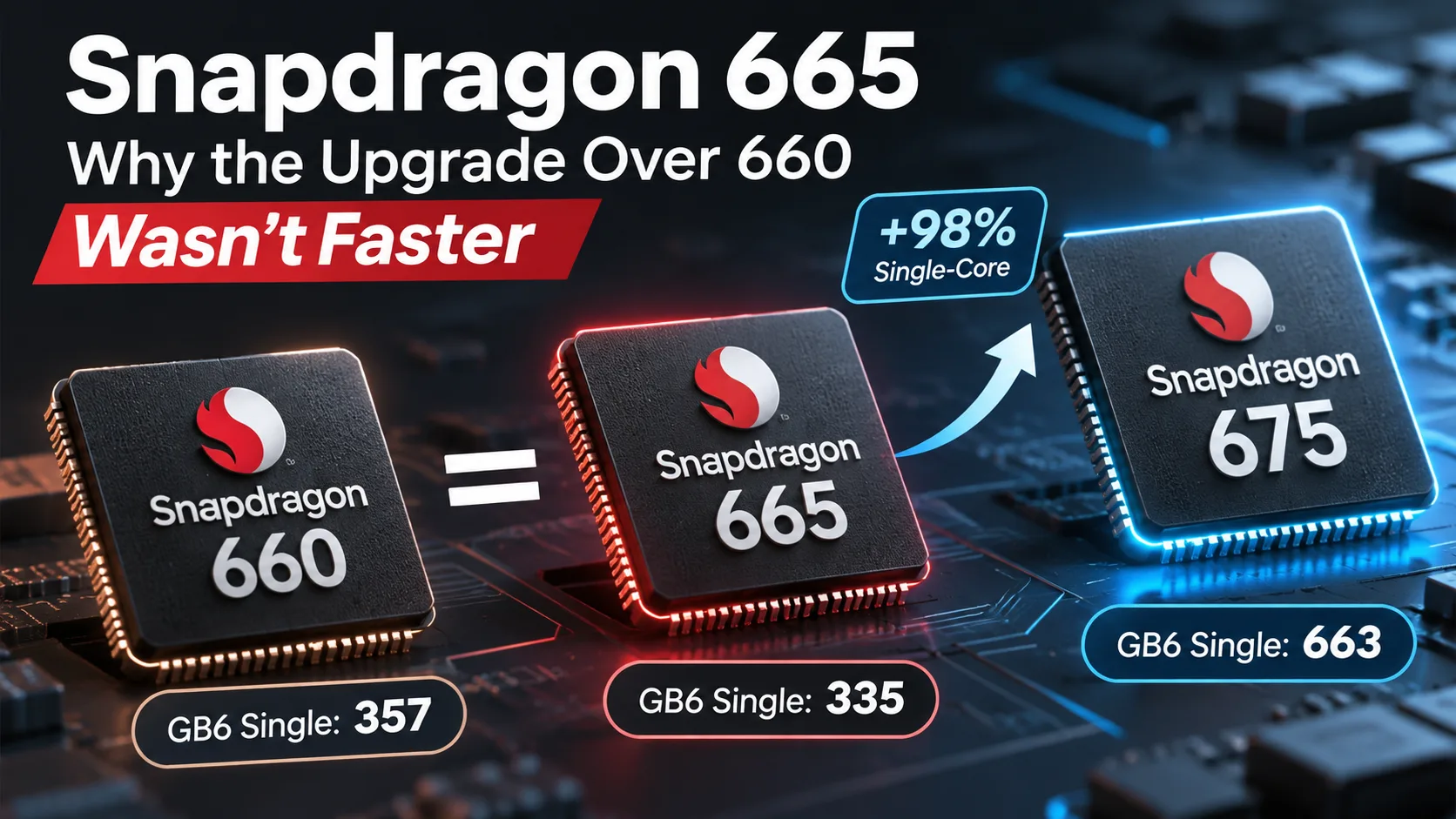
Qualcomm Snapdragon 665: Why the Snapdragon 660 Successor Wasn’t Faster
Qualcomm introduced the Snapdragon 665 in April 2019 as an update to the Snapdragon 660. The chip featured an 11-nm process, Adreno 610 graphics, and enhanced photo-processing capabilities. However, CPU performance remained virtually unchanged, and in some tests the new processor even lagged behind its predecessor.
The reason is simple: Qualcomm retained the previous core architecture and reduced the maximum clock speed. Meanwhile, the Snapdragon 675, introduced back in 2018, turned out to be significantly faster.
Benchmarks: Snapdragon 665 vs. 660, 662, and 675
The table shows Geekbench 6 results for specific smartphones.
| Smartphone | Processor | Geekbench 6 Single | Geekbench 6 Multi |
|---|---|---|---|
| Xiaomi Mi A2 | Snapdragon 660 | 357 | 1285 |
| Xiaomi Redmi Note 8 | Snapdragon 665 | 335 | 1165 |
| Xiaomi Mi A3 | Snapdragon 665 | 335 | 1115 |
| Xiaomi Poco M3 | Snapdragon 662 | 337 | 1155 |
| Xiaomi Redmi Note 7 Pro | Snapdragon 675 | 663 | 1508 |
| Xiaomi Redmi Note 11 | Snapdragon 680 | 411 | 1443 |
These are results from individual Geekbench 6 runs, not averages. Different versions of Geekbench 6, Android, and firmware were used, including unofficial versions. Therefore, small score differences should not be considered proof that one chip is superior to another.
The Snapdragon 665 shows no advantage over the Snapdragon 660. In the tests shown, the Xiaomi Mi A2 even outperforms both smartphones based on the newer chip.
The Snapdragon 662, released in 2020, produces virtually the same results. Despite the new name, Qualcomm once again used a combination of Kryo 260 and Adreno 610.
The most interesting comparison is with the Snapdragon 675. The Redmi Note 7 Pro scores 663 points in the single-core test, nearly twice as much as the Redmi Note 8. The reason for such a large difference is the more modern CPU architecture, not a higher clock speed.
Architecture: What Changed Compared with the Snapdragon 660
The Snapdragon 665 retained eight Kryo 260 cores: four performance cores based on Cortex-A73 and four efficiency cores based on Cortex-A53.
The main changes:
- Process technology: 11 nm instead of 14 nm in the Snapdragon 660.
- Performance-core clock speed: up to 2.0 GHz instead of 2.2 GHz.
- Graphics: Adreno 610 instead of Adreno 512.
- Image processing: Spectra 165 instead of Spectra 160.
- DSP: Hexagon 686 instead of Hexagon 680.
The move to 11 nm made it possible to reduce power consumption, but did not guarantee a performance increase. With the same architecture, reducing the clock speed of the performance cores could even worsen CPU results.
The Snapdragon 675 features two powerful Kryo 460 Gold cores based on Cortex-A76 and six efficiency cores based on Cortex-A55. The new architecture delivered significantly higher single-core performance at comparable clock speeds.
As a result, the Snapdragon 675 handles demanding websites, data processing, and other tasks that are sensitive to the speed of an individual core more effectively.
Adreno 610: New Graphics Without a Noticeable Speed Increase
The Snapdragon 665 uses the Adreno 610 with support for Vulkan 1.1 and OpenGL ES 3.2. Compared with the Adreno 512, its graphics capabilities expanded, but performance barely increased.
The 3DMark Wild Life results confirm this:
| Smartphone | Processor | 3DMark Wild Life |
|---|---|---|
| Xiaomi Mi A2 | Snapdragon 660 | 377 |
| Xiaomi Redmi Note 8 | Snapdragon 665 | 374 |
| Xiaomi Mi A3 | Snapdragon 665 | 379 |
Median device results from the UL Solutions database. A higher score indicates better performance.
The difference between the Snapdragon 660 and 665 is within a few points. Replacing the Adreno 512 with the Adreno 610 did not produce a noticeable speed increase in this test.
At the same time, the Redmi Note 8 scores just 104 points in the more demanding 3DMark Wild Life Extreme. In demanding games, the Adreno 610 has to run at low graphics settings, and a stable frame rate is available in far from all titles.
Display resolution also affects performance. The Xiaomi Mi A3, with its 1560 × 720 display, places less load on the GPU in games than the Redmi Note 8, with its 2340 × 1080 resolution. Therefore, the same chip does not guarantee the same frame rate.
Cameras and Multimedia
One of the most significant Snapdragon 665 upgrades is the Spectra 165 image signal processor with two 14-bit ISPs.
The platform supports photos at resolutions of up to 48 MP, 4K video recording at 30 FPS, and 1080p slow-motion video at 120 FPS. The availability of these modes depends on the specific smartphone.
The Hexagon 686 DSP with HVX extensions accelerates certain image-processing and machine-learning operations. There is no dedicated NPU, and the DSP’s capabilities in AI workloads are inferior to those of the specialized accelerators found in modern SoCs.
Connectivity is handled by the Snapdragon X12 LTE modem, with download speeds of up to 600 Mbps. Wi-Fi 5, Bluetooth 5.0, and Quick Charge 3.0 are also supported. There is no 5G support.
Snapdragon 665 in 2026: Is It Still Worth Using?
The Snapdragon 665’s main limitation today is its low single-core performance by modern standards. This becomes apparent when loading demanding websites, processing photos, and running demanding applications. A shortage of RAM further increases delays.
The age of the smartphones themselves creates just as many problems: batteries lose capacity, and most models stopped receiving Android updates and security patches long ago.
Conclusion: The Snapdragon 665 did not deliver a significant performance increase over the Snapdragon 660 in either CPU or graphics tests. The earlier Snapdragon 675 was considerably faster thanks to its new CPU architecture.
In 2026, the Snapdragon 665 is still suitable for everyday tasks if the smartphone is in good condition and does not suffer from insufficient memory. However, buying a device based on this platform for its performance is no longer justified: even the Snapdragon 680 is noticeably faster in single-core tests, while modern budget chips have moved even further ahead.
SOC Comparison
Compare Snapdragon 665 with other SOCs
Basic
4x 1.8 GHz – Kryo 260 Silver (Cortex-A53)
GPU Specifications
Connectivity
Memory Specifications
Miscellaneous
Benchmarks
Compared to Other SoC
Related SoC Comparisons



Share in social media
Or Link To Us
<a href="https://cputronic.com/index.php/soc/qualcomm-snapdragon-665" target="_blank">Qualcomm Snapdragon 665</a>