HiSilicon Kirin 710A

HiSilicon Kirin 710A: A 2020 Processor in 2026 Tablets
In 2026, Huawei released the MatePad SE 11 with the Kirin 710A processor, which is six years old. In terms of performance, the new tablet is practically no different from the 2024 version. The reason lies in the chip’s own history: the Kirin 710A appeared after production was moved to China’s SMIC, received an older process technology and lower clock speeds. The processor was an important step for China’s semiconductor industry, but its capabilities have long been outdated for buyers.
SMIC Instead of TSMC: Why the Kirin 710A Became Slower
The Kirin 710A appeared in 2020 as a redesigned version of the 2018 Kirin 710. The original processor was manufactured by TSMC using a 12 nm process, while production of the new version was transferred to China’s SMIC, with its 14 nm technology.
The CPU configuration remained unchanged:
- 4 Cortex-A73 cores clocked at up to 2.0 GHz;
- 4 Cortex-A53 cores clocked at up to 1.7 GHz.
The performance cores in the original Kirin 710 operated at up to 2.2 GHz. In the 710A, the maximum clock speed was reduced by approximately 9%. The architecture itself did not change.
The production shift was driven by Huawei’s effort to reduce its dependence on foreign chip manufacturers. One of the first devices with the new processor was the Honor Play 4T.
Even in 2020, the Cortex-A73 was no longer a new core. By 2026, its performance is insufficient for fast browsing on demanding websites and running resource-intensive applications. Even inexpensive modern processors with Cortex-A76 or Cortex-A78 cores significantly outperform the Kirin 710A.
Mali-G51 MP4: Gaming Performance
The Kirin 710A inherited the Mali-G51 MP4 graphics accelerator from its predecessor. It has four compute units, uses the Bifrost architecture, and operates at up to 1 GHz.
That is sufficient for 2D games and simple 3D projects. PUBG Mobile requires reduced settings, while modern demanding games may run at low frame rates.
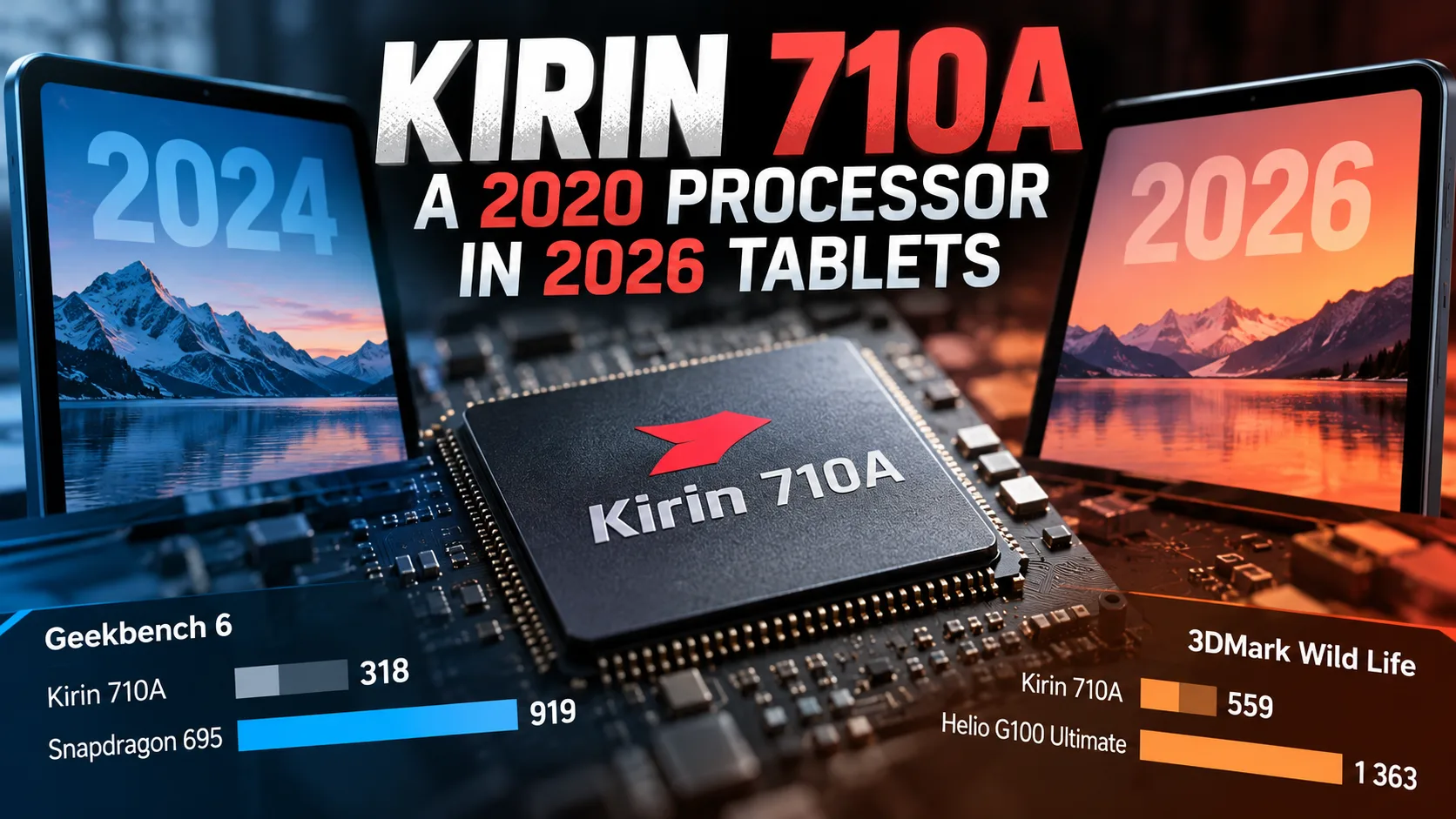
The main limitation is clearly visible in 3DMark Wild Life: tablets with the Kirin 710A score around 550 points, while devices with the Helio G100 Ultimate and Snapdragon 695 exceed 1,200 points.
Benchmarks: Two Years Without a Performance Increase
The Huawei MatePad SE 11 was released in 2024 and 2026 with the same processor. A comparison of the two generations shows how little performance has changed. To illustrate the gap, Tecno and Samsung tablets based on more powerful platforms have also been included.
| Device | Processor | Geekbench 6 Single / Multi | AnTuTu 10 | 3DMark Wild Life |
|---|---|---|---|---|
| Huawei MatePad SE 11 (2026) | Kirin 710A | 318 / 940 | 234,836 | 559 |
| Huawei MatePad SE 11 (2024) | Kirin 710A | 320 / 937 | 191,445 | 554 |
| Tecno Megapad Pro | Helio G100 Ultimate | 738 / 2,036 | 442,733 | 1,363 |
| Samsung Galaxy Tab A9+ | Snapdragon 695 | 919 / 1,993 | 422,144 | 1,216 |
In Geekbench 6, the results of the two MatePad SE 11 generations are practically identical. The difference in 3DMark is also minimal. At the same time, AnTuTu 10 shows a 23% increase that is not confirmed by the individual CPU and GPU tests. Memory and software may have affected the overall score.
There is also an interesting detail: when the 2024 MatePad SE 11 was tested, its performance cores were recorded running at up to 2.4 GHz instead of the standard 2.0 GHz. However, this did not give it any noticeable advantage over the 2026 model.
The gap with competitors is much larger:
- The Helio G100 Ultimate is approximately 2.3 times faster than the Kirin 710A in the single-core Geekbench 6 test and 2.4 times faster in 3DMark Wild Life.
- The Snapdragon 695 is almost three times faster in single-core Geekbench 6, while its advantage in the multi-core test exceeds twofold.
Single-core performance is especially important for browsers and applications. In this area, the Kirin 710A loses even to processors that are themselves no longer considered new designs.
Why the Kirin 710A Is Still Being Used
The Kirin 710A was used in the Honor Play 4T, Huawei P Smart 2021, Honor 10X Lite, and several generations of budget MatePad tablets.
The chip’s appearance was primarily explained by Huawei’s production constraints. But six years later, the platform continues to appear in new devices, even though modern budget processors are significantly faster.
The release of the 2026 MatePad SE 11 shows that refreshing a tablet does not necessarily mean updating its computing platform. The buyer gets a device from a new model year, but with performance that has barely changed from the previous version.
Is It Worth Buying a Device with the Kirin 710A in 2026?
The Huawei MatePad SE 11 (2026) went on sale in Russia at a starting price of 17,999 rubles for the Wi-Fi version with 8 GB of RAM and 128 GB of internal storage.
Its large screen, metal body, and sufficient amount of memory make the tablet suitable for reading, watching videos, video calls, and working with documents. However, the amount of RAM cannot compensate for the low speed of its CPU cores.
The main limitations appear in web browsing, demanding applications, multitasking, and games. Smartphones with the Kirin 710A face the additional problem of lacking 5G support, although this is not significant for an inexpensive Wi-Fi tablet.
At a comparable price, it makes more sense to choose devices with the Helio G99, Helio G100, or Snapdragon 695. They offer significantly higher performance and handle modern applications better.
Conclusion
The Kirin 710A was important to Huawei because production shifted to SMIC, but technically it turned out to be a simplified version of a 2018 processor. Instead of a performance increase, it received an older process technology and a lower rated CPU frequency.
In 2026, the Kirin 710A is suitable for simple tasks, but buying a new tablet with this processor at the price of models based on the Helio G99, Helio G100, or Snapdragon 695 is not worthwhile. The difference in speed is too large, and software updates cannot increase the performance of an old architecture.
SOC Comparison
Compare Kirin 710A with other SOCs
Basic
4x 1.7 GHz – Cortex-A53
GPU Specifications
Connectivity
Memory Specifications
Miscellaneous
Benchmarks
Compared to Other SoC
Related SoC Comparisons




Share in social media
Or Link To Us
<a href="https://cputronic.com/index.php/soc/hisilicon-kirin-710a" target="_blank">HiSilicon Kirin 710A</a>