MediaTek Helio G88

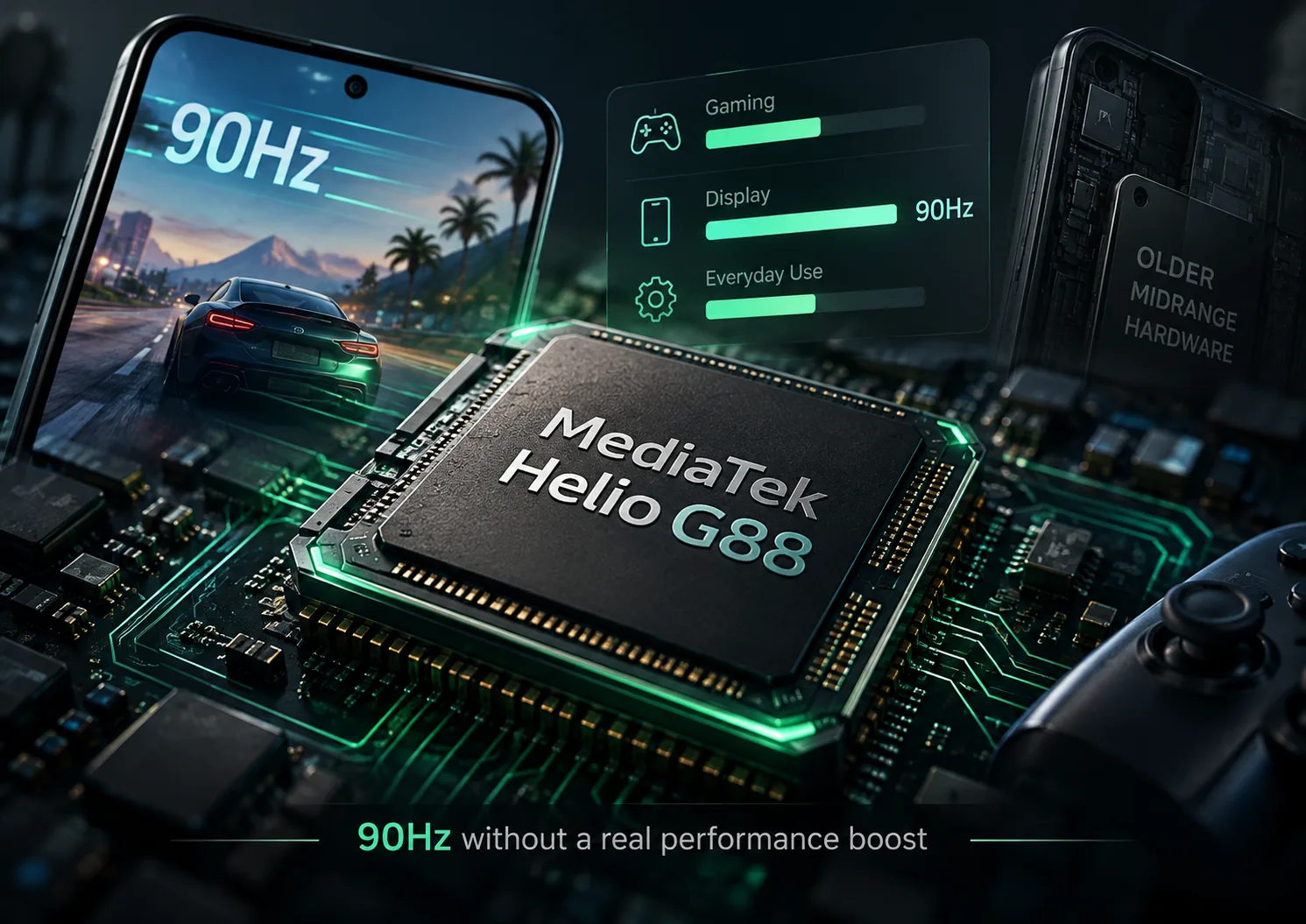
MediaTek Helio G88: 90 Hz Without a Performance Gain
MediaTek introduced the Helio G88 in June 2021 as an update to the Helio G85. The chip added support for 90 Hz displays and cameras of up to 64 MP, but retained the same CPU cores and graphics.
In 2026, the G88 is found in budget smartphones and tablets, although it is slower than the Helio G99 and Dimensity 6300.
What Changed Compared with the Helio G85
The Helio G88 is manufactured using TSMC’s 12-nm process and contains eight cores:
- 2 × Cortex-A75 at up to 2 GHz.
- 6 × Cortex-A55 at up to 1.8 GHz.
The Mali-G52 MC2 GPU runs at up to 1 GHz.
The Helio G88 supports Full HD+ displays with refresh rates of up to 90 Hz, compared with 60 Hz on the G85. The maximum resolution of the main camera increased from 48 to 64 MP.
The chip supports eMMC 5.1 storage, but not UFS. Compared with UFS, this type of storage loads apps and games more slowly.
Benchmarks: Helio G88 vs. G85, G99, and Dimensity 6300
| Processor | Geekbench 6 Single | Geekbench 6 Multi | AnTuTu 11 |
|---|---|---|---|
| Helio G85 | 419 | 1 461 | 348 562 |
| Helio G88 | 430 | 1 375 | 365 001 |
| Helio G99 | 727 | 2 047 | 554 590 |
| Dimensity 6300 | 771 | 1 980 | 528 398 |
The Helio G88 outperforms the G85 by 5% in AnTuTu 11 and by 3% in Geekbench 6 Single-Core. In Geekbench 6 Multi-Core, however, the G85 is 6% ahead. With the same architecture, this difference may depend on the specific smartphone.
The Helio G99 is 69% faster than the G88 in Geekbench 6 Single-Core and 49% faster in Multi-Core. The G99 uses Cortex-A76 cores, and the chip itself is manufactured using a 6-nm process. It also supports faster UFS 2.2 storage.
The Dimensity 6300 outperforms the G88 by 79% in Geekbench 6 Single-Core and supports 5G.
Mali-G52 MC2 Graphics: 3DMark Comparison
3DMark results on five smartphones:
| Smartphone (processor) | Wild Life | Wild Life Extreme | Steel Nomad Light |
|---|---|---|---|
| Motorola Moto G23 (G85) | 746 | 189 | 79 |
| Infinix Hot 30 (G88) | 753 | 190 | 83 |
| Realme C55 (G88) | 742 | 189 | 79 |
| Realme 10 (G99) | 1 363 | 377 | 143 |
| Oppo Reno8 T (G99) | 1 366 | 378 | 141 |
The Infinix Hot 30 with the G88 outperforms the Motorola Moto G23 with the G85 by less than 1% in Wild Life. In Wild Life Extreme, the results are virtually identical-190 and 189 points.
The Realme 10 with the G99 scores 84% more points in Wild Life than the Realme C55 with the G88, while in Wild Life Extreme it scores twice as many. The G99 uses Mali-G57 MC2 graphics instead of the Mali-G52 MC2.
How the Helio G88 Performs in Games
Realme C55 gaming test results:
| Game | Settings | FPS |
|---|---|---|
| PUBG Mobile | Smooth / Ultra | 39 |
| Mobile Legends | High | 60 |
| Genshin Impact | Lowest | 25-30 |
PUBG Mobile runs at approximately 40 FPS on low settings, while Mobile Legends reaches 60 FPS.
In Genshin Impact, the frame rate drops in the open world and during battles, even at the lowest settings.
Is It Worth Buying a Helio G88 Smartphone in 2026?
If a Helio G88 smartphone meets your needs for everyday use, there is no reason to replace it solely because of its processor.
When buying a new device, it is better to consider models with the Helio G99 or Dimensity 6300. Both processors are faster than the G88, especially in games. A G88 smartphone is worth considering only if there is a significant difference in price.
SOC Comparison
Compare Helio G88 with other SOCs
Basic
6x 1.8 GHz – Cortex-A55
GPU Specifications
Connectivity
Memory Specifications
Miscellaneous
Benchmarks
Phones with Helio G88




Tablets with Helio G88


Comparison of Devices with Helio G88
Compared to Other SoC
Related SoC Comparisons




Share in social media
Or Link To Us
<a href="https://cputronic.com/index.php/soc/mediatek-helio-g88" target="_blank">MediaTek Helio G88</a>