MediaTek Dimensity 8300 Ultra
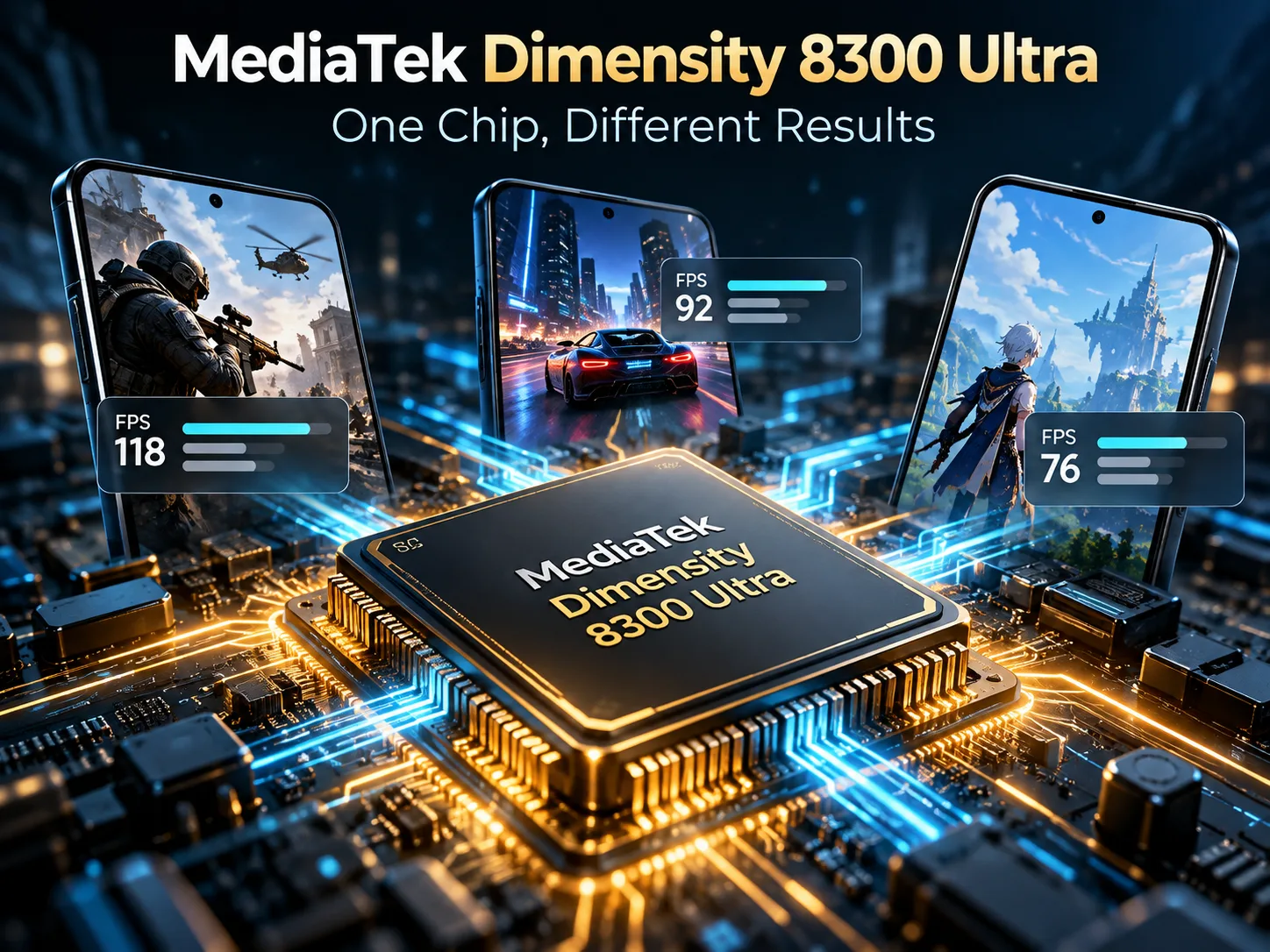
MediaTek Dimensity 8300 Ultra: One Processor, Different Smartphone Results
The MediaTek Dimensity 8300 Ultra was released in November 2023 and became one of the most powerful chips in its class. Four Cortex-A715 cores, Mali-G615 MC6 graphics, and UFS 4.0 support brought it close to flagship platforms from previous generations. However, results vary noticeably between smartphones using this processor: in 3DMark, the Redmi K70E outperforms the POCO X6 Pro by more than 30%, even though the chip’s hardware configuration is identical.
Architecture: Four Performance Cores
The Dimensity 8300 Ultra is manufactured using TSMC’s 4 nm process and uses eight Armv9 cores:
- 1 × Cortex-A715 up to 3.35 GHz
- 3 × Cortex-A715 up to 3.2 GHz
- 4 × Cortex-A510 up to 2.2 GHz
The Dimensity 8300 Ultra does not have a flagship Cortex-X core. Instead, it uses four Cortex-A715 cores, which provide most of the CPU’s computing power.
Compared with the Dimensity 8200, the platform features a newer CPU architecture, Mali-G615 MC6 graphics, and UFS 4.0 support.
The Ultra suffix denotes a version of the platform for Xiaomi and POCO devices rather than a separate architecture. Its core CPU and GPU configuration is the same as that of the Dimensity 8300.
Geekbench 6 and AnTuTu: Comparing Smartphones
The Dimensity 8300 Ultra is used in the POCO X6 Pro, Xiaomi 14T, and Redmi K70E. Despite having the same processor, these models produce different results.
| Smartphone | Geekbench 6 Single | Geekbench 6 Multi | AnTuTu 11 |
|---|---|---|---|
| Redmi K70E | 1493 | 4708 | 1 886 429 |
| POCO X6 Pro | 1370 | 4509 | 1 604 305 |
| Xiaomi 14T | 1335 | 4107 | 1 598 339 |
In Geekbench 6, the Redmi K70E leads the POCO X6 Pro by 9% in the single-threaded test and by 4% in the multi-threaded test. Its lead over the Xiaomi 14T reaches 12% and 15%, respectively.
The Redmi K70E’s advantage is even more significant in AnTuTu 11. However, the result of 1.89 million points was obtained from a small sample, so it cannot be considered typical for every unit of the smartphone.
Mali-G615 MC6 Graphics: Up to a 39% Difference
Graphics processing is handled by the Mali-G615 MC6, with six compute units and a clock speed of up to 1400 MHz. The GPU supports Vulkan 1.3 and delivers high performance in mobile games.
The most noticeable difference between the smartphones appears in 3DMark.
| Smartphone (chip) | Solar Bay | Steel Nomad Light |
|---|---|---|
| Redmi K70E (Dimensity 8300 Ultra) | 4614 | 1182 |
| POCO X6 Pro (Dimensity 8300 Ultra) | 3458 | 852 |
| Xiaomi 14T (Dimensity 8300 Ultra) | 3346 | 836 |
In Solar Bay, the Redmi K70E scores 33% more than the POCO X6 Pro. In Steel Nomad Light, the difference reaches 39%. The gap between the POCO X6 Pro and Xiaomi 14T is much smaller-just 2-3%.
The smartphones were tested under different conditions, so the exact cause of the discrepancy cannot be determined. Firmware, graphics drivers, power mode, and temperature can all affect the results.
The Redmi K70E’s advantage in synthetic tests does not imply a comparable increase in gaming FPS.
Gaming Performance and Thermal Throttling
In Genshin Impact, the POCO X6 Pro and Xiaomi 14T deliver virtually identical frame rates.
| Smartphone | Genshin Impact, maximum graphics |
|---|---|
| POCO X6 Pro | 59.5 FPS |
| Xiaomi 14T | 59.1 FPS |
Both smartphones operate close to the 60 FPS limit. As a result, these figures do not reveal the GPU’s maximum performance. The measurements were also taken using different versions of the game, but the difference between the results is virtually nonexistent.
In PUBG Mobile, the Xiaomi 14T reaches around 89 FPS on Smooth settings, 59 FPS in HD, and 40 FPS in Ultra HD. The maximum frame rate depends on the selected graphics mode.
Under sustained load, performance declines considerably more.
| Smartphone | 3DMark Wild Life Extreme Stress Test stability |
|---|---|
| POCO X6 Pro | 66.8% |
| Xiaomi 14T | 67.4% |
In this stress test, both smartphones lose approximately one-third of their initial graphics performance. The difference between them is less than one percentage point.
Based on the Genshin Impact and Wild Life Extreme results, the POCO X6 Pro and Xiaomi 14T are virtually identical, despite the differences seen in other graphics tests.
Comparison with the Snapdragon 7+ Gen 3 and Dimensity 8400
By 2026, the Dimensity 8300 Ultra has more powerful competitors. The progress is especially noticeable in CPU performance.
| Processor | Geekbench 6 Single | Geekbench 6 Multi | AnTuTu 10 |
|---|---|---|---|
| Snapdragon 7+ Gen 3 | 1906 | 5330 | 1 485 700 |
| Dimensity 8300 Ultra | 1506 | 4844 | 1 518 170 |
| Dimensity 8400 | 1684 | 6970 | 1 772 345 |
The Snapdragon 7+ Gen 3 outperforms the Dimensity 8300 Ultra by 27% in the single-core Geekbench 6 test and by 10% in the multi-core test. Its advantage is partly due to the use of the more powerful Cortex-X4 core.
At the same time, the Dimensity 8300 Ultra scores approximately 2% higher in AnTuTu 10. The overall result includes CPU, GPU, memory, and interface performance, so it does not directly reflect the advantage in CPU computing.
The Dimensity 8400 leads it by 12% in Single-Core and by 44% in Multi-Core. MediaTek switched to eight high-performance Cortex-A725 cores without a separate cluster of efficiency cores.
In AnTuTu 10, the Dimensity 8400’s advantage reaches 17%. Its newer Mali-G720 MC7 graphics also increase its gaming potential.
Memory, Cameras, and Connectivity
The Dimensity 8300 Ultra supports LPDDR5X at speeds of up to 8533 Mbps per pin and UFS 4.0 storage. This combination is used in the POCO X6 Pro, Redmi K70E, and Xiaomi 14T.
Image processing is handled by the Imagiq 980, which supports sensors of up to 320 MP and 4K video recording. Camera capabilities nevertheless depend on the specific smartphone. The Xiaomi 14T records 4K video at 60 FPS, while the POCO X6 Pro is limited to 4K at 30 FPS.
The platform also includes the APU 780 for artificial intelligence tasks, a 5G modem with download speeds of up to 5.17 Gbps, Wi-Fi 6E, and Bluetooth 5.4.
Is the Dimensity 8300 Ultra Worth Buying in 2026?
The Dimensity 8300 Ultra still provides enough performance for everyday apps and modern mobile games. However, when buying a smartphone, it is worth comparing it with models based on the Dimensity 8400 and newer platforms.
The POCO X6 Pro is worth considering if there is a significant price difference compared with models using the Dimensity 8400 and other newer processors. Its main advantages are high performance and fast storage.
The Xiaomi 14T offers a more advanced camera system with a telephoto lens. When choosing between it and the POCO X6 Pro, camera quality, the display, and battery life are more important to assess than the difference in CPU performance.
The Redmi K70E stands out with high scores in certain synthetic tests. However, it is a model for the Chinese market, so firmware, support for cellular bands, and update availability must be taken into account.
All three smartphones were released in 2023-2024. When buying one in 2026, the remaining period of software support is already a significant consideration.
Conclusion
The Dimensity 8300 Ultra still has enough performance for modern games, but by 2026 it has already fallen behind newer platforms, especially the Dimensity 8400 in multi-threaded workloads. The difference between the Redmi K70E, POCO X6 Pro, and Xiaomi 14T shows that synthetic test results do not always reflect real-world gaming speed. When buying, it is therefore more important to evaluate the specific smartphone, its price, cooling system, and remaining update support.
SOC Comparison
Compare Dimensity 8300 Ultra with other SOCs
Basic
GPU Specifications
Connectivity
Memory Specifications
Miscellaneous
Benchmarks
Phones with Dimensity 8300 Ultra



Tablets with Dimensity 8300 Ultra

Comparison of Devices with Dimensity 8300 Ultra
Compared to Other SoC
Related SoC Comparisons


Share in social media
Or Link To Us
<a href="https://cputronic.com/index.php/soc/mediatek-dimensity-8300-ultra" target="_blank">MediaTek Dimensity 8300 Ultra</a>