MediaTek Dimensity 8300
MediaTek Dimensity 8300: Why Six GPU Cores Aren’t Always Faster Than Five
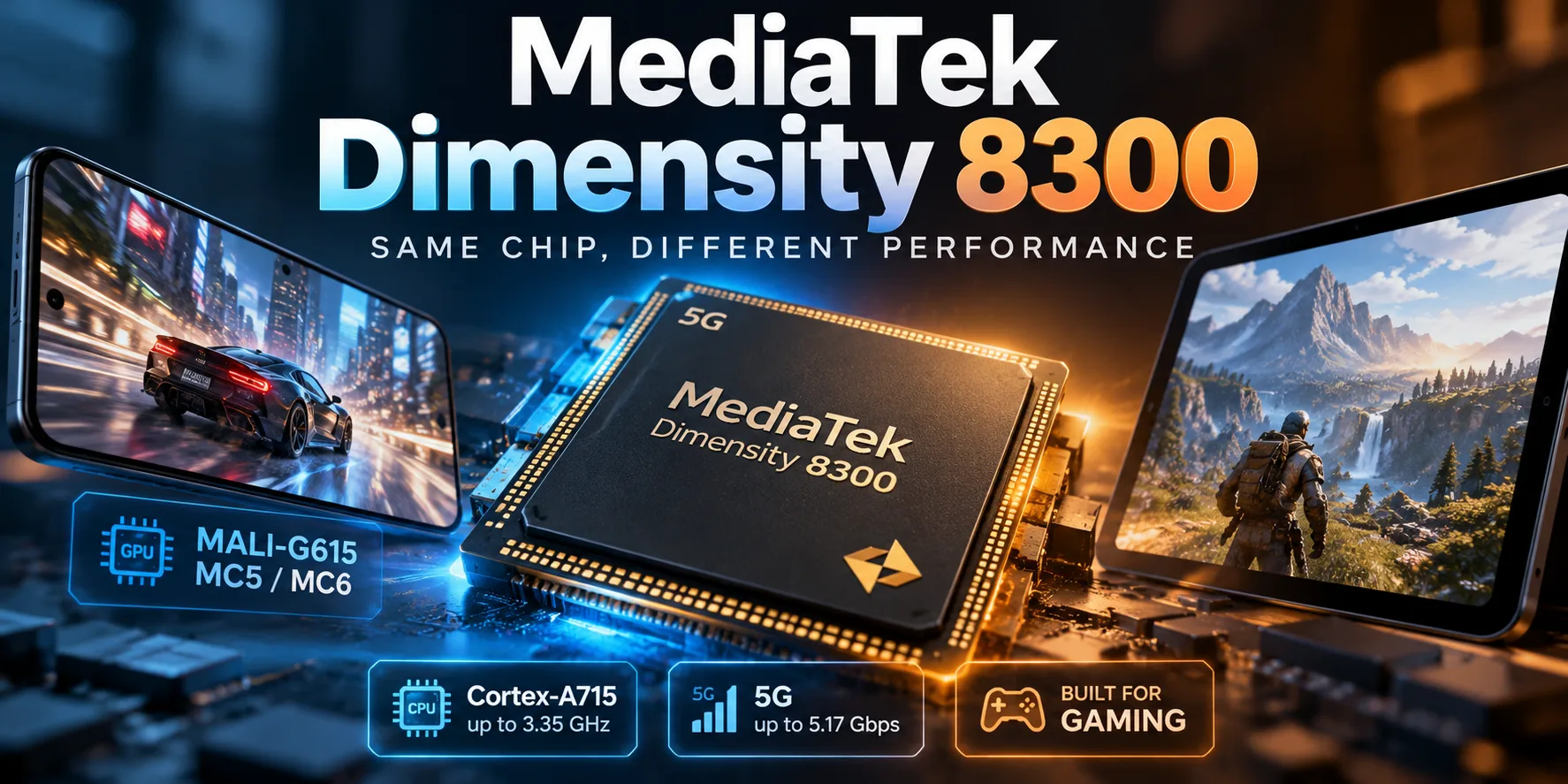
The MediaTek Dimensity 8300 comes in two Mali-G615 graphics configurations. The Lenovo Idea Tab Pro uses the five-core version, while the rugged Tank 4 Pro smartphone has the six-core version. The latter scores 34% higher in 3DMark Steel Nomad Light. However, the six-core POCO X6 Pro falls behind even the Lenovo. The difference is determined not only by the processor’s specifications but also by how the manufacturer has configured the device.
Architecture: Cortex-A715 Instead of Cortex-A78
The Dimensity 8300 was introduced in November 2023. It is manufactured by TSMC using a 4 nm process and features eight CPU cores:
- 1 × Cortex-A715 clocked at up to 3.35 GHz.
- 3 × Cortex-A715 clocked at up to 3.2 GHz.
- 4 × Cortex-A510 clocked at up to 2.2 GHz.
Its predecessor, the Dimensity 8200, also has four performance cores, but they use the Cortex-A78 architecture. Switching to Cortex-A715 and A510 increased performance without increasing the core count. MediaTek claimed CPU performance gains of more than 20% and graphics performance gains of up to 60%.
The chip supports LPDDR5X at speeds of up to 8533 MT/s and UFS 4.0 storage. However, the final specifications depend on the device. For example, the 128 GB Lenovo Idea Tab Pro uses UFS 3.1, while the 256 GB version has UFS 4.0.
Mali-G615: Five or Six GPU Cores
The Mali-G615 is available in two configurations:
- MC6 - six GPU cores, used in the Tank 4 Pro and smartphones with the Dimensity 8300 Ultra.
- MC5 - five GPU cores, used in the Lenovo Idea Tab Pro.
At the same clock speeds, the MC6 has more computing resources. However, graphics performance also depends on power consumption, cooling, and drivers.
The Mali-G615 supports hardware ray tracing, although most mobile games do without it. For this reason, it is more useful to compare several tests when evaluating graphics performance rather than relying solely on Solar Bay.
Dimensity 8300 and 8300 Ultra Benchmarks
| Device and processor | Geekbench 6 Single | Geekbench 6 Multi | 3DMark Steel Nomad Light | 3DMark Solar Bay | Price |
|---|---|---|---|---|---|
| Lenovo Idea Tab Pro, Dimensity 8300 (MC5) | 1405 | 4438 | 881 | 3688 | $350 |
| Unihertz Tank 4 Pro, Dimensity 8300 (MC6) | 1396 | 4257 | 1179 | 4794 | $650 |
| POCO X6 Pro, Dimensity 8300 Ultra (MC6) | 1370 | 4509 | 852 | 3458 | $299 |
| Redmi K70E, Dimensity 8300 Ultra (MC6) | 1493 | 4708 | 1182 | 4614 | $282 |
Prices are listed in US dollars at the time the devices were released. For the Redmi K70E, the equivalent of its launch price in China is used.
CPU: The Difference Stays Within 11%
In Geekbench 6 Multi-Core, the results range from 4257 to 4708 points. The Redmi K70E leads, while the Tank 4 Pro takes last place.
All four devices use the same CPU architecture, so the differences are related to power settings, cooling, and testing conditions. The Ultra suffix does not provide an advantage by itself.
GPU: The Spread Reaches 38%
In Steel Nomad Light, the Tank 4 Pro scores 1179 points versus 881 for the Lenovo Idea Tab Pro. The six-core Mali-G615’s advantage is 34%.
Solar Bay shows a similar picture: 4794 versus 3688 points, a 30% difference. However, this test uses hardware ray tracing, so its results cannot be directly applied to ordinary games.
The comparison with the POCO X6 Pro is more interesting. Despite having a Mali-G615 MC6, the smartphone scores only 852 points in Steel Nomad Light-less than the Lenovo tablet with five GPU cores. Between the POCO X6 Pro and Redmi K70E, both equipped with the same Dimensity 8300 Ultra, the gap in this test reaches 38%.
The number of GPU cores determines the GPU’s capabilities, but it does not guarantee corresponding performance in a finished device.
Gaming and Throttling
The Dimensity 8300 handles Genshin Impact, PUBG Mobile, Call of Duty: Mobile, and other demanding games. But peak performance in a short test does not show how stable the frame rate will remain after half an hour.
The Tank 4 Pro demonstrates this problem particularly clearly. In a prolonged test, CPU performance fell by 46% over 30 minutes, while the GPU lost 40% of its performance over 20 minutes.
As a result, a smartphone with high peak performance can slow down noticeably once it heats up. For extended gaming sessions, sustained clock speeds matter more than a difference of several hundred points in 3DMark.
Dimensity 8300 Versus 8300 Ultra and 8350
The Dimensity 8300 Ultra is used in the POCO X6 Pro and Redmi K70E. It is a Xiaomi-adapted version of the platform with the same CPU architecture and Mali-G615 MC6 graphics.
The tests do not show a consistent advantage for the Ultra. For example, the standard Dimensity 8300 in the Tank 4 Pro outperforms the POCO X6 Pro in both graphics benchmarks.
The Dimensity 8350, released later, also retained four Cortex-A715 cores, four Cortex-A510 cores, and Mali-G615 MC6 graphics. The maximum CPU frequency remained unchanged at 3.35 GHz.
The main change is the StarSpeed Engine gaming engine, designed to manage performance and power consumption. MediaTek claims improved frame stability and power efficiency, but the actual effect depends on the game and the device implementation.
Therefore, the Dimensity 8350 does not provide a fundamental leap in computing power over the 8300. Paying extra is justified only if the smartphone offers other advantages.
Cameras and Connectivity
The Dimensity 8300 supports cameras with resolutions of up to 320 MP, 4K video recording at 60 frames per second, and hardware AV1 decoding. The APU 780 is used for image processing and artificial intelligence tasks.
The 5G modem provides theoretical download speeds of up to 5.17 Gbps. Wi-Fi 6E and Bluetooth 5.4 are also supported.
Is the Dimensity 8300 Worth Buying in 2026?
Three years after its release, the Dimensity 8300 still offers enough performance for most applications and mobile games. However, the results of specific devices vary more than their specifications might suggest.
The Lenovo Idea Tab Pro with Mali-G615 MC5 falls behind faster MC6 implementations, but even six-core graphics do not guarantee an advantage. The Tank 4 Pro looks excellent in short tests, yet slows down substantially under sustained load.
The Dimensity 8300 Ultra has no guaranteed advantage over the standard version, while the Dimensity 8350 brings no notable architectural changes to the CPU.
Conclusion: The Dimensity 8300 remains a competitive processor, but in 2026 the specific device plays the decisive role. For gaming, cooling and frame-rate stability matter; for everyday use, price, display, battery life, and the length of Android update support are more important. If all other specifications are equal, it is not worth paying extra solely for the Ultra suffix or the newer 8350.
SOC Comparison
Compare Dimensity 8300 with other SOCs
Basic
3x 3.2 GHz – Cortex-A715
4x 2.2 GHz – Cortex-A510
GPU Specifications
Connectivity
Memory Specifications
Miscellaneous
Benchmarks
Phones with Dimensity 8300
Tablets with Dimensity 8300


Comparison of Devices with Dimensity 8300
Compared to Other SoC
Related SoC Comparisons


Share in social media
Or Link To Us
<a href="https://cputronic.com/index.php/soc/mediatek-dimensity-8300" target="_blank">MediaTek Dimensity 8300</a>