AMD Radeon 820M
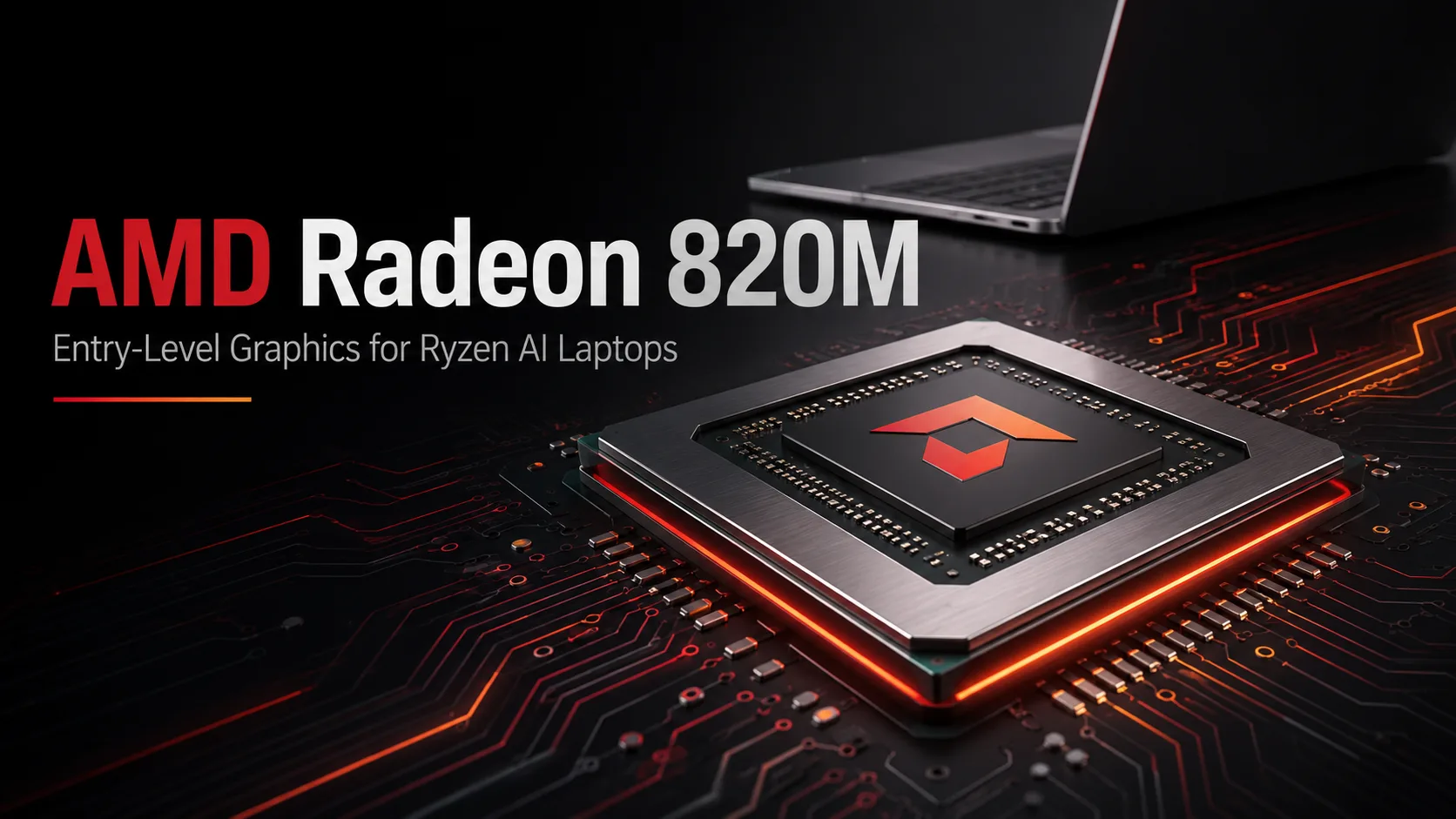
AMD Radeon 820M: Ryzen AI is present, gaming graphics are nearly absent
June 2026
AMD Radeon 820M is the most basic integrated graphics found in laptops with the Ryzen AI 5 330. Feature-wise, it is modern: it has AV1 support, external display support, and a platform with an NPU for Copilot+ PC. However, the graphical unit is significantly cut down - it has only 2 cores. Therefore, the Radeon 820M should be viewed not as an entry-level gaming iGPU, but as basic graphics for an inexpensive Ryzen AI laptop.
What is Radeon 820M
Radeon 820M is the basic integrated graphics in Ryzen AI 5 330. It belongs to the Radeon 800M family but occupies the junior position. For comparison: Radeon 840M has 4 graphical cores, Radeon 860M has 8, while Radeon 880M and 890M are found in more expensive and faster laptops.
In terms of capabilities, the Radeon 820M is not outdated. It includes DisplayPort 2.1, HDMI 2.1, FreeSync, AV1, and supports multiple displays. The limitation lies not in features, but in the number of compute units. Under 3D loads, the 2 graphical cores quickly become its main weak point.
The primary task of the Radeon 820M is to handle basic graphical tasks of a laptop without a discrete graphics card. This is sufficient for Windows, browsing, video, office applications, video calls, and older games. It is inadequate for modern gaming.
Why Radeon 820M is easy to overestimate
Radeon 820M is easy to overestimate due to the processor it is paired with. The Ryzen AI 5 330 features an NPU with up to 50 TOPS and meets the Copilot+ PC requirements. In specifications, such a laptop looks convincing: Ryzen AI, local AI features, fast memory, modern media block.
But the graphics remain entry-level. The Ryzen AI in the name does not mean that the laptop has a powerful iGPU. In this configuration, roles are strictly divided: the NPU handles AI functions, the CPU handles ordinary performance, and the Radeon 820M covers basic graphics and multimedia.
Performance: lower than Radeon 840M and 860M
According to tests, the Radeon 820M remains one of the weakest iGPUs in the Radeon 800M lineup. In 3DMark Time Spy Graphics, the result is around 786 points. This is acceptable for an office laptop, but insufficient for gaming.
The table shows the limits of its capabilities: light and older games still run reasonably well, while modern titles quickly hit the limitations of 2 graphical cores.
| Game and Settings | Approximate Result Radeon 820M |
|---|---|
| Dota 2 Reborn, 1080p Ultra | around 40 FPS |
| GTA V, 1080p Low | around 130 FPS |
| GTA V, 1080p High | around 22 FPS |
| Cyberpunk 2077, 1080p Low | around 13 FPS |
| Baldur’s Gate 3, 1080p Low | around 13 FPS |
| Battlefield 6, 1080p Low | around 11 FPS |
| Strange Brigade, 1080p Low | around 76 FPS |
Dota 2, older games, and light online projects are still feasible. Cyberpunk 2077, Baldur’s Gate 3, or Battlefield 6 are no longer suitable for comfortable gaming. Even on low settings and in Full HD, the Radeon 820M quickly reaches the limits of its basic graphical capabilities.
What Radeon 820M is suitable for
The Radeon 820M meets the needs for which it is used in inexpensive Ryzen AI laptops. It is a basic iGPU for everyday work rather than graphics with gaming potential.
It is suitable for such tasks:
- office programs, documents, spreadsheets, and browsing;
- video, streaming, and video conferencing;
- connecting external monitors;
- simple photo editing;
- older games and light online projects;
- laptops with Copilot+ PC features thanks to the NPU in Ryzen AI 5 330.
For such laptops, this is a rational configuration. The Radeon 820M does not increase the device's price, does not require complex cooling, and allows for a thin chassis. If the laptop is purchased for work, study, and everyday tasks, this level of graphics is adequate.
Main limitations of Radeon 820M
The main limitation of the Radeon 820M is its two graphical cores. Fast LPDDR5X memory helps the integrated graphics, but it does not change the device class. This iGPU has too few compute units for modern games and heavy 3D tasks.
Do not choose the Radeon 820M if you need:
- modern gaming in Full HD;
- stable FPS in AAA titles;
- 3D rendering;
- editing with active GPU acceleration;
- work in Blender on the GPU;
- a reserve of graphical power for the future.
Do not expect the Radeon 820M to perform at the level of the Radeon 680M or Radeon 780M. Those iGPUs had significantly more compute units and thus performed better in gaming. The Radeon 820M belongs to a different class: it is graphics for an affordable thin laptop.
Another important point is the dependence on the specific laptop model. Integrated graphics use system memory, and the result depends on its speed, operating mode, power limits, and cooling. But even in a favorable configuration, the Radeon 820M remains the lower-tier iGPU.
How to compare Radeon 820M
The most accurate comparison for the Radeon 820M is within AMD’s range:
| Graphics | Positioning |
|---|---|
| Radeon 820M | basic graphics for office use, video, and older games |
| Radeon 840M | superior due to 4 graphical cores |
| Radeon 860M | reasonable minimum for light gaming |
| Radeon 880M / 890M | significantly higher class of iGPU |
With Intel, the situation depends on the specific processor and number of graphical units. Higher-end Intel Arc Graphics in Core Ultra may significantly outperform, but lower configurations are often limited as well. Therefore, it is necessary to compare not just series names, but specific laptops and tests.
A practical guideline is this: if gaming is not important, the Radeon 820M is sufficient. If you occasionally wish to run modern projects, it’s better to consider at least the Radeon 860M. If stable gaming performance is needed, a discrete graphics card is required.
Conclusion
AMD Radeon 820M is functionally modern but very limited in 3D performance integrated graphics. Its main value is not FPS, but its role in an affordable platform with Ryzen AI featuring a full NPU.
Purchasing a laptop with the Radeon 820M for gaming is not worthwhile. It is a lower configuration with 2 graphical cores: it provides modern media capabilities, but not a reserve for 3D loads.
If an inexpensive Copilot+ PC for work and study is needed, the Radeon 820M makes sense. If gaming, 3D work, or heavy GPU acceleration is important, it’s better to look at models with Radeon 860M, 880M, 890M, or a laptop with a discrete graphics card.
GPU Comparison
Compare Radeon 820M with other GPUs
Basic
Memory Specifications
Display and Media
Theoretical Performance
AI Features
Miscellaneous
Benchmarks
Compared to Other GPU
Related GPU Comparisons
Share in social media
Or Link To Us
<a href="https://cputronic.com/gpu/amd-radeon-820m" target="_blank">AMD Radeon 820M</a>