Intel Core Ultra X7 358H
Intel Core Ultra X7 358H: the main strength of Panther Lake lies not in the CPU
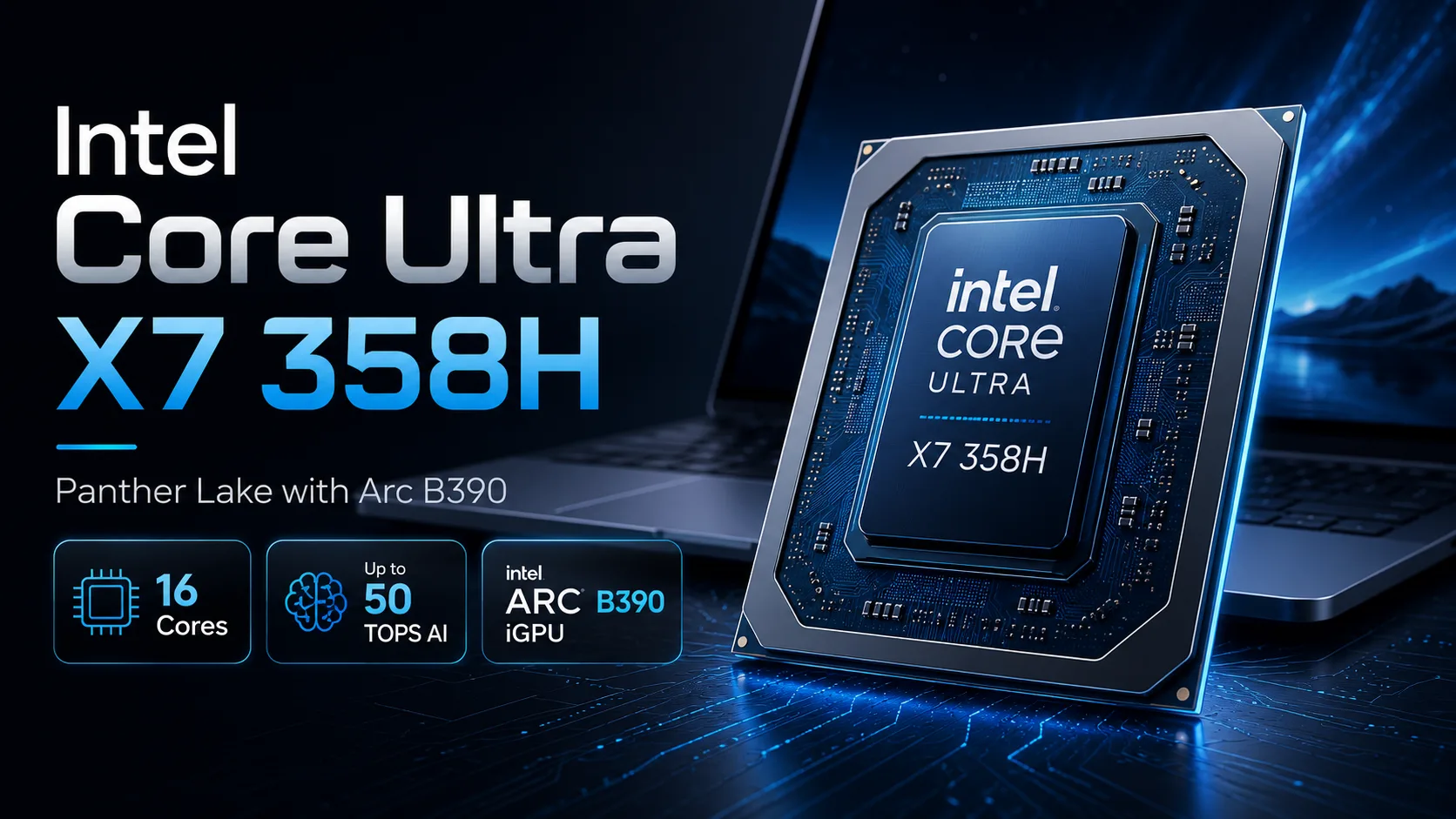
At first glance, the Intel Core Ultra X7 358H appears to be just another high-performance mobile processor from Intel. However, the most significant change in Panther Lake is not in the CPU cores. It features a 16-core CPU manufactured using Intel's 18A process and an NPU with 50 TOPS, but the main distinguishing feature of the X7 358H is the Arc B390. For the first time in this class, Intel's integrated graphics are becoming a serious argument in processor selection.
16 cores without a frequency chase
The Core Ultra X7 358H is equipped with 4 powerful P-cores, 8 E-cores, and 4 low-power LP-E-cores. In total, it has 16 cores and 16 threads. The maximum frequency of the P-cores is 4.8 GHz, and its Smart Cache capacity is 18 MB.
The processor's base power is rated at 25 W, while the maximum Turbo Power reaches 80 W. Therefore, the specific performance of a laptop significantly depends on cooling and power limits.
The X7 358H does not aim for extremely high P-core frequencies. Multi-threaded performance relies on the combined effort of the 16-core configuration, and the main difference from regular Core Ultra H lies outside the CPU block.
Geekbench 6 in real laptops
A single average result poorly reflects the capabilities of the X7 358H. Even mass-produced laptops with the same processor show noticeable differences in performance.
| Laptop | Geekbench 6 Single | Geekbench 6 Multi |
|---|---|---|
| Dell XPS 14 (2026) | 2867 | 16 927 |
| MSI Prestige 14 Flip AI+ | 2839 | 16 558 |
| ASUS ExpertBook Ultra B9406CAA | 2825 | 16 506 |
| Acer Swift 16 AI | 2789 | 15 926 |
The difference between the fastest and slowest systems in this sample is about 6% in Multi Core. For a mobile processor, this variation is normal considering different chassis, power profiles, and cooling systems.
In more compact or power-limited systems, the drop can be more pronounced. The Framework Laptop 13 Pro with the same X7 358H shows around 14.3 thousand points in Multi Core, while the best implementations exceed 17 thousand.
Thus, having the same X7 358H does not guarantee equivalent long-term performance.
Arc B390 - here's why the letter X appears
The main advantage of the X7 358H is the integrated Intel Arc B390. It features 12 next-generation Xe cores and operates at frequencies up to 2.5 GHz.
The Arc B390 can no longer be considered graphics only for interfaces and casual games. The Acer Swift 16 AI shows approximately 46 fps in Cyberpunk 2077 without XeSS, while the ASUS ExpertBook Ultra scores about 6900 Graphics points in 3DMark Time Spy.
For a thin laptop without a discrete graphics card, this is a significant result.
XeSS and frame generation can further increase frame rates, but such results cannot be mixed with native performance. More importantly, modern heavy games on the Arc B390 can already be launched at Full HD without a discrete graphics card.
If the laptop is needed for more than just browsing and office tasks, the Arc B390 becomes the main argument in favor of the X7 358H.
Hidden context of the lineup
In the Core Ultra Series lineup, models with Arc B390 feature the X index, while regular Core Ultra 7 H models receive simpler integrated graphics.
| Model | Cores | Max Turbo | Integrated Graphics |
|---|---|---|---|
| Core Ultra 7 356H | 16 | 4.7 GHz | Intel Graphics |
| Core Ultra X7 358H | 16 | 4.8 GHz | Arc B390 |
| Core Ultra X7 368H | 16 | 5.0 GHz | Arc B390 |
| Core Ultra X9 388H | 16 | 5.1 GHz | Arc B390 |
Against this backdrop, the X7 358H stands out as one of the more rational options in the lineup. Upgrading to the X7 368H or X9 388H does not increase the number of CPU cores or improve the integrated graphics configuration. The additional cost is primarily for higher CPU frequencies.
If the price difference between laptops is significant, upgrading to higher models quickly loses meaning.
NPU and memory
The built-in NPU provides up to 50 TOPS INT8 and meets the requirements of Copilot+ PC. The NPU here complements the platform rather than defines its value.
It supports LPDDR5X-9600 memory with a capacity of up to 96 GB. The high memory bandwidth is particularly important for the Arc B390 since it does not have dedicated video memory. Therefore, memory bandwidth can significantly impact the performance of the Arc B390.
Laptops with the X7 358H come at very different prices
The same processor appears in models priced around $1300-1800 and in laptops costing about $3000.
The MSI Prestige 14 Flip AI+ with the X7 358H, 32 GB of RAM, and a 1 TB SSD starts at around $1299. The Acer Swift 16 AI starts at about $1599, while the configuration with 32 GB of RAM is priced at $1799.
The Dell XPS 14 falls into a completely different price category. A configuration with the X7 358H, 32 GB LPDDR5X, and a 1 TB SSD costs around $2550. The ASUS ExpertBook Ultra with the same processor, 32 GB of RAM, and a 1 TB SSD approaches $3000.
In the $1300-1800 range, the X7 358H is well-positioned: the buyer receives a fast 16-core CPU and Arc B390 without a separate graphics card.
At the $2500-3000 price point, the processor alone does not justify the cost. Buyers must evaluate the display, weight, chassis, battery life, memory, and other features of the laptop separately. The $1000-1500 difference must be justified by the chassis, screen, memory, and other system characteristics rather than the processor.
Conclusion
The strong point of the Core Ultra X7 358H is not record-breaking CPU performance. Its main advantage lies in the Arc B390, which provides sufficient performance for GPU tasks and modern Full HD gaming in a thin laptop without a discrete graphics card.
The X7 358H performs best in laptops priced around $1300-1800. If the same processor is being sold in laptops costing $2500-3000, you are definitely not paying extra for the Core Ultra X7 358H.
CPU Comparison
Compare Core Ultra X7 358H with other CPUs
Basic
CPU Specifications
Memory Specifications
GPU Specifications
Interfaces and Ports
Benchmarks
Compared to Other CPU
Related CPU Comparisons




Share in social media
Or Link To Us
<a href="https://cputronic.com/en/cpu/intel-core-ultra-x7-358h" target="_blank">Intel Core Ultra X7 358H</a>