Apple M2 Ultra

Apple M2 Ultra
Apple M2 Ultra processor review

Apple M2 Ultra - 24-Core Processor with Up to 76 GPU Cores

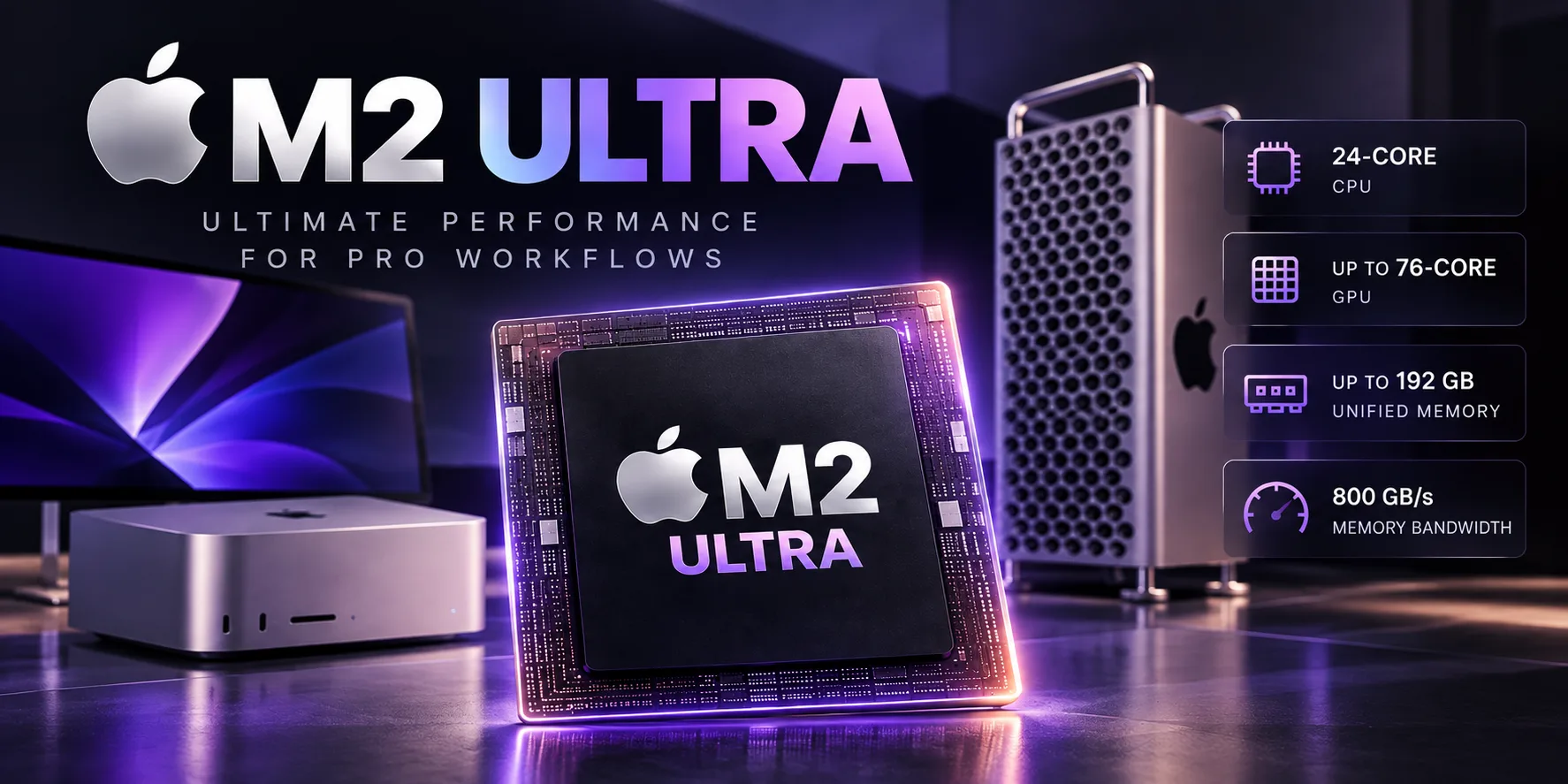
The Apple M2 Ultra was released in June 2023 as the top-end chip in the M2 family. It was used in the Mac Studio and Mac Pro, and featured 24 CPU cores, while its integrated GPU was available in 60- and 76-core versions.

The M2 Ultra is built from two M2 Max dies connected through UltraFusion. The number of CPU cores was doubled, while the GPU offered 60 or 76 cores versus a maximum of 38 in the M2 Max. Unified memory bandwidth increased to 800 GB/s.

M2 Ultra Architecture and Versions

The M2 Ultra is manufactured using a second-generation 5nm process and contains 134 billion transistors.

The CPU includes 24 cores-16 performance cores and eight efficiency cores. The two M2 Max dies are connected through UltraFusion with inter-die bandwidth of more than 2.5 TB/s. macOS and applications use them as a single SoC.

The GPU was available in two configurations, with 60 or 76 cores. The number of CPU cores is the same in both, so the versions differ primarily in GPU performance.

The M2 Ultra supports 64, 128, or 192 GB of unified memory with bandwidth of 800 GB/s.

M2 Ultra Performance in Real-World Devices

The M2 Ultra was installed only in desktop systems-the Mac Studio and Mac Pro. Both computers use active cooling, so the difference between them in CPU tests is small.

A Mac Studio with the M2 Max has been added to the table for comparison.

Device Chip Geekbench 6 Single-Core Geekbench 6 Multi-Core Cinebench R23 Single-Core Cinebench R23 Multi-Core Launch Price
Mac Studio (2023) M2 Max 12C / 38C GPU ~2695 ~14,900 ~1695 ~14,800 $2199
Mac Studio (2023) M2 Ultra 24C / 60C GPU ~2685 ~21,200 ~1755 ~27,100 $3999
Mac Studio (2023) M2 Ultra 24C / 76C GPU ~2680 ~21,200 ~1730 ~28,500 $4999
Mac Pro (2023) M2 Ultra 24C / 76C GPU ~2780 ~21,400 ~1695 ~28,600 $7999

The M2 Ultra’s single-threaded performance is almost identical to that of the M2 Max because they use cores from the same generation with similar clock speeds.

The difference is much larger in multi-threaded tests. In Geekbench 6, the M2 Ultra scores around 21,000 points versus approximately 15,000 for the M2 Max. In Cinebench R23, the gap is even larger-around 27,000-28,500 versus 14,800.

The additional CPU cores accelerate rendering, compilation, and other highly parallelizable workloads.

The Mac Studio and Mac Pro with the same M2 Ultra deliver similar CPU performance. The Mac Pro’s higher price is primarily related to its enclosure and PCIe expansion capabilities, rather than a faster processor.

M2 Ultra Graphics Performance

The M2 Ultra has 60 or 76 GPU cores, compared with 38 in the top-end M2 Max.

Chip GPU Geekbench 6 Metal Geekbench 6 OpenCL
M2 Max 38 cores ~147,200 ~89,600
M2 Ultra 60 cores ~183,500 ~104,900
M2 Ultra 76 cores ~232,000 ~132,900

The 60-core M2 Ultra is approximately one-quarter faster than the 38-core M2 Max in Geekbench Metal. The 76-core version’s advantage reaches approximately 58%.

In OpenCL, the score rises from approximately 89,600 for the M2 Max to 104,900 for the 60-core M2 Ultra and around 132,900 for the 76-core version.

Separately, in the Blender 3.5 GPU Benchmark, the 76-core M2 Ultra scores around 3412 points versus approximately 1917 for the 38-core M2 Max. In this test, a higher score indicates higher performance. The difference is approximately 78%.

Because different systems were tested, some of the variation is related to the device configuration.

The M2 Ultra belongs to the generation that predates the introduction of hardware-accelerated ray tracing in Apple silicon. These units appeared only in the M3 family, so the M2 Ultra is slower in ray tracing than Apple silicon generations with hardware-accelerated ray tracing.

Memory and Media Engine

128 and 192 GB of memory are primarily useful for large video projects, 3D scenes, virtual machines, and computational workloads in which the CPU and GPU simultaneously use large amounts of data.

The M2 Ultra’s media engine is doubled relative to the M2 Max. The chip has two video decode engines, four encode engines, and four ProRes encode and decode engines.

Hardware support is provided for H.264, HEVC, ProRes, and ProRes RAW. The M2 Ultra can simultaneously play back up to 22 streams of 8K ProRes 422.

The memory and SSD cannot be upgraded after purchase, so the memory and storage capacity must be selected when buying the device.

Apple M2 Ultra in 2026

In multi-threaded CPU and GPU workloads, the M2 Ultra is noticeably faster than the M2 Max. The 24-core CPU accelerates rendering, compilation, video processing, and other highly parallelizable workloads.

In single-threaded and lightly parallelized workloads, the difference from the M2 Max is considerably smaller.

The 60-core-and especially the 76-core-GPU is significantly faster than the M2 Max in Metal, OpenCL, and Blender.

When buying a Mac with the M2 Ultra in 2026, the main factors to consider are the price, memory capacity, and GPU configuration. The Mac Studio and Mac Pro with the same M2 Ultra are close in computing performance, while the Mac Pro’s advantage is primarily its PCIe expansion.

CPU Comparison

Compare Apple M2 Ultra with other CPUs

Please select CPU from the dropdown list.

Basic

Label Name
Apple
Platform
Desktop
Launch Date
June 2023
CPU Architecture
Apple Avalanche + Apple Blizzard
CPU Name
Apple M2 Ultra
Model Name
The Intel processor number is just one of several factors - along with processor brand, system configurations, and system-level benchmarks - to be considered when choosing the right processor for your computing needs.
Apple M2 Ultra
Foundry
TSMC
Generation
Apple M2 series

CPU Specifications

Interconnect Bandwidth
Over 2.5 TB/s
Interconnect Technology
UltraFusion
Total Cores
Cores is a hardware term that describes the number of independent central processing units in a single computing component (die or chip).
24
Total Threads
Where applicable, Intel® Hyper-Threading Technology is only available on Performance-cores.
24
Performance-cores
16
Efficient-cores
8
Efficient-core Max Turbo Frequency
Maximum E-core turbo frequency derived from Intel® Turbo Boost Technology.
2.42 GHz
Instruction Set Extensions
NEON
Performance-core Max Turbo Frequency
Maximum P-core turbo frequency derived from Intel® Turbo Boost Technology.
3.50 GHz
Extended Instruction Set
Armv8.5-A, NEON
L1 Cache
P-cores: 192 KB instruction + 128 KB data per core; E-cores: 128 KB instruction + 64 KB data per core
L2 Cache
P-core clusters: 72 MB total; E-core clusters: 8 MB total
L3 Cache
96 MB system level cache
Technology
Lithography refers to the semiconductor technology used to manufacture an integrated circuit, and is reported in nanometer (nm), indicative of the size of features built on the semiconductor.
5 nm
Instruction Set
The instruction set is a hard program stored inside the CPU that guides and optimizes CPU operations. With these instruction sets, the CPU can run more efficiently. There are many manufacturers that design CPUs, which results in different instruction sets, such as the 8086 instruction set for the Intel camp and the RISC instruction set for the ARM camp. x86, ARM v8, and MIPS are all codes for instruction sets. Instruction sets can be extended; for example, x86 added 64-bit support to create x86-64. Manufacturers developing CPUs that are compatible with a certain instruction set need authorization from the instruction set patent holder. A typical example is Intel authorizing AMD, enabling the latter to develop CPUs compatible with the x86 instruction set.
Armv8.5-A
Transistor Count
134 billion

Memory Specifications

Memory Bus Width
1024-bit
Memory Type
Intel® processors come in four different types: Single Channel, Dual Channel, Triple Channel, and Flex Mode. Maximum supported memory speed may be lower when populating multiple DIMMs per channel on products that support multiple memory channels.
Unified LPDDR5-6400
LPDDR5 Speed
LPDDR5-6400
Max Memory Size
Max memory size refers to the maximum memory capacity supported by the processor.
192 GB
Memory Channels
The number of memory channels refers to the bandwidth operation for real world application.
8
Max Memory Bandwidth
Max Memory bandwidth is the maximum rate at which data can be read from or stored into a semiconductor memory by the processor (in GB/s).
800 GB/s
Maximum Memory Speed
6400 MT/s

GPU Specifications

External Display Standard
Thunderbolt 4, HDMI 2.1
GPU Name
Apple M2 Ultra GPU
Max External Display Resolution
Up to eight 4K 60Hz displays, six 6K 60Hz displays, or three 8K 60Hz displays; HDMI up to 8K 60Hz or 4K 240Hz
Video Concurrency
Up to 22 streams of 8K ProRes 422 video
Video Decode
H.264, HEVC, ProRes, ProRes RAW
Video Encode
H.264, HEVC, ProRes, ProRes RAW
Video Processing Unit
Apple media engine with ProRes acceleration
GPU Max Dynamic Frequency
1400 MHz
Graphics Base Frequency
Graphics Base frequency refers to the rated/guaranteed graphics render clock frequency in MHz.
450 MHz
Graphics Core Count
76
Number of Displays Supported
Up to 8 displays
GPU APIs
Metal, OpenCL
Graphics Performance
Up to 26.98 TFLOPS FP32
Media Engine
Hardware-accelerated H.264, HEVC, ProRes, and ProRes RAW
Video Decode Engines
2
Video Encode Engines
4
ProRes Encode/Decode Engines
4
OpenCL Support
OpenCL (Open Computing Language) is a multi-platform API (Application Programming Interface) for heterogeneous parallel programming.
Yes

AI Specifications

AI Engine
32-core Apple Neural Engine
Neural Engine Core Count
32
NPU Name
Apple Neural Engine
NPU Performance
31.6 TOPS

Connectivity

Bluetooth Support
Yes
Bluetooth Version
Bluetooth 5.3
Wi-Fi Standard
Wi-Fi 6E (802.11ax)

Interfaces and Ports

Thunderbolt Support
Yes, Thunderbolt 4 up to 40 Gb/s
USB Version
USB4
USB4 Support
Yes, USB4 up to 40 Gb/s

Miscellaneous

Hardware-Verified Secure Boot
Yes, Apple silicon secure boot chain of trust
Runtime Anti-Exploitation
Hardware-verified secure boot and runtime anti-exploitation technologies

Benchmarks

Cinebench R23
Single Core Score
1695
Cinebench R23
Multi Core Score
28570
Geekbench 6
Single Core Score
2776
Geekbench 6
Multi Core Score
21430
Geekbench 5
Single Core Score
1940
Geekbench 5
Multi Core Score
27860
Geekbench 7
Single Core Score
2589
Geekbench 7
Multi Core Score
28713
Passmark CPU
Single Core Score
4208
Passmark CPU
Multi Core Score
50932
Cinebench 2024
Single Core Score
126
Cinebench 2024
Multi Core Score
1918
Cinebench 2024 GPU
Score
8668
Blender
Score
502

Compared to Other CPU

Cinebench R23 Single Core
2154 +27.1%
1836 +8.3%
1695
1477 -12.9%
1126 -33.6%
Cinebench R23 Multi Core
45651 +59.8%
28570
16068 -43.8%
13316 -53.4%
M3
10437 -63.5%
Geekbench 6 Single Core
3167 +14.1%
2894 +4.3%
2776
Geekbench 6 Multi Core
38432 +79.3%
21430
16988 -20.7%
15550 -27.4%
Geekbench 5 Single Core
2974 +53.3%
2027 +4.5%
1940
1793 -7.6%
1705 -12.1%
Geekbench 5 Multi Core
86607 +210.9%
36476 +30.9%
27860
19650 -29.5%
16448 -41%
Geekbench 7 Single Core
2602 +0.5%
2592 +0.1%
2589
2569 -0.8%
Geekbench 7 Multi Core
29547 +2.9%
28713
Passmark CPU Single Core
4453 +5.8%
4287 +1.9%
4208
4136 -1.7%
Passmark CPU Multi Core
59285 +16.4%
54933 +7.9%
50932
46925 -7.9%
44421 -12.8%
Cinebench 2024 Single Core
135 +7.1%
126
123 -2.4%
120 -4.8%
Cinebench 2024 Multi Core
2167 +13%
1918
1756 -8.4%
Cinebench 2024 GPU
12980 +49.7%
12948 +49.4%
8668
7768 -10.4%
6139 -29.2%
Blender
1154 +129.9%
502
201 -60%
151 -69.9%
71 -85.9%