Intel Core Ultra 5 338H

Intel Core Ultra 5 338H: Arc B370 Is Faster Than the Core Ultra 7 255H’s Graphics
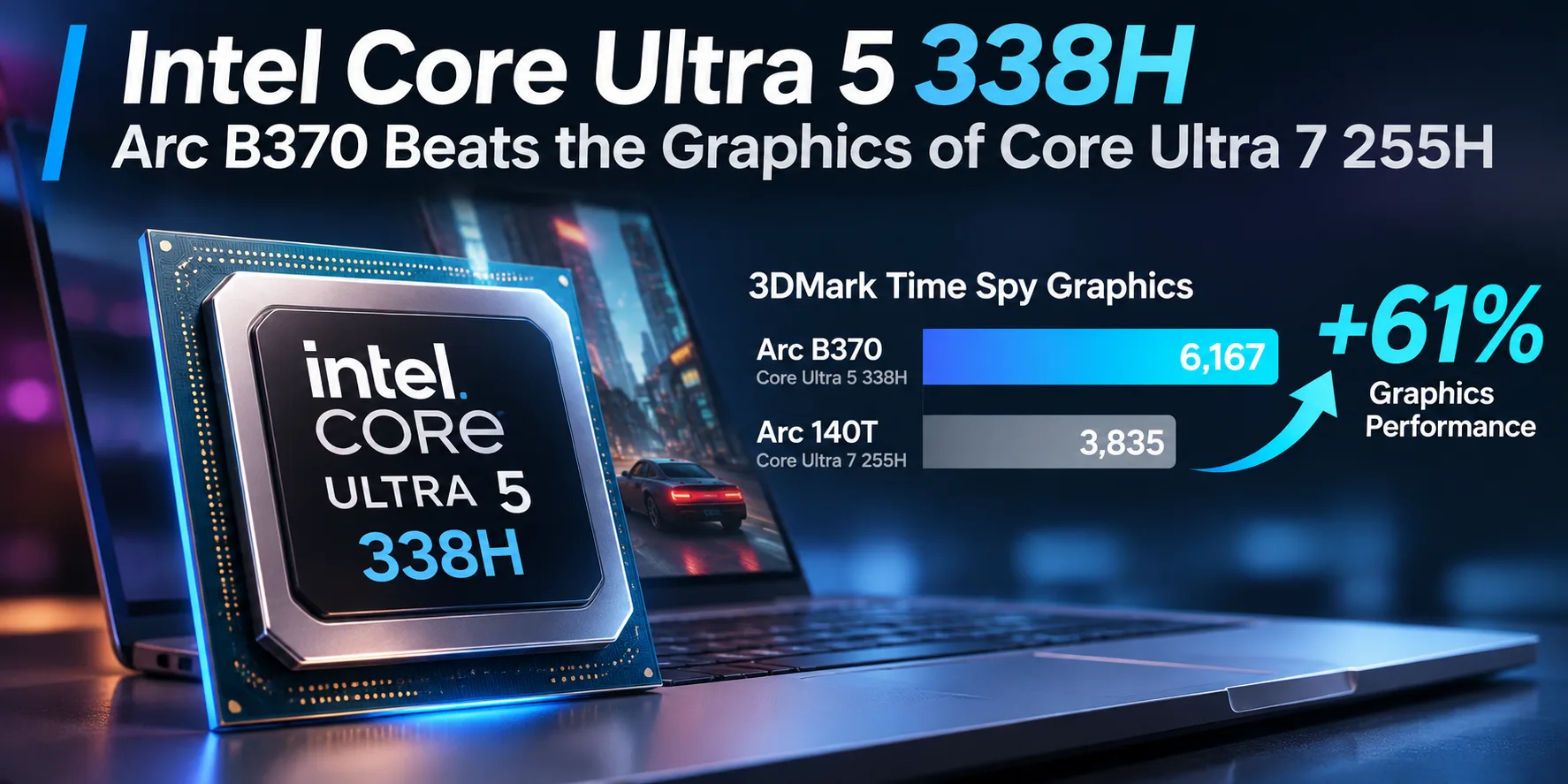
In the HONOR MagicBook Pro 14, the Intel Arc B370 graphics in the Core Ultra 5 338H scored 6167 points in 3DMark Time Spy Graphics. That is 61% higher than the Arc 140T result in the HONOR MagicBook Art 14 with a Core Ultra 7 255H. At the same time, both processors delivered nearly identical performance in Geekbench 6. The 338H’s main advantage is its integrated graphics, which makes Full HD gaming possible without a discrete graphics card, although demanding games require lower settings.
Core Ultra 5 338H vs. 336H: The Main Difference Is the Graphics
Both processors belong to the Panther Lake family. They have the same core configuration: 4 high-performance Cougar Cove cores, 4 power-efficient Darkmont cores, and 4 LP E-cores. Each processor has 12 cores, 12 threads, and 18 MB of L3 cache.
| Specification | Core Ultra 5 336H | Core Ultra 5 338H |
|---|---|---|
| Maximum P-core frequency | 4.6 GHz | 4.7 GHz |
| Maximum LP E-core frequency | 3.2 GHz | 3.3 GHz |
| Integrated graphics | Intel Graphics | Intel Arc B370 |
| Xe graphics cores | 4 | 10 |
| Maximum GPU frequency | 2.3 GHz | 2.4 GHz |
| GPU performance, INT8 | 37 TOPS | 98 TOPS |
The 338H’s maximum P-core frequency is only 100 MHz higher. However, the Arc B370 has 2.5 times as many Xe cores as the graphics in the Core Ultra 5 336H. This does not mean the same increase in FPS: the result depends on the game, memory bandwidth, and the laptop’s power limits.
The processor cores are manufactured using Intel 18A, while the graphics block is manufactured using TSMC N3E. Intel specifies a base power of 25 W and a maximum turbo power of 65 W.
CPU Performance: Comparison with Core Ultra 7 and Ryzen AI 9
In the HONOR MagicBook Pro 14 (2026), the Core Ultra 5 338H briefly consumes up to 65 W. Under sustained load, power stabilizes at around 50 W.
| Laptop and processor | Geekbench 6 Single | Geekbench 6 Multi | Cinebench 2024 Multi | Time Spy Graphics |
|---|---|---|---|---|
| HONOR MagicBook Pro 14 (2026), Core Ultra 5 338H | 2840 | 14,499 | 968 | 6167 |
| HONOR MagicBook Art 14 (2025), Core Ultra 7 255H | 2797 | 14,454 | 810 | 3835 |
| Dell XPS 14 (2026), Core Ultra X7 358H | 2927 | 17,121 | 974 | 7043 |
| TUXEDO InfinityBook Pro 14 Gen10 AMD, Ryzen AI 9 HX 370 | 2949 | 15,735 | 1207 | 3142 |
In Geekbench 6 Multi-Core, the 338H and 255H scored almost the same. In Cinebench 2024, the 338H’s advantage is about 20%. However, the MagicBook Pro 14 has a higher sustained processor power limit than the thinner MagicBook Art 14.
In Cinebench 2024, the Ryzen AI 9 HX 370 outperforms the 338H by approximately 25%. The AMD processor appears stronger for sustained rendering, although the result also depends on the laptop’s cooling system.
The Core Ultra X7 358H is 18% faster in Geekbench 6 Multi-Core, but in Cinebench 2024 the results of the Dell XPS 14 and HONOR MagicBook Pro 14 are virtually identical. Therefore, these processors cannot be compared without taking the laptops’ power limits into account.
Intel Arc B370: Gaming Performance
The Arc B370 uses the Xe3 architecture and contains 10 graphics cores. It supports hardware ray tracing, XeSS upscaling, and AV1 encoding.
In 3DMark Time Spy Graphics, the Arc B370 scores nearly twice as many points as the Radeon 890M in the TUXEDO InfinityBook Pro 14. However, a twofold difference in a synthetic test does not mean twice the FPS.
A comparison with the more powerful Arc B390 shows how strongly results depend on the laptop’s cooling system and power limits.
| Laptop and graphics | Cyberpunk 2077, 1080p Ultra | Baldur's Gate 3, 1080p Ultra |
|---|---|---|
| HONOR MagicBook Pro 14, Arc B370 | 43.5 FPS | 40.6 FPS |
| Dell XPS 14, Arc B390 | 40.9 FPS | 48.7 FPS |
In Cyberpunk 2077, the HONOR with the Arc B370 delivered 43.5 FPS versus 40.9 FPS for the Dell XPS 14 with the B390. This single result is not enough to conclude that the B370 is faster. The HONOR has a higher sustained power limit, which likely partly explains the difference. In Baldur's Gate 3, the B390’s advantage is approximately 20%.
To achieve 60 FPS in demanding games, settings will have to be reduced. For example, in Cyberpunk 2077 at medium settings and 1920 x 1080, the HONOR delivers 57.7 FPS without FSR. In Assassin's Creed Shadows, the result is around 32 FPS even at low settings.
The Arc B370 makes Full HD gaming possible without a discrete graphics card, but maximum settings are suitable for far from every game.
Memory, NPU, and Laptop Features
The Core Ultra 5 338H supports up to 96 GB of LPDDR5X-8533 memory. The Arc B370 does not have dedicated video memory and uses system RAM, so its bandwidth affects graphics performance. The HONOR MagicBook Pro 14 has 32 GB of LPDDR5X-8533 memory soldered to the motherboard.
The specified NPU performance is 47 TOPS for INT8 calculations. It accelerates AI workloads in applications that support this block. However, TOPS values cannot determine the speed of a specific AI model.
When choosing a laptop with the 338H, consider the following:
- Cooling and power limits. They determine performance under sustained load, especially in games.
- The amount of RAM. In laptops with LPDDR5X, it is usually not upgradeable.
- The price difference compared with the Core Ultra 5 336H. If the laptop is needed only for office work, web browsing, and video playback, paying extra for the Arc B370 is not necessary.
Conclusion
The Core Ultra 5 338H is close to the Core Ultra 7 255H in CPU performance, but noticeably outperforms it in integrated graphics. In Time Spy Graphics, the Arc B370’s advantage in the tested laptops is 61%, while in some games it comes close to the higher-end Arc B390.
Compared with the Core Ultra 5 336H, the 338H’s main argument remains its graphics. The lower-end model is sufficient for office work and most programming tasks. If the laptop is being purchased without a discrete graphics card and is intended for gaming, the Arc B370 offers considerably more possibilities.
CPU Comparison
Compare Core Ultra 5 338H with other CPUs
Basic
CPU Specifications
Memory Specifications
GPU Specifications
Interfaces and Ports
Benchmarks
Compared to Other CPU
Related CPU Comparisons





Share in social media
Or Link To Us
<a href="https://cputronic.com/en/cpu/intel-core-ultra-5-338h" target="_blank">Intel Core Ultra 5 338H</a>