Intel Core Ultra 9 275HX

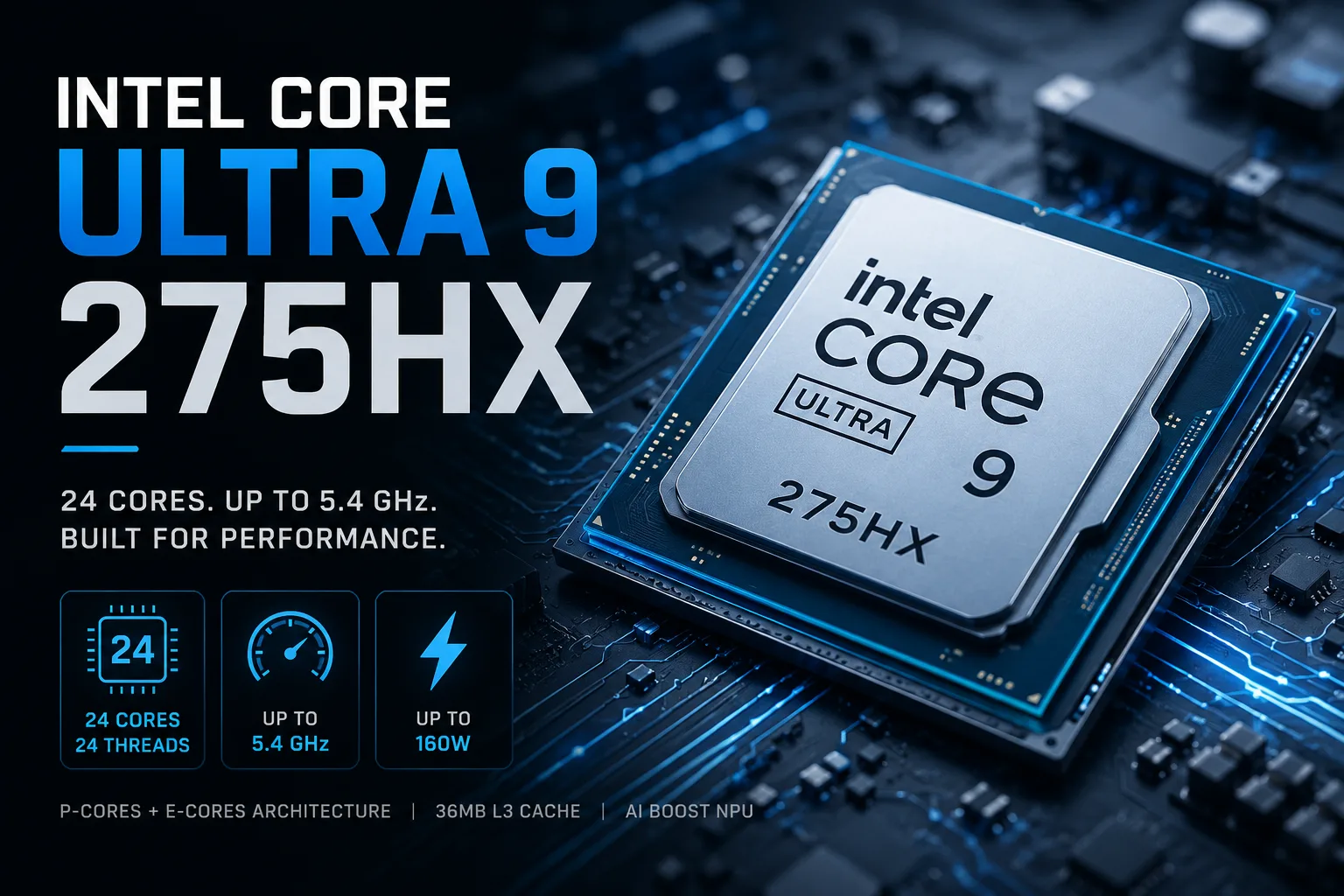
Intel Core Ultra 9 275HX: 24 Cores and Just 100 MHz Less Than the Higher Model
The Intel Core Ultra 9 275HX is very similar to the higher-end Core Ultra 9 285HX: they share the same core configuration and cache size, with a mere 100 MHz difference in maximum frequency. Therefore, when choosing a laptop, it's more important to look at the graphics card, cooling system, and the overall price of the configuration rather than just the CPU model.
Unlike the economical U and V series, the 275HX is designed for larger laptops. It features 24 cores, and its maximum power in turbo mode reaches up to 160 watts. For such a processor, an effective cooling system is particularly crucial.
24 Cores Without Hyper-Threading
The Core Ultra 9 275HX combines eight performance (P) cores and sixteen energy-efficient (E) cores. Hyper-Threading is not supported; thus, 24 physical cores handle 24 threads.
The maximum frequency of the P cores reaches 5.4 GHz, while the E cores can go up to 4.6 GHz. The L3 cache size is 36 MB, and the L2 cache is 40 MB.
The absence of Hyper-Threading is compensated by the large number of physical cores. The additional E cores assist in rendering, editing, compiling, and running virtual machines. In most games, the performance of the P cores is more critical, so the advantage of the 24-core configuration does not always manifest itself.
Comparison with Core Ultra 7 265HX and Core Ultra 9 285HX
| Characteristic | Core Ultra 7 265HX | Core Ultra 9 275HX | Core Ultra 9 285HX |
|---|---|---|---|
| P cores | 8 | 8 | 8 |
| E cores | 12 | 16 | 16 |
| Cores / Threads | 20 / 20 | 24 / 24 | 24 / 24 |
| Max P core frequency | 5.3 GHz | 5.4 GHz | 5.5 GHz |
| L3 Cache | 30 MB | 36 MB | 36 MB |
| Base Power | 55 W | 55 W | 55 W |
| Max Turbo Power | up to 160 W | up to 160 W | up to 160 W |
| NPU Performance | up to 13 TOPS | up to 13 TOPS | up to 13 TOPS |
The four additional E cores separate the 275HX from the 265HX, primarily in rendering, encoding, and other multithreaded tasks. In games, the difference is usually smaller since both models have eight P cores.
The higher Core Ultra 9 285HX differs from the 275HX mainly in its maximum frequency: 5.4 GHz versus 5.5 GHz. The difference is too small to choose a laptop based solely on CPU index. Cooling and power settings have a more significant impact on performance.
A laptop with the 275HX and an efficient cooling system may perform better than a compact model with the 285HX, which reaches temperature or power limits sooner.
Why Cooling is More Important Than Short Tests
The base power of the Core Ultra 9 275HX is 55 W, and in turbo mode, the processor can consume up to 160 W. Manufacturers set their own power limits, so the same CPU can yield different results in different laptops.
A short test result is not enough to evaluate such a processor. It's more important to observe what frequencies it can maintain after 10-20 minutes of rendering or compiling and how loud the fans are during that time.
For the Core Ultra 9 275HX, it's particularly vital to have:
- An effective cooling system;
- High long-term power limits;
- Thoughtful case ventilation.
In a thin case, the processor heats up faster and lowers its frequencies. One should not expect long battery life either.
What Core Ultra 9 275HX Offers in Gaming
The Core Ultra 9 275HX is typically installed alongside a powerful discrete graphics card. The fast P cores are especially beneficial in games with high frame rates, where the CPU often restricts overall system performance.
The additional cores are useful for simultaneous gaming, recording video, streaming, and running background applications. However, the difference with the Core Ultra 7 265HX will be minor in most games. The extra E cores provide a more noticeable boost in rendering and encoding.
When choosing a gaming laptop, consider the specifications in the following order:
- Graphics card and its power.
- Cooling system.
- Screen.
- RAM capacity.
- CPU model.
For gaming, it’s better to choose a laptop with the 275HX and a more powerful graphics card rather than overpaying for the 285HX with less powerful graphics.
Integrated Graphics for Auxiliary Tasks
The integrated graphics includes four Xe cores with a frequency of up to 1.9 GHz. Its capabilities are insufficient for demanding modern games.
It handles image output, video playback, and operates the laptop when the discrete graphics card is turned off. There’s support for H.264, H.265, and AV1 formats, as well as Intel Quick Sync Video.
The hardware media block will be useful for editing, streaming, and converting videos, provided the software used can utilize the integrated graphics separately from the discrete GPU.
Purpose of the Integrated NPU
The Intel AI Boost neural block provides up to 13 TOPS. The total proclaimed performance of the CPU, graphics, and NPU in AI tasks reaches 36 TOPS.
The NPU can handle background camera effects, gaze correction, and noise suppression without constant CPU core load. However, it lacks the performance for heavy local neural network tasks - such tasks are executed faster by discrete graphics.
When choosing a laptop with the 275HX, the NPU specifications are unlikely to be a decisive factor.
Memory and Storage
The platform supports DDR5-6400 memory up to 256 GB, as well as PCIe 5.0, PCIe 4.0, and Thunderbolt 4 interfaces.
However, the configuration is determined by the laptop manufacturer. Before purchasing, check the number of memory slots, M.2 connectors, and available ports. Even a powerful processor cannot compensate for soldered memory with no expansion options or a single slot for storage.
Who Needs the Core Ultra 9 275HX
Buying a laptop with the Core Ultra 9 275HX makes sense for:
- Rendering, 3D modeling, and engineering calculations;
- Video editing and encoding;
- Compiling large software projects;
- Working with virtual machines;
- Gaming at high frame rates;
- Simultaneous gaming, video recording, and streaming.
For browsing, office applications, and less demanding games, the processor is overkill. It shows the greatest difference in prolonged rendering, encoding, and compiling, where all 24 cores can be utilized.
Conclusion
The Core Ultra 9 275HX retains the configuration of the higher 285HX, only falling short by 100 MHz in maximum frequency. In practice, cooling and power limits have a more significant effect on results than this difference.
It is a 24-core processor for large gaming laptops and mobile workstations. In games, its capabilities are usually more than sufficient, while the additional E cores provide more benefit in rendering, editing, and compiling.
With the same graphics card, cooling, and memory capacity, a cheaper laptop with the Core Ultra 9 275HX would be a more sensible choice than a model with the 285HX.
CPU Comparison
Compare Core Ultra 9 275HX with other CPUs
Basic
CPU Specifications
Memory Specifications
GPU Specifications
Benchmarks
Compared to Other CPU
Related CPU Comparisons





Share in social media
Or Link To Us
<a href="https://cputronic.com/en/cpu/intel-core-ultra-9-275hx" target="_blank">Intel Core Ultra 9 275HX</a>