AMD Ryzen 9 8940HX

AMD Ryzen 9 8940HX

AMD Ryzen 9 8940HX: Flagship Mobile Power for Demanding Tasks

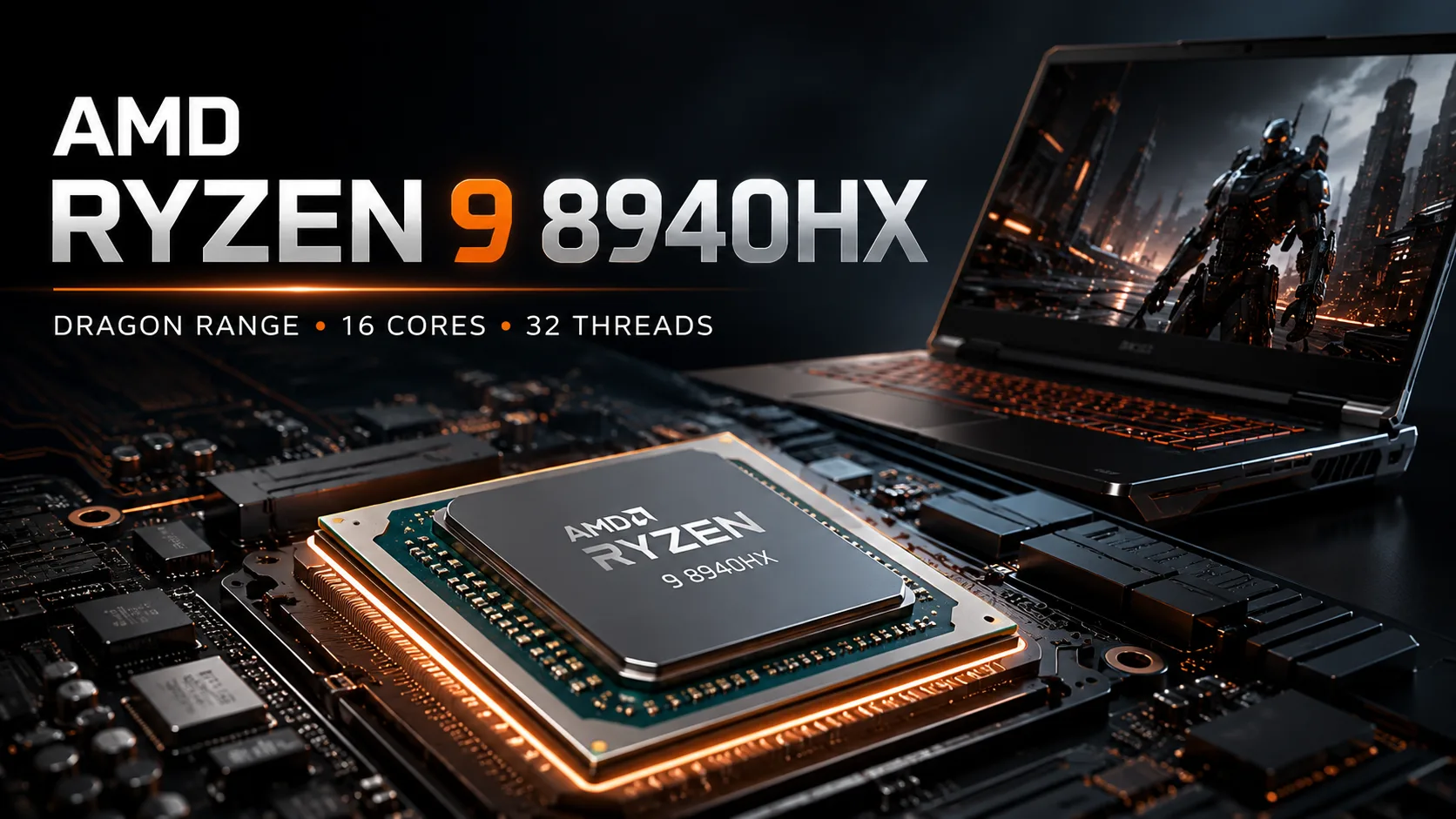
In the world of high-performance mobile processors, the HX segment occupies a special place. These chips are essentially desktop CPUs adapted for laptops, offering a level of performance previously unavailable in portable systems. The AMD Ryzen 9 8940HX is a prime representative of this class on the Dragon Range platform. Let's delve into what the specifications entail and who truly needs such power in a mobile format.

Architecture and Manufacturing Process: The Foundation of High Performance

At the heart of the Ryzen 9 8940HX is the Zen 4 microarchitecture, manufactured using TSMC's 5nm process technology. This is a key factor that dictates both high performance and energy efficiency.

  • Cores and Threads: The processor features 16 full-fledged high-performance cores and supports 32 computing threads. This number of cores in the mobile segment is indicative of a top-tier workstation or flagship gaming laptop.
  • Clock Frequencies: The base clock speed is set at 2.4 GHz, which is a conservative value for energy saving during idle or light load. The real power is revealed in maximum turbo boost mode, reaching 5.3 GHz on one or more cores. This allows for excellent speed in gaming and applications sensitive to frequency.
  • Cache Memory: The cache size significantly affects performance. The configuration is impressive: 64 KB L1 and 1 MB L2 per core, as well as a shared third-level cache of 64 MB. Such a massive L3 cache minimizes latency when accessing RAM, which is critically important for gaming and complex calculations.
  • Integrated Graphics: The built-in Radeon 610M GPU, based on the RDNA 2 architecture, serves as a supplementary solution. It will provide image output, video processing for everyday tasks, and help save battery life. For serious gaming or graphics work, a discrete graphics card (NVIDIA GeForce RTX or AMD Radeon RX) is necessary.
  • Other Features: Support for DDR5-5200 memory in dual-channel mode and PCIe 5.0 interface ensures high bandwidth for graphics cards and fast NVMe SSDs. The presence of an unlocked multiplier allows for manual overclocking in compatible laptops.

Power Consumption and Thermal Design Power (TDP): Balancing Power and Heat

The nominal TDP of the processor is stated at 55W. However, for HX series chips, this is a baseline. In reality, laptops with such CPUs are configured to operate in much higher energy settings to unlock the full potential of turbo frequencies and multi-core performance.

  • Maximum Temperature: The Max Operating Temperature of 100°C indicates that the chip is designed to operate under high thermal loads, which is typical for compact gaming laptop chassis.
  • Importance of Cooling System: This parameter makes the choice of a laptop with a powerful and well-thought-out cooling system critically important. Without it, the processor will not be able to maintain high frequencies under load for long and will throttle to prevent overheating.

Real-World Performance

The synthetic test results (Geekbench 6, PassMark) provide a clear understanding of the CPU's positioning.

  • Single-Core Performance: High scores (Geekbench 6 ~2735) are directly linked to the ability to boost to 5.3 GHz. This guarantees immediate system responsiveness, high FPS in most games, and quick operation of "heavy" applications.
  • Multi-Core Performance: Massive figures (Geekbench 6 ~13522, PassMark ~55745) place the Ryzen 9 8940HX alongside powerful desktop processors. This directly benefits:
  • Rendering: 3D visualization in Blender, V-Ray.
  • Code Compilation: Programmers working on large projects.
  • Video Processing: Encoding and exporting videos in 4K/8K.
  • Scientific Calculations and Engineering Software.
  • Turbo Mode Behavior: The effectiveness of turbo mode entirely depends on the laptop's cooling system. In a well-cooled system, the processor will dynamically increase frequencies during short loads and consistently maintain high frequencies across all cores during prolonged tasks.

Use Cases: Who Truly Needs It?

The Ryzen 9 8940HX is a specialized tool.

  • Gaming: An excellent choice for enthusiasts who want maximum FPS in games while having enough power for streaming and recording gameplay.
  • Professional Work: Ideal for mobile workstations used by designers, architects, video editors, engineers, and scientists who need desktop-level performance in a portable format.
  • Everyday Tasks: For office applications, web browsing, and video viewing, this processor is overkill. In such scenarios, its powerful cores may remain idle, and battery life will be lower than on laptops with energy-efficient CPUs.

Battery Life: The Cost of Power

Battery life is a weak point for laptops with HX-class processors.

  • Impact on Battery: Even in idle mode, power consumption from the platform with such a CPU is higher. Under load, the laptop will consume a significant amount of energy, and battery life in such modes is usually limited to just one hour or even less.
  • Energy-Saving Technologies: The processor employs modern power-saving techniques: aggressive frequency and voltage reduction during idle, disabling unused cores. However, an architecture aimed at maximum performance is inherently less efficient in ultra-low power modes.
  • Practical Advice: A laptop with Ryzen 9 8940HX should be viewed as a high-performance portable workstation capable of running on battery power, rather than as a standalone ultrabook.

Comparison with Competitors

  • Previous Generation (AMD Ryzen 9 7945HX): The 8940HX is essentially a refresh of that model. The key architectural features are identical. In real-world tests, the difference is likely minimal.
  • Main Competitor (Intel Core i9-14900HX): Intel’s flagship also offers high turbo frequencies. In gaming, they often perform neck-and-neck. The key difference is AMD's massive L3 cache (64 MB vs 36 MB for Intel), which can provide an advantage in some tasks. The choice often boils down to the specific laptop model, cooling system, and price.
  • Apple M3 Max: In the Apple ecosystem, M3 Max chips demonstrate phenomenal energy efficiency and high performance in supported professional applications. However, for cross-platform tasks, gaming on Windows, or specialized Windows software, AMD and Intel remain the primary choices.

Pros and Cons of Ryzen 9 8940HX

Strengths:

  • Desktop-level multi-core performance in a mobile form factor.
  • Huge third-level cache (64 MB).
  • High single-core frequency (up to 5.3 GHz).
  • Support for modern standards: PCIe 5.0 and DDR5.
  • Overclocking potential thanks to the unlocked multiplier.

Possible Drawbacks:

  • High power consumption and heat generation under load.
  • Low battery life in performance modes.
  • Mandatory requirement for a powerful cooling system.
  • Basic-level integrated graphics, with a discrete graphics card necessary.
  • High overall cost of laptops with such a processor.

Recommendations for Laptop Selection

A laptop with Ryzen 9 8940HX is always a large and powerful device. Here’s what to pay attention to:

  1. Type of Device: Is it specifically a gaming laptop or a mobile workstation?
  2. Cooling System: This is the most critical criterion. Look for reviews that test temperature and noise under prolonged load.
  3. Graphics Card: To unlock the CPU's potential in gaming, an appropriate GPU is needed. A minimum reasonable option is an NVIDIA GeForce RTX 4070 or AMD Radeon RX 7700S.
  4. Display: For gaming, a high refresh rate (144Hz and above) is important. For color work, color space coverage and high brightness are crucial.
  5. Memory and Storage: Minimum requirements include 32 GB DDR5-5200 and a fast NVMe SSD of at least 1 TB. For work tasks, 64 GB of RAM is often required.

Final Verdict

The AMD Ryzen 9 8940HX is a powerful mobile processor for those who prioritize performance, and mobility is expressed in the ability to transport a powerful system. It will perform excellently as the heart of a top-tier gaming laptop or a portable workstation for resource-intensive creative and engineering tasks.

Key Benefits: Maximum available multi-core power on the AMD platform, advantages in tasks sensitive to large cache sizes.

It’s right for you if: You are a professional working with 3D, video, or code; a gamer wanting to play at high settings; or an enthusiast for whom performance is the top priority. However, if light weight, a slim profile, and long battery life are paramount, consider processors with lower TDP.

Basic

Label Name
AMD
Platform
Laptop
Launch Date
April 2025
Model Name
?
The Intel processor number is just one of several factors - along with processor brand, system configurations, and system-level benchmarks - to be considered when choosing the right processor for your computing needs.
Ryzen 9 8940HX
Code Name
Dragon Range
Generation
Zen 4

CPU Specifications

Total Cores
?
Cores is a hardware term that describes the number of independent central processing units in a single computing component (die or chip).
16
Total Threads
?
Where applicable, Intel® Hyper-Threading Technology is only available on Performance-cores.
32
Basic Frequency
2.4 GHz
Max Turbo Frequency
?
Max Turbo Frequency is the maximum single-core frequency at which the processor is capable of operating using Intel® Turbo Boost Technology and, if present, Intel® Turbo Boost Max Technology 3.0 and Intel® Thermal Velocity Boost. Frequency is typically measured in gigahertz (GHz), or billion cycles per second.
Up to 5.3 GHz
L1 Cache
1024 KB
L2 Cache
16 MB
L3 Cache
64 MB
CPU Socket
?
The socket is the component that provides the mechanical and electrical connections between the processor and motherboard.
FL1
Unlocked for Overclocking
?
AMD`s product warranty does not cover damages caused by overclocking, even when overclocking is enabled via AMD hardware and/or software. GD-26.
Yes
Technology
?
Lithography refers to the semiconductor technology used to manufacture an integrated circuit, and is reported in nanometer (nm), indicative of the size of features built on the semiconductor.
TSMC 5nm FinFET
TDP
55W
Max. Operating Temperature
?
Junction Temperature is the maximum temperature allowed at the processor die.
100°C
PCI Express Version
?
PCI Express Revision is the supported version of the PCI Express standard. Peripheral Component Interconnect Express (or PCIe) is a high-speed serial computer expansion bus standard for attaching hardware devices to a computer. The different PCI Express versions support different data rates.
PCIe® 5.0
Instruction Set
?
The instruction set is a hard program stored inside the CPU that guides and optimizes CPU operations. With these instruction sets, the CPU can run more efficiently. There are many manufacturers that design CPUs, which results in different instruction sets, such as the 8086 instruction set for the Intel camp and the RISC instruction set for the ARM camp. x86, ARM v8, and MIPS are all codes for instruction sets. Instruction sets can be extended; for example, x86 added 64-bit support to create x86-64. Manufacturers developing CPUs that are compatible with a certain instruction set need authorization from the instruction set patent holder. A typical example is Intel authorizing AMD, enabling the latter to develop CPUs compatible with the x86 instruction set.
x86-64

Memory Specifications

Memory Type
?
Intel® processors come in four different types: Single Channel, Dual Channel, Triple Channel, and Flex Mode. Maximum supported memory speed may be lower when populating multiple DIMMs per channel on products that support multiple memory channels.
DDR5
Max Memory Size
?
Max memory size refers to the maximum memory capacity supported by the processor.
64 GB
Memory Channels
?
The number of memory channels refers to the bandwidth operation for real world application.
2
Maximum Memory Speed
2x1R DDR5-5200, 2x2R DDR5-5200
ECC Memory Support
No

GPU Specifications

Integrated Graphics Model
?
An integrated GPU refers to the graphics core that is integrated into the CPU processor. Leveraging the processor's powerful computational capabilities and intelligent power efficiency management, it delivers outstanding graphics performance and a smooth application experience at a lower power consumption.
AMD Radeon™ 610M
Graphics Frequency
?
Graphics max dynamic frequency refers to the maximum opportunistic graphics render clock frequency (in MHz) that can be supported using Intel® HD Graphics with Dynamic Frequency feature.
2200 MHz
Graphics Core Count
2

Miscellaneous

Official Website
OS Support
Windows 11 - 64-Bit Edition, Windows 10 - 64-Bit Edition, RHEL x86 64-Bit, Ubuntu x86 64-Bit

Benchmarks

Geekbench 6
Single Core Score
2735
Geekbench 6
Multi Core Score
13522
Passmark CPU
Single Core Score
4122
Passmark CPU
Multi Core Score
55745

Compared to Other CPU

Geekbench 6 Single Core
3142 +14.9%
2866 +4.8%
2650 -3.1%
2544 -7%
Geekbench 6 Multi Core
15336 +13.4%
14548 +7.6%
12701 -6.1%
11978 -11.4%
Passmark CPU Single Core
4295 +4.2%
4184 +1.5%
4023 -2.4%
3926 -4.8%
Passmark CPU Multi Core
66918 +20%
61037 +9.5%
51104 -8.3%
46747 -16.1%