Intel Core Ultra 9 185H

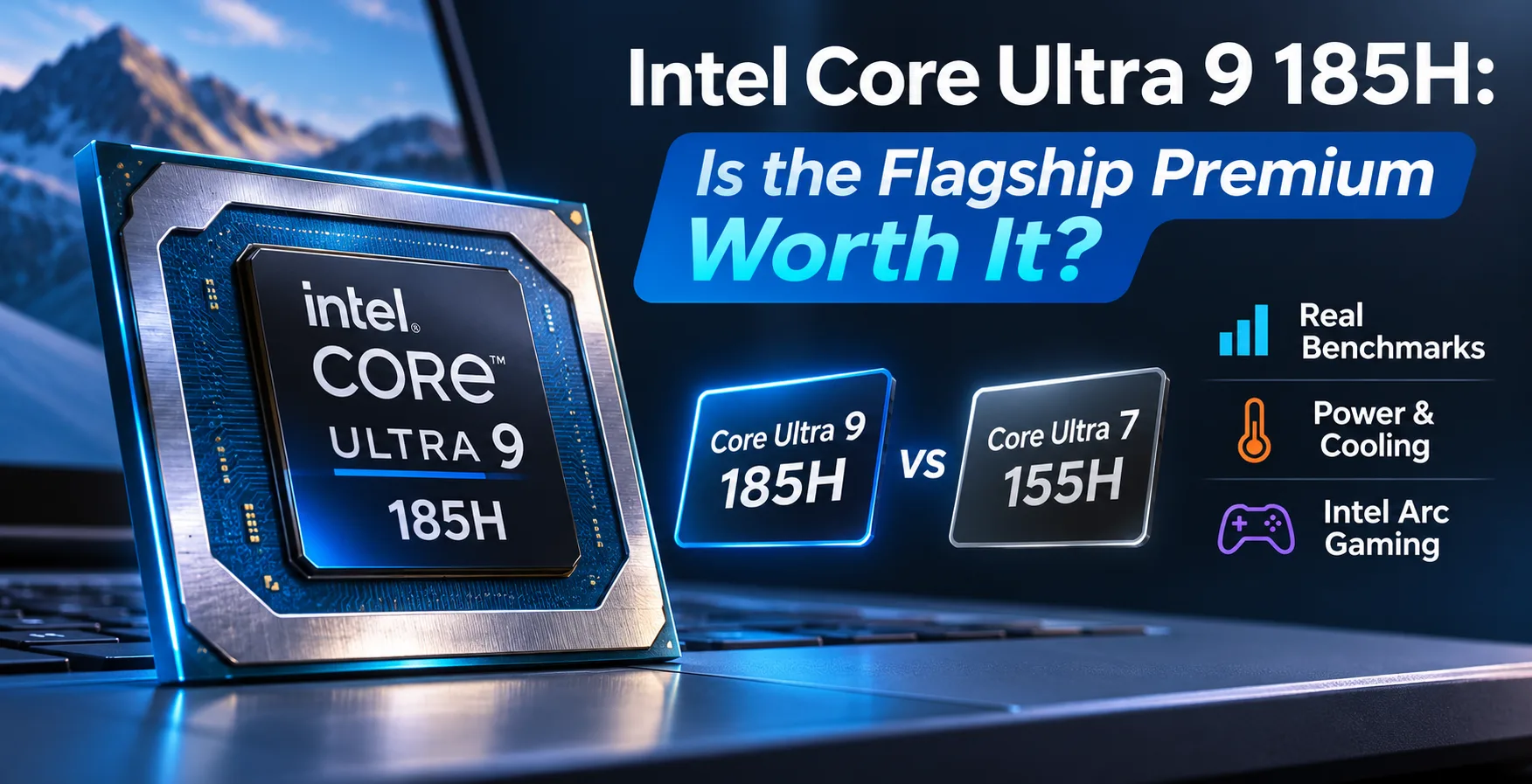
Intel Core Ultra 9 185H: Why Paying Extra for the Flagship Often Isn’t Worth It
The Intel Core Ultra 9 185H is the top-end mobile processor in the Meteor Lake family, introduced in late 2023. It features 16 cores, Arc graphics, and a dedicated neural processor. However, compared with the more affordable Core Ultra 7 155H, it differs mainly in clock speeds, while its advantage in Geekbench 6 is only a few percent. In 2026, the situation has changed even more: laptops with the 185H sell for anywhere from $800-1100 to over $1400. At the lower price, the purchase can be worthwhile; at the higher price, it has to compete with more modern platforms.
Core Ultra 9 vs. Core Ultra 7: What’s the Difference?
The Core Ultra 9 185H and Core Ultra 7 155H use the same configuration: six high-performance Redwood Cove P-cores, eight power-efficient Crestmont E-cores, and two low-power LP E-cores. Both processors have 22 threads and 24 MB of L3 cache.
| Specification | Core Ultra 9 185H | Core Ultra 7 155H |
|---|---|---|
| Maximum P-core frequency | 5.1 GHz | 4.8 GHz |
| Base P-core frequency | 2.3 GHz | 1.4 GHz |
| Base power | 45 W | 28 W |
| Maximum GPU frequency | 2.35 GHz | 2.25 GHz |
The Core Ultra 9’s maximum P-core frequency is 300 MHz higher. The difference in base frequencies is partly related to their different rated power levels-45 W versus 28 W. At the same time, both processors have a maximum turbo power of 115 W.
Architecture and Capabilities
The Core Ultra 9 185H is based on the modular Meteor Lake architecture. The CPU compute block is manufactured using Intel 4, while the graphics and other functional blocks are placed on separate dies.
Key specifications:
- 16 cores and 22 threads;
- 24 MB of L3 cache;
- support for DDR5-5600 and LPDDR5x-7467;
- integrated Intel Arc graphics with eight Xe cores;
- an Intel AI Boost neural processor with performance of up to 11 TOPS.
The Arc graphics support hardware AV1 encoding and decoding. The neural processor accelerates compatible machine-learning workloads, but its 11 TOPS are not enough for Windows features that require Copilot+ PC-class hardware with an NPU delivering at least 40 TOPS.
Geekbench 6 Performance
Results from specific laptops show how small the Core Ultra 9’s advantage can be in short computational tests.
| Laptop | Processor | Single-Core | Multi-Core |
|---|---|---|---|
| Huawei MateBook X Pro 2024 | Core Ultra 9 185H | 2,507 | 13,756 |
| ASUS Zenbook Duo UX8406MA | Core Ultra 9 185H | 2,483 | 13,351 |
| ASUS ZenBook 14 UX3405MA | Core Ultra 7 155H | 2,454 | 12,971 |
| Lenovo ThinkPad X1 Carbon Gen 12 | Core Ultra 7 155H | 2,420 | 12,171 |
| ASUS Zenbook 14 OLED UM3406HA | Ryzen 7 8840HS | 2,552 | 11,279 |
In Geekbench 6.7, the Huawei MateBook X Pro with the Core Ultra 9 outperforms the ASUS ZenBook 14 with the Core Ultra 7 by 2% in the single-core test and 6% in the multi-core test. At the same time, the Ryzen 7 8840HS in the ASUS Zenbook 14 delivers a slightly higher single-core score.
Both Intel processors are fast enough for everyday work, programming, and multitasking. However, Geekbench results do not indicate performance under sustained workloads, where cooling and power limits have a much greater impact.
Sustained Workloads: The Difference Reaches 25% with the Same Processor
On the ASUS Zenbook Duo UX8406MA, Core Ultra 9 185H performance changes significantly when switching between power profiles.
| Mode | Sustained CPU Power | Cinebench R23 Multi |
|---|---|---|
| Whisper | 18 W | 10,852 |
| Standard | 20 W | 12,688 |
| Performance | 35 W | 15,923 |
Switching from Standard to Performance mode increases the score by 25%. At the same time, fan noise rises from 39.4 to 47.8 dB(A).
The difference between the modes on a single Core Ultra 9 is considerably larger than its advantage over the Core Ultra 7 in the Geekbench tests above. As a result, a laptop with a Core Ultra 7 and more effective cooling can be faster than a Core Ultra 9 model operating under strict power limits.
Core Ultra 9 185H vs. Ryzen 7 8840HS
In sustained workloads, the eight-core Ryzen 7 8840HS can outperform the 16-core Core Ultra 9 185H.
In a looping Cinebench R15 Multi test, the Huawei MateBook X Pro with the Intel processor averages 1,990 points with a sustained CPU power limit of around 45 W. The ASUS Zenbook 14 with the Ryzen 7 8840HS reaches 2,166 points with a limit of around 30 W.
In this comparison, the Ryzen laptop is approximately 9% faster despite the processor’s lower power limit.
The results were obtained on different devices, so they cannot be directly extrapolated to all models with these processors. Nevertheless, the test shows that the Core Ultra 9’s advantage in Geekbench does not guarantee leadership under sustained workloads.
Integrated Intel Arc Graphics: Gaming Performance
The Core Ultra 9 185H is equipped with Intel Arc graphics featuring eight Xe cores. They are considerably faster than the Iris Xe graphics of previous generations and make it possible to run many games without a discrete graphics card.
Results from two laptops with the same processor:
| Test | Huawei MateBook X Pro 2024 | ASUS Zenbook Duo UX8406MA |
|---|---|---|
| 3DMark Time Spy Graphics | 3,719 | 3,283 |
| GTA V, 1080p, High | 48.9 FPS | 37.6 FPS |
| The Witcher 3, 1080p, High | 57 FPS | 42 FPS |
In The Witcher 3, the Huawei delivers 36% more frames per second. However, the laptops were tested using different power profiles: Huawei in Performance mode and ASUS in Standard mode. The difference reflects the performance of the specific configurations rather than the superiority of one graphics chip over the other.
Intel Arc is suitable for Dota 2, GTA V, and other relatively undemanding games. In demanding modern titles, you will need to lower the resolution or graphics settings.
If a laptop is equipped with a GeForce RTX 4050 or RTX 4060, its gaming performance will depend much more on the discrete GPU and its power limit than on the choice between the Core Ultra 9 185H and Core Ultra 7 155H.
Is the Core Ultra 9 185H Worth Buying in 2026?
In October 2026, new laptops with the Core Ultra 9 185H are sold at widely varying prices. Some models cost less than $900, while certain business configurations approach $1500.
Examples of offers from U.S. stores:
| Laptop | Processor | RAM / SSD | Display | Price |
|---|---|---|---|---|
| GEEKOM GeekBook M16 | Ultra 9 185H | 16 GB / 512 GB | 16″ IPS | $839 |
| GEEKOM GeekBook X14 Pro | Ultra 9 185H | 32 GB / 1 TB | 14″ OLED | $1,119 |
| Lenovo ThinkBook 16 Gen 8 | Ultra 9 185H | 32 GB / 1 TB | 16″ IPS | $1,463 |
| HP OmniBook 5 | Ryzen AI 7 350 | 32 GB / 1 TB | 16″ IPS Touch | $1,200 |
| ASUS Zenbook 14 UX3405CA | Ultra 9 285H | 32 GB / 1 TB | 14″ OLED | $1,450 |
The prices are listed in USD based on offers from Best Buy, Newegg, and Walmart in October 2026, excluding taxes and shipping. These are individual retail offers rather than average market prices.
At $839, the Core Ultra 9 185H looks attractive. The GEEKOM GeekBook M16 offers a 16-core processor, a large display, and a battery with a capacity of nearly 100 Wh. The main drawback of this configuration is its 16 GB of soldered RAM, which cannot be expanded. That is sufficient for office work and most everyday tasks, but the limitation can become significant when working with large projects.
In the $1,100 range, the GEEKOM GeekBook X14 Pro is interesting. For $1,119, buyers get 32 GB of memory, a 1 TB SSD, and an OLED display. This combination of specifications makes the laptop worth considering even against newer platforms, although cooling quality and battery life need to be evaluated separately.
At $1,400-1500, buying a laptop with the Core Ultra 9 185H already requires strong justification. The Lenovo ThinkBook 16 with 32 GB of memory costs $1,463, while the HP OmniBook 5 with a Ryzen AI 7 350 and the same amount of memory is available for $1,200. AMD provides more powerful AI acceleration, although CPU performance depends on the specific workload.
For $1,450, the ASUS Zenbook 14 with a Core Ultra 9 285H, 32 GB of memory, and an OLED display is also available. For a comparable price, it offers a newer processor architecture and high computational performance. The ThinkBook may have the advantage of its larger display, memory expandability, and business-series features, but the Core Ultra 9 185H itself no longer gives it an edge.
Conclusion
The Core Ultra 9 185H remains a fast processor, but its advantage over the Core Ultra 7 155H is too small to justify a substantial premium. Cooling and power settings often have a greater impact on laptop performance than the difference between the two chips.
In 2026, the Core Ultra 9 185H is primarily attractive in inexpensive configurations. Laptops priced at $800-1100 can offer a good combination of performance and features. At around $1400-1500, competitors with newer Intel Core Ultra and AMD Ryzen AI processors look preferable unless the Meteor Lake model has other significant advantages.
CPU Comparison
Compare Core Ultra 9 185H with other CPUs
Basic
CPU Specifications
Memory Specifications
GPU Specifications
Benchmarks
Compared to Other CPU
Related CPU Comparisons




Share in social media
Or Link To Us
<a href="https://cputronic.com/en/cpu/intel-core-ultra-9-185h" target="_blank">Intel Core Ultra 9 185H</a>