Qualcomm Snapdragon X2 Elite X2E-84-100
Qualcomm Snapdragon X2 Elite X2E-84-100: Strong 12-Core Version with Controversial Positioning in the Lineup
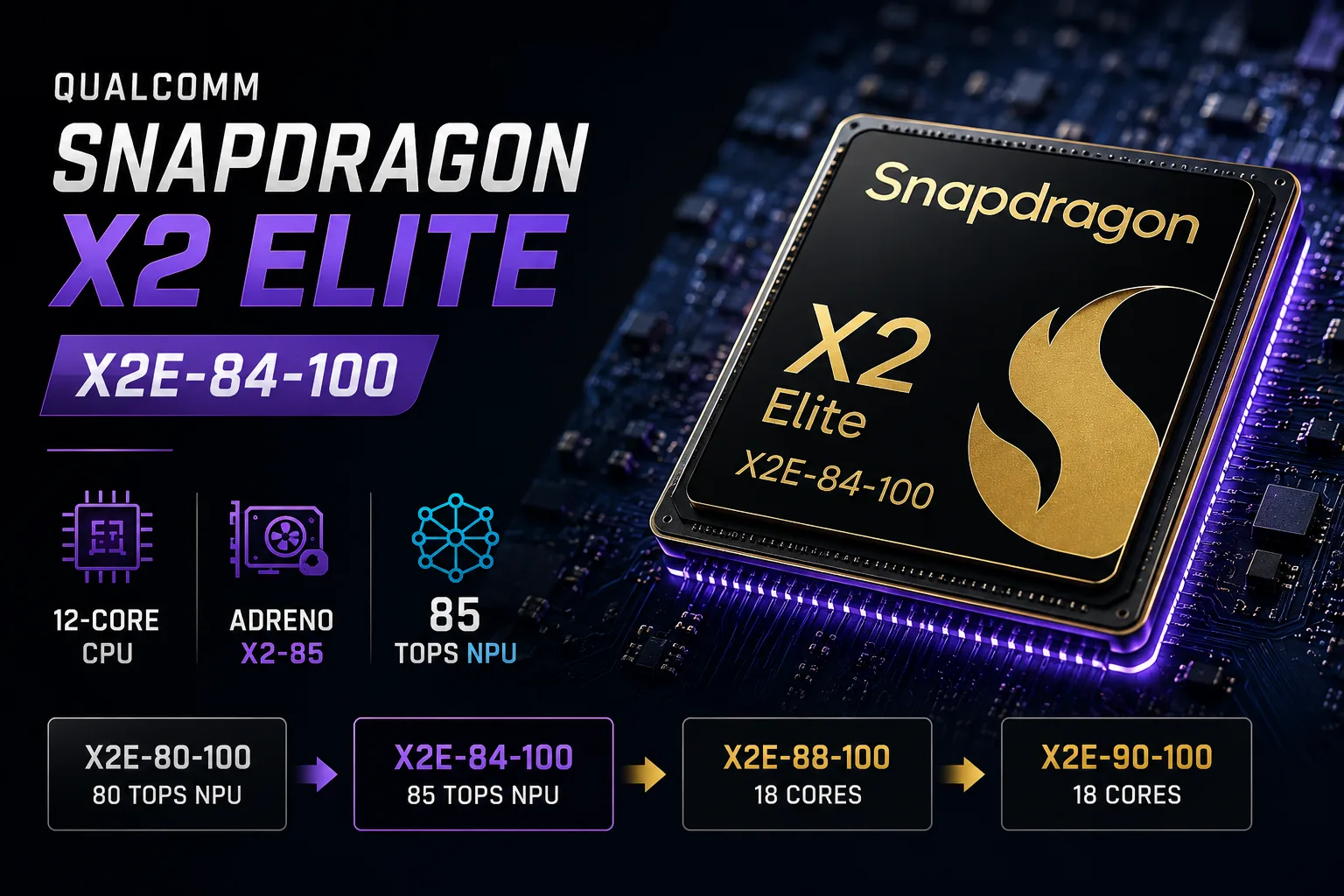
Qualcomm Snapdragon X2 Elite X2E-84-100 is one of the options from the second generation of Snapdragon X Elite for Windows laptops on ARM. It is positioned between the X2E-80-100 and X2E-88-100 in the lineup: it features a 12-core CPU, Adreno X2-85, and an NPU with 85 TOPS, but lacks the 18 cores and Adreno X2-90 graphics.
On paper, the X2E-84-100 looks like a strong 12-core version of Snapdragon X2 Elite. However, its place in the lineup is questionable: it mainly differs from the X2E-80-100 in terms of NPU, while a real upgrade begins only with the X2E-88-100.
Position in the Snapdragon X2 Lineup
The Snapdragon X2 Elite lineup can be confusing due to similar naming and minor differences between neighboring SKUs. The X2E-84-100 sits between the X2E-80-100 and X2E-88-100, but in terms of specifications, it is closer to the X2E-80-100.
| Model | Key Difference |
|---|---|
| Snapdragon X2 Elite X2E-90-100 | 18 cores, 53 MB cache, Adreno X2-90, NPU 85 TOPS |
| Snapdragon X2 Elite X2E-88-100 | 18 cores, 53 MB cache, Adreno X2-90, NPU 80 TOPS |
| Snapdragon X2 Elite X2E-84-100 | 12 cores, 34 MB cache, Adreno X2-85, NPU 85 TOPS |
| Snapdragon X2 Elite X2E-80-100 | 12 cores, 34 MB cache, Adreno X2-85, NPU 80 TOPS |
| Snapdragon X2 Elite X2E-78-100 | 12 cores, lower CPU/GPU frequencies, NPU 80 TOPS |
The weak point of the X2E-84-100 is its positioning next to the X2E-80-100. They share the same number of cores, the same cache size, integrated Adreno X2-85 graphics, and memory bandwidth. The key difference is the NPU: 85 TOPS vs. 80 TOPS.
Thus, choosing the X2E-84-100 over the X2E-80-100 makes sense only when the prices are close and the level of display, memory, SSD, battery, and cooling are the same. In such a case, the X2E-84-100 is more logical as it is a slightly higher SKU with an NPU at 85 TOPS. However, if a laptop with the X2E-80-100 is significantly cheaper, it is usually not worth overpaying just for the additional 5 TOPS.
A real upgrade starts with the X2E-88-100. There, you get 18 cores instead of 12, 53 MB of cache instead of 34 MB, and a more powerful graphics unit, Adreno X2-90. This is not just a cosmetic difference, but a noticeable improvement in CPU and graphics performance. Against this backdrop, the X2E-84-100 appears not as “almost flagship,” but rather as an upper 12-core version with an unclear position in the lineup: it is good at the right price but does not justify a significant surcharge.
CPU and Performance
The X2E-84-100 features 12 cores: 6 Prime cores and 6 Performance cores. The Prime cores can operate at up to 4.7 GHz under single-threaded and dual-threaded loads. Under prolonged stress, performance will be limited by the cooling and power constraints of a specific laptop.
For browsing, office tasks, video calls, light development, and multitasking, this is sufficient. High single-thread performance is crucial for system responsiveness and everyday tasks, while 12 cores provide headroom for parallel tasks. However, for regular rendering, prolonged compilation, heavy editing, and other workloads where the CPU runs all cores for extended periods, the 18-core X2E-88-100 and X2E-90-100 will be more suitable.
That’s why the X2E-84-100 shouldn’t be considered an intermediate step towards the 18-core Snapdragon X2 Elite. In terms of CPU, it remains in the same 12-core class as the X2E-80-100. The difference between them mainly affects AI tasks rather than standard CPU performance.
According to early tests on the Qualcomm Reference Laptop, the X2E-84-100 scores around 3838 points in Geekbench 6.6 Single-Core, approximately 16117 points in Geekbench 6.6 Multi-Core, and about 4609 points in Cinebench 2026 Multi-Core. These figures are useful as a reference but not as a universal evaluation for all laptops with this chip: retail models may vary in cooling, power, and manufacturer settings.
| Test | Approximate Result |
|---|---|
| Geekbench 6.6 Single-Core | around 3800 |
| Geekbench 6.6 Multi-Core | around 16000 |
| Cinebench 2026 Multi-Core | around 4600 |
Graphics and NPU
The graphics are handled by the Adreno X2-85, clocked up to 1.70 GHz. This is sufficient for everyday graphics, video, external displays, and light gaming. However, purchasing the X2E-84-100 as a gaming processor is inadvisable. The limitations are not only due to the power of the iGPU; some games and older software may still perform worse due to compatibility issues, drivers, or emulation in Windows on ARM.
Compared to the higher versions of Snapdragon X2 Elite, it uses Adreno X2-85 rather than Adreno X2-90. If graphical performance is paramount, the X2E-88-100 and X2E-90-100 are better choices. The X2E-84-100 is better viewed as a chip for a thin, versatile laptop rather than as a replacement for a model with a discrete graphics card.
The NPU with 85 TOPS is a plus for this version, but not a standalone reason for a significant premium over the X2E-80-100. It is needed for local AI functions in Windows, image and sound processing, video calls, background AI tasks, and applications that can utilize the NPU. However, the difference between 80 and 85 TOPS is too small to outweigh factors such as price, display, memory, SSD, and battery life of a specific laptop.
Suitable Laptops
The Snapdragon X2 Elite X2E-84-100 is most reasonable in thin laptops where battery life, quiet operation, quick system response, and local AI capabilities are important. This chip is for browsing, documentation, video calls, studying, traveling, and light development with an emphasis on battery operation.
Real configurations with this processor are already available, such as the HP OmniBook Ultra with X2E-84-100, 32 GB LPDDR5x, and a 1 TB SSD. This illustrates the typical class of devices for such a chip: a compact upper-segment laptop rather than a heavy workstation.
Before purchasing, the processor index is not the only important factor. For a laptop on Snapdragon X2 Elite, it is essential to consider memory, SSD size, display, battery, cooling, and compatibility of required software with Windows on ARM. It is especially important to check compatibility for old professional software, games, and specific utilities that may be designed for x86.
For the X2E-84-100, it is advisable not to opt for the minimal configuration. If the laptop is purchased for the long term, 32 GB of RAM will be more practical than 16 GB, as memory is usually soldered and not upgradeable. A 1 TB SSD is also preferable if the device will be used as a primary work laptop.
Conclusion
Qualcomm Snapdragon X2 Elite X2E-84-100 is a strong 12-core version of Snapdragon X2 Elite, but with ambiguous positioning. It primarily differs from the X2E-80-100 in the NPU at 85 TOPS instead of 80 TOPS, so with a significant price difference, the X2E-80-100 becomes more rational.
It makes sense to choose the X2E-84-100 if the laptop with it is priced similarly to the model with X2E-80-100 or if the laptop with X2E-84-100 has better display, memory, SSD, battery, or cooling. A true step up is the X2E-88-100 with 18 cores, larger cache, and Adreno X2-90 graphics. For a thin Windows laptop on ARM, the X2E-84-100 is only favorable at the right price.
CPU Comparison
Compare Snapdragon X2 Elite X2E-84-100 with other CPUs
Basic
CPU Specifications
Memory Specifications
GPU Specifications
AI Specifications
Connectivity
Interfaces and Ports
Miscellaneous
Benchmarks
Compared to Other CPU
Related CPU Comparisons

Share in social media
Or Link To Us
<a href="https://cputronic.com/cpu/qualcomm-snapdragon-x2-elite-x2e-84-100" target="_blank">Qualcomm Snapdragon X2 Elite X2E-84-100</a>