NVIDIA RTX Spark N1X
NVIDIA RTX Spark N1X: First Benchmarks of the 20-Core Arm Chip with Blackwell
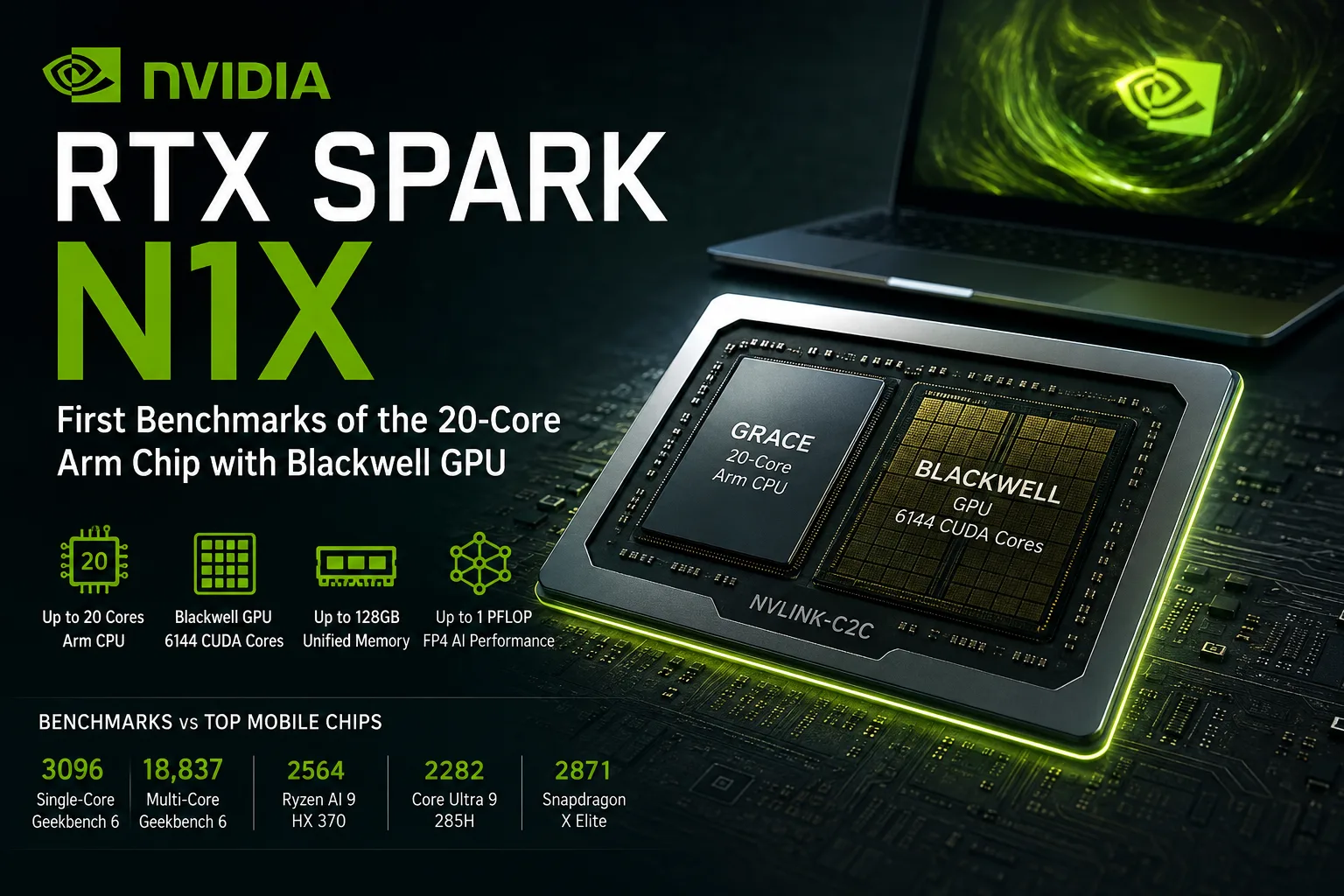
NVIDIA RTX Spark N1X combines a 20-core Arm processor, Grace, with Blackwell graphics featuring 6144 CUDA cores. However, CPU performance is not the main distinction of the platform. The RTX Spark merges Blackwell GPU, CUDA, and up to 128 GB of shared memory, which was previously uncommon for Windows laptops.
| Parameter | NVIDIA RTX Spark N1X |
|---|---|
| CPU | NVIDIA Grace, Arm |
| CPU Cores | Up to 20 |
| GPU | NVIDIA Blackwell RTX |
| CUDA Cores | Up to 6144 |
| Tensor Cores | 5th Generation |
| AI Performance | Up to 1 PFLOP FP4 |
| Memory | Up to 128 GB unified memory |
| CPU-GPU Connection | NVLink-C2C |
The CPU has been developed by NVIDIA in collaboration with MediaTek. The processor and the Blackwell GPU connect via NVLink-C2C and operate with a unified memory pool. NVIDIA claims performance of up to 1 PFLOP in FP4 and the local running of Large Language Models (LLMs) with up to 120 billion parameters.
Initial Benchmarks for RTX Spark N1X: Currently Only Prototypes
There are no production RTX Spark laptops available yet, making it impossible to compare several ready models. The existing results were obtained on an engineering platform from HP and a pre-production Surface Laptop Ultra.
| Device | Benchmark | Single-Core | Multi-Core |
|---|---|---|---|
| HP 83A3, Engineering Platform N1X | Geekbench 6 | 3096 | 18,837 |
| Microsoft Surface Laptop Ultra EV1.5, Prototype | Cinebench 2024 | 123 | 1386 |
The HP engineering system was running Ubuntu 24.04.1 and was equipped with a 20-core N1X and 128 GB of memory. In Geekbench 6, the processor scored 3096 points in single-core performance and 18,837 points in multi-threaded tests. The frequency reached about 4 GHz. These scores cannot yet be considered indicative of the performance of a production N1X.
The prototype Surface Laptop Ultra better demonstrates how the N1X behaves in a laptop case. The pre-production specimen scored 123/1386 points in Cinebench 2024. During prolonged CPU loads, the temperature reached approximately 100 °C, and the CPU power consumption in various modes was around 38-50 W.
N1X vs. Ryzen, Core Ultra, and Snapdragon
The early result of the N1X can be compared with the performance of other mobile processors in Geekbench 6. This is not a direct lab comparison; systems differ in OS, memory, cooling, and power settings. Nevertheless, the numbers allow us to evaluate the performance order of the N1X.
| Processor | Geekbench 6 Single-Core | Geekbench 6 Multi-Core |
|---|---|---|
| NVIDIA N1X, Engineering Platform HP | 3096 | 18,837 |
| AMD Ryzen AI 9 HX 370 | 2564 | 16,265 |
| Intel Core Ultra 9 285H | 2282 | 14,763 |
| Snapdragon X Elite, Dev Kit | 2871 | 14,995 |
If production devices maintain similar results, the N1X will find itself in the upper segment of mobile CPUs. In Multi-Core, the engineering sample scores 18,837 points-higher than the Ryzen AI 9 HX 370, Core Ultra 9 285H, and Snapdragon X Elite listed in the table.
However, a single engineering result is not sufficient to draw conclusions about the performance of production laptops. Final performance will be influenced by power limits, cooling, memory, and driver conditions.
Geekbench 7 results have also emerged: the engineering 20-core RTX Spark scored 2570/23,126 points, while an 18-core version found there achieved 2541/21,776. These values are not directly comparable to Geekbench 6, so they are not included in the main table. NVIDIA has yet to announce a separate production model with 18 CPU cores.
The Main Distinction of N1X - Blackwell and Up to 128 GB of Shared Memory
In its maximum configuration, the N1X features Blackwell GPU with 6144 CUDA cores, fifth-generation Tensor Cores, and access to a shared memory pool of up to 128 GB. The platform also supports CUDA without a separate discrete graphics card.
Why 6144 CUDA Cores Do Not Make N1X an Equivalent of the RTX 5070
The number of CUDA cores in the N1X matches that of the desktop GeForce RTX 5070-also with 6144 Blackwell CUDA cores. However, the same number of compute units does not imply similar performance. The RTX 5070 is a standalone graphics card with 12 GB of GDDR7, a Boost frequency of up to 2.51 GHz, and a power limit of 250 W. In the N1X, the GPU is integrated into the SoC, utilizes shared memory, and shares power and cooling with the 20-core CPU.
Therefore, comparing these solutions solely based on the number of CUDA cores is not accurate. Real performance depends on GPU clock speeds, memory bandwidth, available power, and the cooling capabilities of the specific device.
Unlike mobile discrete GPUs with fixed VRAM volumes, Blackwell in the N1X accesses significantly larger shared memory pools. This is particularly important for the local execution of large language models, working with intensive 3D scenes, and other memory-sensitive tasks.
NVIDIA claims support for LLMs of up to 120 billion parameters, working with 90-gigabyte 3D scenes, and processing 12K video. These are the manufacturer’s assertions; the actual speed of such workloads will need to be verified on production devices.
Windows on Arm: Compatibility Still Matters
The RTX Spark operates within the Windows on Arm ecosystem. Native Arm64 applications run directly on Arm architecture, while many x86 and x64 programs run through Microsoft Prism emulation.
Compatibility on Windows on Arm has improved significantly over the past years: versions available for Chrome, Blender, DaVinci Resolve, and many Microsoft applications already exist in Arm64. Yet, not all limitations have disappeared. Issues can arise with programs and peripherals that require specific x86/x64 drivers, as well as certain games with driver protection systems.
For the RTX Spark, this is a significant factor: high CPU and GPU performance does not guarantee that all familiar Windows software will work as seamlessly as on an x86 laptop. It's advisable to check the compatibility of critical work programs and games before purchasing such a system.
Which Laptops Will Feature RTX Spark
NVIDIA has already named the first models based on RTX Spark: ASUS ProArt P16, Dell XPS 16, HP OmniBook X 14, Lenovo Yoga Pro 9n, Microsoft Surface Laptop Ultra, and MSI Prestige N16 Flip AI+. Compact desktop systems are also in preparation. The release of the first devices is slated for fall 2026.
The performance of the N1X will depend on the power limits and cooling of the specific device. For example, the Surface Laptop Ultra is reported to have a total thermal budget of about 110 W for the RTX Spark. The CPU and GPU share the overall power limit, so the same N1X may show different results in a slim 14-inch laptop versus a larger system with robust cooling.
Conclusion
The RTX Spark N1X stands out not so much for CPU performance but for the configuration of the entire platform. The engineering 20-core N1X already demonstrates upper-tier mobile processor levels in Geekbench 6, but existing tests are still too few, and all were obtained on engineering or pre-production equipment.
The main distinction of the N1X is the Blackwell GPU with 6144 CUDA cores, CUDA, and up to 128 GB of shared memory. However, the identical number of CUDA cores as the RTX 5070 does not imply comparable graphical performance: the mobile SoC operates under entirely different power and memory constraints.
A lingering question remains regarding Windows on Arm. Compatibility is now much better than a few years ago, but for professional software, peripherals, and some games, it should still be checked in advance.
A definitive assessment of the N1X should be made after the release of production Surface Laptop Ultra, ASUS ProArt P16, and other RTX Spark systems. Their tests will demonstrate what kind of performance Blackwell can maintain in a laptop and how beneficial CUDA and a large shared memory pool will be in real-world workloads.
CPU Comparison
Compare RTX Spark N1X with other CPUs
Basic
CPU Specifications
Memory Specifications
GPU Specifications
Benchmarks
Compared to Other CPU
Related CPU Comparisons





Share in social media
Or Link To Us
<a href="https://cputronic.com/cpu/nvidia-rtx-spark-n1x" target="_blank">NVIDIA RTX Spark N1X</a>