Intel Core Ultra 5 115U

Intel Core Ultra 5 115U: Not Much Left from Core Ultra 5
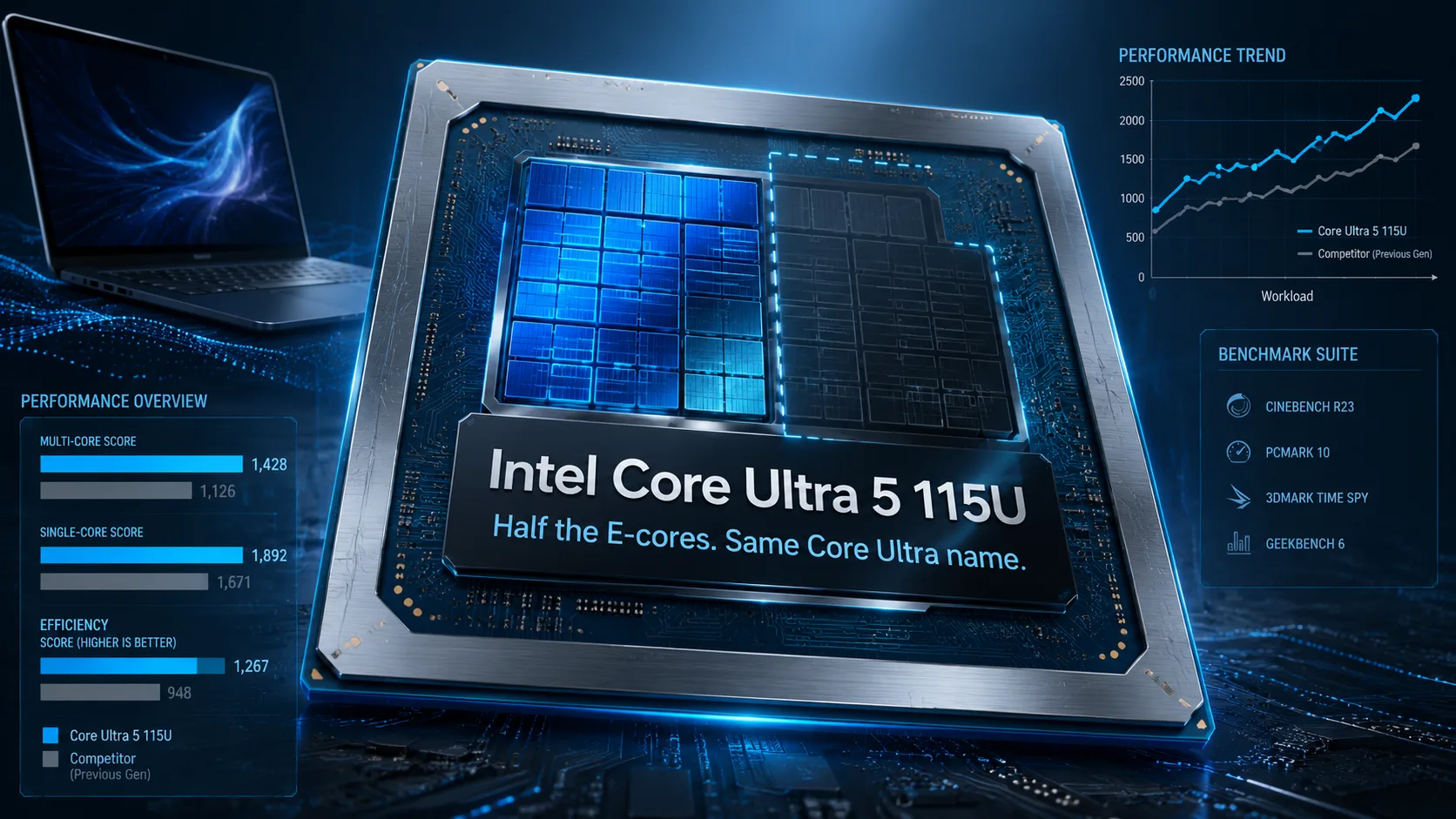
By its name, the Core Ultra 5 115U stands quite close to the 125U. However, the difference in the processor's architecture is much more significant. Intel retained 2 P-cores but reduced the number of E-cores from eight to four. The platform remains modern, but the multi-threaded performance has suffered more than one might expect from the Core Ultra 5.
Where Intel Cut Costs
The Core Ultra 5 115U features 2 performance P-cores, 4 E-cores, and 2 low-power LP E-cores. The Core Ultra 5 125U has eight E-cores.
Intel removed half of the E-cores while making minimal changes to the maximum frequencies.
| Parameter | Core Ultra 5 115U | Core Ultra 5 125U |
|---|---|---|
| Cores / Threads | 8 / 10 | 12 / 14 |
| Configuration | 2P + 4E + 2 LPE | 2P + 8E + 2 LPE |
| Max frequency of P-cores | 4.2 GHz | 4.3 GHz |
| L3 Cache | 10 MB | 12 MB |
| Xe cores (GPU) | 3 | 4 |
| Base Power | 15 W | 15 W |
| Max Turbo Power | 57 W | 57 W |
In single-threaded tests, the 115U keeps close to the higher models in the series. However, during prolonged multi-threaded workloads, the loss of four E-cores becomes quite noticeable.
Performance in Real Laptops
In Geekbench 6, two Windows laptops show nearly identical results.
| Device | Geekbench 6 Single | Geekbench 6 Multi |
|---|---|---|
| Acer Aspire Spin 14 ASP14-52MTN-51V5 | 2096 | 7409 |
| Ninkear S13 16 GB / 1 TB | 2041 | 7440 |
A brief Geekbench does not capture the difference in prolonged power limits.
In Cinebench R23, the difference is massive.
| Device | Long Power Limit | Single Core | Multi Core |
|---|---|---|---|
| Acer Aspire Spin 14 ASP14-52MTN-51V5 | around 28 W | 1518 | 7569 |
| Ninkear S13 | around 15 W | 1523 | 4531 |
Single Core almost does not change, but in Multi Core, Acer is about 67% faster.
At a limit of around 28 W, the Core Ultra 5 115U can achieve over 7500 points in Cinebench R23 Multi. At 15 W, the trimmed configuration drops to 4531 points.
By its name alone, the Core Ultra 5 115U cannot determine the performance of a specific laptop.
The Core Ultra 5 115U is also found in the Acer Chromebook Plus Spin 714, but its Geekbench results should not be compared directly with Windows models due to platform differences.
Integrated Graphics is Also Reduced
The Core Ultra 5 115U uses Intel Graphics built on the Xe-LPG architecture with 3 Xe-cores and a frequency of up to 1.8 GHz. The Core Ultra 5 125U has 4 Xe-cores.
Three Xe-cores are primarily designed for interface, video, and light graphical load. They fall significantly short of the integrated Arc Graphics in the higher Meteor Lake-H.
The media block has suffered less. There is hardware encoding and decoding for AV1, HEVC, and H.264.
NPU Available, But No Longer a Benefit
Intel AI Boost delivers up to 11 TOPS, while the overall claimed AI performance of the platform reaches 21 TOPS.
11 TOPS was a typical result for the first Meteor Lake, but the current NPUs are noticeably faster. The NPU can accelerate supported local functions, but it is no longer a compelling argument for the 115U.
Position of 115U in the Lineup
Even among the Core Ultra Series 1, the 115U model stands out from the overall scheme.
| Processor | Architecture | Configuration |
|---|---|---|
| Core Ultra 5 115U | Meteor Lake | 2P + 4E + 2 LPE |
| Core Ultra 5 125U | Meteor Lake | 2P + 8E + 2 LPE |
| Core Ultra 5 135U | Meteor Lake | 2P + 8E + 2 LPE |
Laptops with the 115U are considerably less common than those with the 125U. It was released alongside the Acer Aspire Spin 14, Acer Chromebook Plus Spin 714, and Ninkear S13.
Laptops and Prices
The main problem with the Core Ultra 5 115U today is the price of devices.
The Acer Aspire Spin 14 with 16 GB LPDDR5X and a 1 TB SSD costs about 999 euros. The Ninkear S13 with 16 GB of memory and a 1 TB SSD is around 859 euros before any temporary discounts.
Laptops with the newer Core Ultra 5 225U start at around 960 euros. It has more cores, higher frequencies, and faster integrated graphics.
The Aspire Spin 14 is a convertible with a touchscreen, while the Ninkear S13 is a Windows tablet with a detachable keyboard. There is also a premium for an unusual form factor.
However, at 900-1000 euros, the Core Ultra 5 115U looks like a weak purchase. If you don’t need a transformer or tablet, it would make more sense to look for a faster processor within that budget.
Conclusion
The 115U features Thunderbolt 4, DDR5/LPDDR5X, a modern media block, and an NPU.
But Intel has significantly cut CPU capabilities compared to the other first-generation Core Ultra 5s. The loss of four E-cores hits a prolonged multi-threaded load particularly hard, and the integrated graphics are weaker than those in the 125U.
A laptop with the 115U can still be justified for around 600-700 euros, especially if it is a good convertible or compact model.
At 900-1000 euros, the unusual screen, case, or form factor must genuinely justify the extra cost.
The Core Ultra 5 115U should only be considered in a well-priced laptop. Paying extra for the Core Ultra label is definitely not worth it.
CPU Comparison
Compare Core Ultra 5 115U with other CPUs
Basic
CPU Specifications
Memory Specifications
Depends on motherboard-5600
GPU Specifications
Interfaces and Ports
Benchmarks
Compared to Other CPU
Related CPU Comparisons


Share in social media
Or Link To Us
<a href="https://cputronic.com/cpu/intel-core-ultra-5-115u" target="_blank">Intel Core Ultra 5 115U</a>