Intel Core 3 304

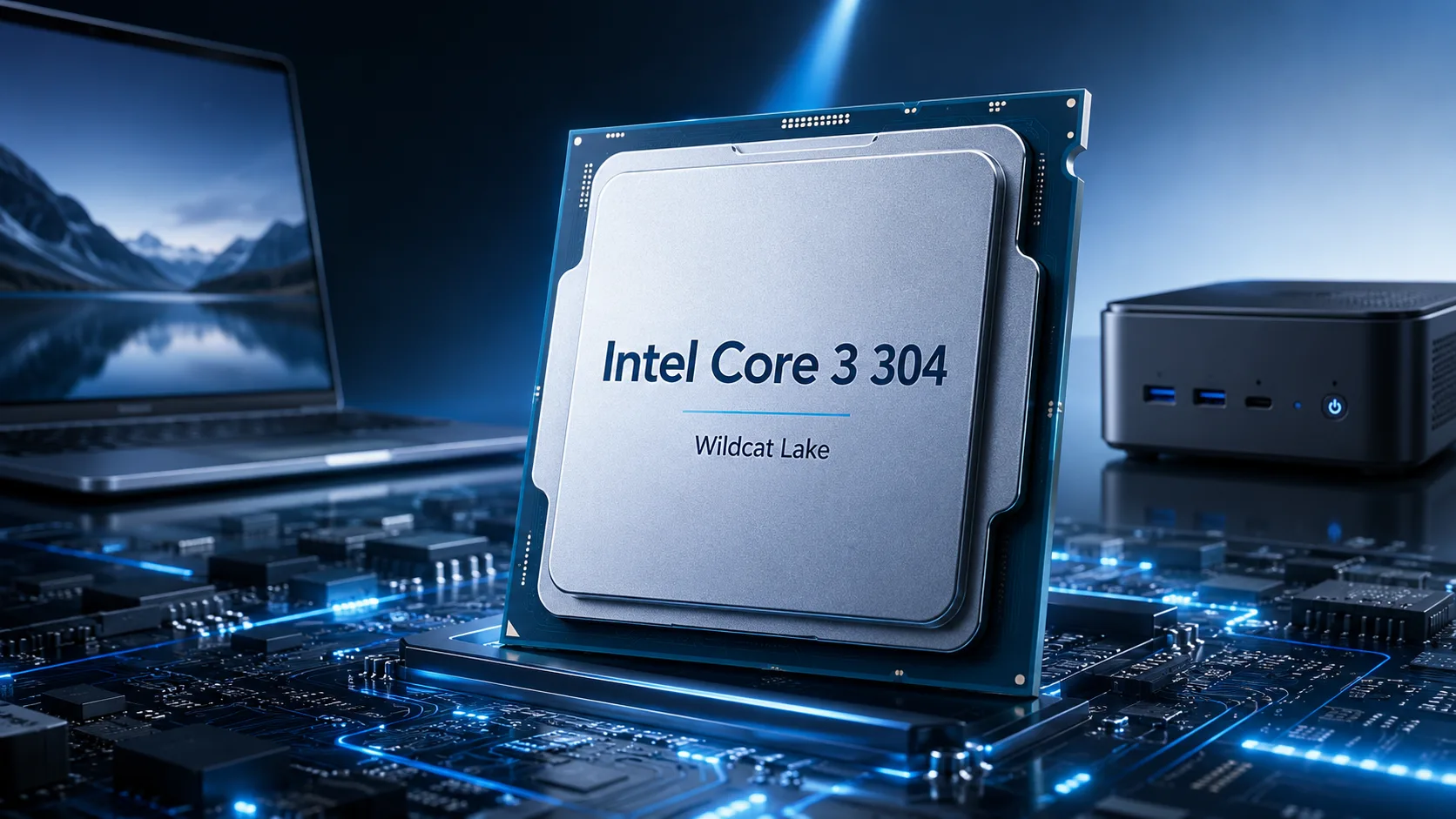
Intel Core 3 304: Faster than the N-series, but with just one P-core
The Intel Core 3 304 is the base mobile model of the Wildcat Lake family. The processor combines one powerful P-core and four energy-efficient LP E-cores, resulting in five cores and five threads. It is designed for budget laptops, mini-PCs, and compact office systems.
The Core 3 304 stands above the Intel N150 and N250. The modern P-core significantly accelerates application launches, webpage processing, and other short tasks. However, under sustained multithreaded loads, the configuration with a single P-core quickly hits its limits.
Benchmark Performance
Available results were obtained on various platforms. Geekbench 6 ran on a reference Intel system, while Cinebench R23, PCMark 10, and graphics tests were conducted on the production mini-PC Beelink EQi with 16 GB of LPDDR5-6400.
| Benchmark | Result | Device |
|---|---|---|
| Geekbench 6 Single-Core | 2472 | Intel Wildcat Lake Client Platform, RVP2 |
| Geekbench 6 Multi-Core | 6708 | Intel Wildcat Lake Client Platform, RVP2 |
| Cinebench R23 Single-Core | 1732 | Beelink EQi |
| Cinebench R23 Multi-Core | 4863 | Beelink EQi |
| PCMark 10 | 5294 | Beelink EQi |
| PassMark CPU Mark | 11,371 | Beelink EQi |
| 3DMark Fire Strike | 1940 | Beelink EQi |
| Unigine Heaven 4.0, 1080p | 495 points, 19.6 FPS | Beelink EQi |
In Geekbench 6, the processor scored 2472 points in single-core and 6708 points in multithreading. The first metric is particularly important for this model: a single fast P-core ensures good system responsiveness when launching applications, browsing the web, and performing office tasks.
In Cinebench R23, the Beelink EQi mini-PC scored 1732 and 4863 points. The single-threaded result is convincing for the entry-level category, but the multithreaded score is noticeably weaker than those of modern Core i5 and Ryzen 5 processors.
The average score for the Core 3 304 in the PassMark database is about 11,700 CPU Mark points and 3600 points in the single-thread test. This confirms the same trend: the processor excels at short sequential tasks but is limited when all cores are fully loaded.
In tests, the Core 3 304 significantly outperformed the Intel N100 and Core i3-N305 in single-core speed. However, in the multithreaded Cinebench R23, the advantage over the eight-core Core i3-N305 was much smaller. The four LP E-cores handle background processes but do not replace a second full-fledged P-core.
Everyday Work
In an office or home system, the Core 3 304 confidently manages web browsing, documents, spreadsheets, video calls, and high-resolution video playback. Its application launch speed and interface responsiveness are notably better than those of Intel's N-series models.
However, multitasking remains limited. Simultaneous video conferencing, several heavy web applications, system updates, and resource-intensive programs can almost fully load the processor.
For a Windows laptop, it is advisable to choose a configuration with at least 16 GB of RAM. In models with 8 GB, the memory can become the main bottleneck before the processor.
Heavy editing, prolonged rendering, compiling large projects, and processing large datasets are not its tasks. For such workloads, it is better to look at Core i5 or Ryzen 5 with multiple performance cores.
Integrated Graphics
The Core 3 304 features Intel Xe3 graphics with one Xe-core. In the 3DMark Fire Strike test, the Beelink EQi mini-PC scored 1940 points-higher than systems with the Intel N100 and Core i3-N305 but significantly lower than modern integrated Radeon graphics and higher versions of Intel Graphics.
The graphics are sufficient for the Windows interface, hardware-accelerated video decoding, connecting multiple monitors, and low-demand gaming. Older titles can be run at reduced resolution and minimum settings, but modern demanding games remain outside its capabilities.
The graphics are limited not only by the single Xe-core but also by the single-channel memory. For an integrated GPU, bandwidth is particularly important, so even a high frequency for the graphics unit doesn’t compensate for the narrow memory bus.
NPU and AI Features
The built-in Intel AI Boost provides up to 15 TOPS, while the graphics block can offer an additional 9 TOPS. The NPU can be useful for noise cancellation, background blurring, camera processing, and other local app functions.
For image generation, running large language models, and heavy video processing, the Core 3 304 is not designed. The NPU's performance is insufficient for the demands of Copilot+ PC, and the weak graphics further limit local AI tasks.
Devices with Intel Core 3 304
| Device | Format and Configuration |
|---|---|
| CHUWI UniBook | 14-inch laptop, 8 GB LPDDR5, 256 GB SSD, 1920 × 1200 screen |
| Lenovo IdeaPad Slim 3 15IWC11 | 15.3-inch laptop, up to 32 GB DDR5 |
| HP ProBook 4 G2i | Business laptop available in 14 and 16-inch screen versions |
| Beelink EQi Wildcat Lake | Mini-PC with 16-32 GB RAM, two M.2 slots, and fast network interfaces |
The Core 3 304 is found in both budget home models and business laptops. For a typical office computer, its performance is sufficient, but the configuration should be assessed as a whole.
A model with 8 GB of non-upgradable memory and a small SSD will be significantly less practical than a device with 16 GB of RAM. In mini-PCs, cooling quality, availability of storage slots, and network interfaces are also essential.
Power Consumption and Cooling
The base power of the Core 3 304 is 15 W, with a short-term limit of 35 W. The processor can be installed in both thin laptops and compact desktop systems.
In mini-PCs with active cooling, it can maintain high frequencies for longer. A thin laptop may lower power limits for quietness and battery life, so results from two devices with the same processor can sometimes vary significantly.
Manufacturer settings, in particular, greatly influence prolonged multithreaded loads. In regular office work, the difference between devices will be less noticeable.
Conclusion
The Intel Core 3 304 is a significant step forward compared to the N100, N150, and N250. One modern P-core provides high speed for short tasks, while four LP E-cores handle background processes.
The main limitations remain five threads, single-channel memory, and graphics with one Xe-core. The processor is suitable for office work, studying, browsing, video calls, and multimedia, but it is not designed for heavy editing, rendering, or modern gaming.
The optimal configuration for the Core 3 304 is a device with 16 GB of memory and a decent SSD. In this form, it is notably more practical than N-series models, although it still falls behind full-fledged Core i5 and Ryzen 5 in terms of multithreading and graphics performance.
CPU Comparison
Compare Core 3 304 with other CPUs
Basic
CPU Specifications
Memory Specifications
Up to DDR5 6400 MT/s
GPU Specifications
AI Specifications
Interfaces and Ports
Miscellaneous
Benchmarks
Compared to Other CPU
Related CPU Comparisons


Share in social media
Or Link To Us
<a href="https://cputronic.com/cpu/intel-core-3-304" target="_blank">Intel Core 3 304</a>