AMD Ryzen AI 7 445
AMD Ryzen AI 7 445: AI is present, but the Ryzen 7 level is questionable
The AMD Ryzen AI 7 445 formally belongs to the Ryzen AI 7 class: it features a Zen 5 architecture, a dedicated NPU for AI tasks, and supports Copilot+ PC. However, in terms of configuration, it is not a direct replacement for the Ryzen 7 7840U or Ryzen 7 8840U. AMD has equipped the new chip with a strong neural processor but limited the number of cores, cache size, and integrated graphics.
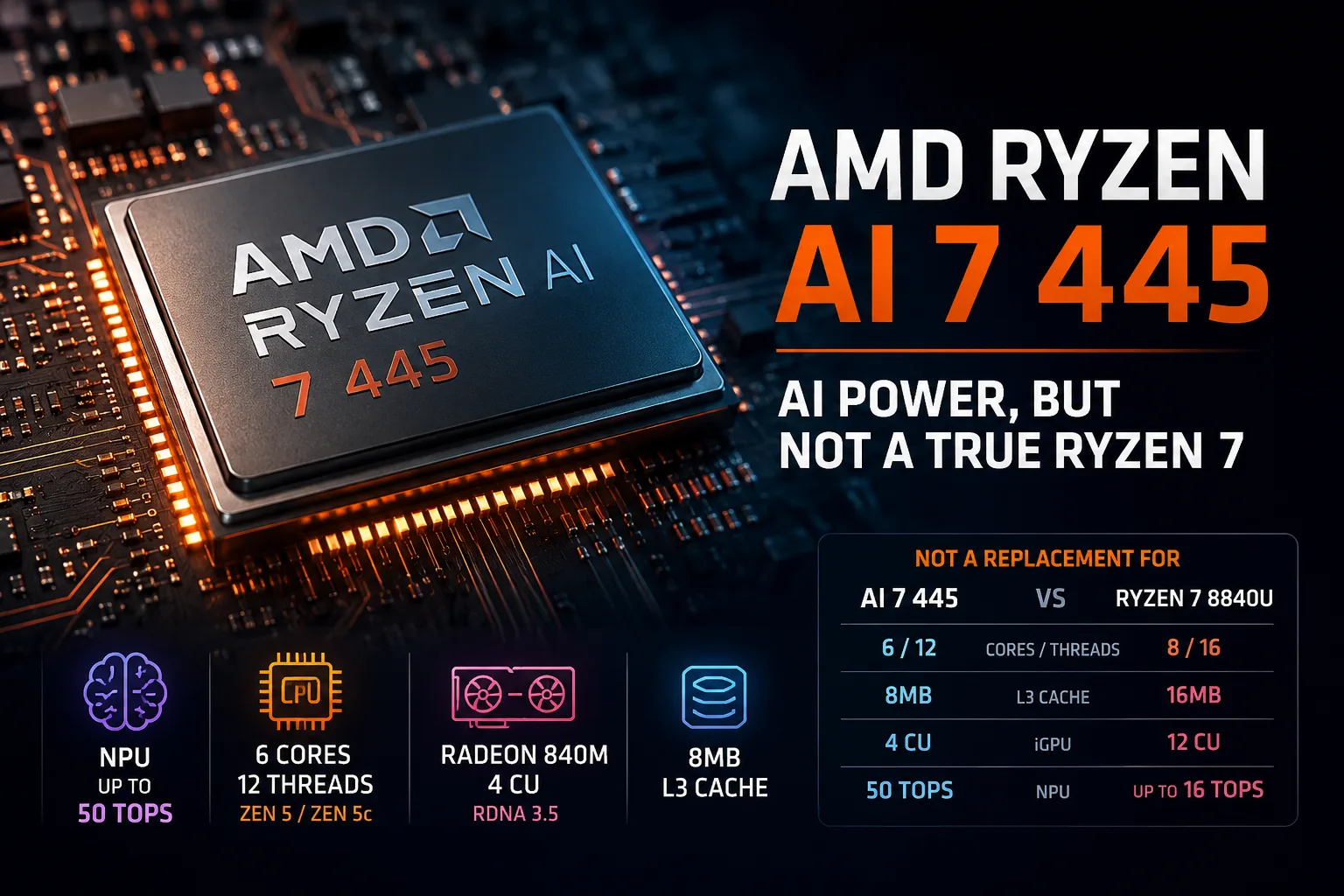
Inside the Ryzen AI 7 445 are 6 cores and 12 threads: 2 high-performance Zen 5 cores and 4 compact Zen 5c cores. The maximum frequency reaches 4.6 GHz, L3 cache size is 8 MB, and the default thermal design power is 28 W with a range of 15-54 W. Graphics are handled by the Radeon 840M with 4 RDNA 3.5 graphics cores. The main advantage of the processor is the NPU with up to 50 TOPS. This is the key difference between the Ryzen AI 7 445 and older mobile Ryzen processors.
New NPU instead of the familiar Ryzen 7 level
The main question regarding the Ryzen AI 7 445 is its positioning. The older Ryzen 7 7840U and Ryzen 7 8840U were 8-core processors with 16 threads, 16 MB of L3 cache, and strong integrated graphics in the form of the Radeon 780M. The new Ryzen AI 7 445 has fewer cores, less cache, and noticeably simpler integrated graphics.
In AI tasks, the new chip is stronger: the NPU at 50 TOPS is significantly more powerful than the neural block of the Ryzen 7 8840U. However, in multi-threaded applications and games using integrated graphics, the older Ryzen 7 7840U and 8840U can be faster due to their 8 cores, 16 MB of L3 cache, and Radeon 780M.
| Processor | CPU | L3 | iGPU | NPU | Comparison Overview |
|---|---|---|---|---|---|
| Ryzen AI 7 445 | 6/12 | 8 MB | Radeon 840M, 4 CU | 50 TOPS | Strong NPU; CPU/iGPU closer to mid-range |
| Ryzen 7 8840U | 8/16 | 16 MB | Radeon 780M, 12 CU | up to 16 TOPS | Older but more powerful in CPU/GPU |
| Ryzen 7 7840U | 8/16 | 16 MB | Radeon 780M, 12 CU | up to 10 TOPS | Strong older Ryzen 7 with no new AI focus |
| Ryzen 5 7640U | 6/12 | 16 MB | Radeon 760M, 8 CU | up to 10 TOPS | Closer to 445 in CPU class |
| Ryzen AI 7 350 | 8/16 | 16 MB | Radeon 860M, 8 CU | 50 TOPS | More complete Ryzen AI 7 |
The table shows the main point: the Ryzen AI 7 445 should not be evaluated as a high-end Ryzen 7 but as a mainstream chip for laptops featuring Copilot+ PC. In terms of CPU, it is closer to Ryzen 5, while its graphics performance lags behind even some older 6-core AMD models.
Why the Ryzen AI 7 445 is closer to Ryzen 5
In terms of configuration, the Ryzen AI 7 445 is more akin to mainstream 6-core models than to the older Ryzen 7s. With 6 cores, 12 threads, 8 MB of L3 cache, and a Radeon 840M, it fits the profile of a typical thin laptop rather than a high-end mobile Ryzen.
The older Ryzen 5 7640U also has 6 cores and 12 threads, but it has 16 MB of L3 cache and a Radeon 760M with 8 graphics cores. Therefore, even the previous generation Ryzen 5 can appear stronger in tasks where integrated graphics or cache size are important. The advantage of the Ryzen AI 7 445 lies elsewhere: it supports modern AI features in Windows and meets the requirements for Copilot+ PC.
The Ryzen AI 7 445 is appropriate for office and educational laptops: web browsing, document handling, video conferencing, light photo editing, and local Windows AI functions. For gaming on integrated graphics, heavy video editing, rendering, and extended multi-threaded workloads, it's better to consider the Ryzen 7 7840U, Ryzen 7 8840U, Ryzen AI 7 350/450, or models with discrete graphics.
Performance: everyday level, not a replacement for 8-core Ryzen 7
Initial benchmarks confirm this positioning. In the Asus Vivobook 14, the Ryzen AI 7 445 scored around 2600 points in Geekbench 6 Single-Core and about 9000 points in Multi-Core. For an everyday laptop, this is sufficient: browsing, office applications, and regular multitasking run smoothly without taxing the processor too much.
However, multi-threaded performance is limited by the 6-core configuration. The Ryzen AI 7 445 does not appear to be a processor that can replace the 8-core Ryzen 7 processors of the previous generation. In short bursts of workload, the strong Zen 5 core helps, but with full load across all threads, the 8-core AMD models maintain an advantage.
The limitations of the integrated graphics are even more pronounced. The Radeon 840M with 4 CU is significantly weaker than the Radeon 780M with 12 CU. It is suitable for the interface, video, simple games, and less demanding online projects. However, if older Ryzen 7s were purchased for their strong iGPU, the Ryzen AI 7 445 represents a step back.
Intel Competitors: Lunar Lake Stronger in Integrated Graphics
The main competitor from Intel is the Core Ultra 7 256V. This is a mobile Lunar Lake processor for thin laptops: 8 cores, 8 threads, an NPU around 47 TOPS, and integrated Arc 140V graphics. In terms of the AI block, it is similar to the Ryzen AI 7 445, but the Arc 140V significantly outperforms the Radeon 840M in graphics tests.
This shifts the usual balance: integrated graphics have often been a strong point for Ryzen, but the Radeon 840M with 4 CU does not compete equally with the Arc 140V. Therefore, the Core Ultra 7 256V may be a more dangerous option as a complete platform for a thin laptop, particularly if battery life and integrated graphics are priorities.
The more affordable Core Ultra 5 226V is also worth comparing. It features a modern NPU, integrated Arc 130V graphics, and the same focus on thin AI laptops. In this class, buyers will evaluate not just the processor, but the entire laptop: screen, battery, cooling, price, and memory capacity.
Apple as a benchmark, not a direct competitor
The Apple M4 and M5 chips are not direct competitors to the Ryzen AI 7 445: different OS, different architecture, and a different memory approach. However, for buyers of thin laptops, comparisons still arise. The MacBook Air offers a strong CPU/GPU component, good battery life, and stable performance in a thin chassis. The Ryzen AI 7 445 responds with Windows, x86 compatibility, Copilot+ PC, and the potential for more affordable models. If a Windows laptop is needed, the Ryzen AI 7 445 should be evaluated based on the specific model's price. If the platform is not critical, comparisons should focus on complete laptops rather than just processors.
Conclusion
The AMD Ryzen AI 7 445 should be seen not as a fast new Ryzen 7, but as a lower-tier AI chip for Ryzen AI 400 laptops. Its strengths lie in the NPU at 50 TOPS and support for Copilot+ PC. Its weaknesses are the 6 cores, 8 MB of L3 cache, and Radeon 840M with 4 CU.
A laptop based on the Ryzen AI 7 445 makes sense only at a significantly lower price than models based on Ryzen AI 7 350/450 or older laptops with Ryzen 7 7840U/8840U. For browsing, document handling, video conferencing, and studying, it is sufficient. However, for multi-threaded work and gaming on integrated graphics, older 8-core Ryzen 7s may still outperform it, despite their age.
The key is not to expect the Ryzen AI 7 445 to match the performance level of older Ryzen 7s. This is a processor for accessible AI laptops, not a universal upgrade in CPU and graphics.
CPU Comparison
Compare Ryzen AI 7 445 with other CPUs
Basic
CPU Specifications
Memory Specifications
GPU Specifications
Miscellaneous
Benchmarks
Compared to Other CPU
Related CPU Comparisons



Share in social media
Or Link To Us
<a href="https://cputronic.com/cpu/amd-ryzen-ai-7-445" target="_blank">AMD Ryzen AI 7 445</a>