AMD Ryzen AI 7 445
vs
AMD Ryzen AI 7 350
CPU Comparison Result
AMD Ryzen AI 7 445 vs Ryzen AI 7 350: Newer Doesn't Mean Faster
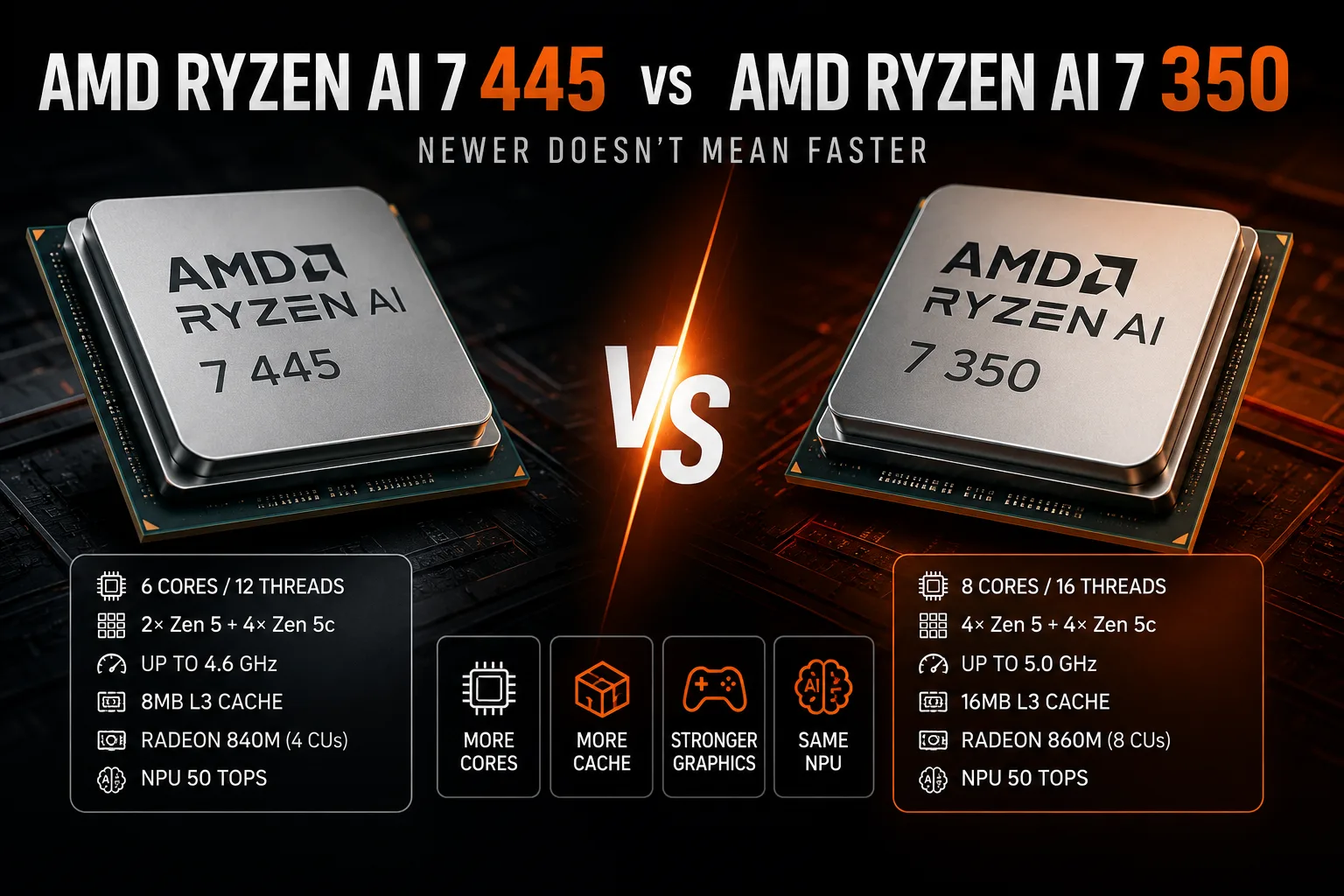
By its model number, the Ryzen AI 7 445 can be seen as a successor to the Ryzen AI 7 350. However, the new chip has six cores instead of eight, half the L3 cache, and a Radeon 840M instead of the more powerful Radeon 860M.
The Ryzen AI 7 445 was released a year later, but at a comparable price, the Ryzen AI 7 350 appears to be a better deal: it has more processor cores and significantly more powerful integrated graphics.
Ryzen AI 7 445 Is Newer but Much Simpler
Both processors feature Zen 5 and Zen 5c cores. The Ryzen AI 7 350 has eight cores-four of each type. The Ryzen AI 7 445 has two Zen 5 cores and four Zen 5c cores, totaling six.
| Characteristic | Ryzen AI 7 445 | Ryzen AI 7 350 |
|---|---|---|
| Cores and Threads | 6 / 12 | 8 / 16 |
| Configuration | 2 × Zen 5 + 4 × Zen 5c | 4 × Zen 5 + 4 × Zen 5c |
| Max Frequency | 4.6 GHz | 5.0 GHz |
| L3 Cache | 8 MB | 16 MB |
| Integrated Graphics | Radeon 840M | Radeon 860M |
| Graphics Units | 4 | 8 |
| NPU | 50 TOPS | 50 TOPS |
The index 445 indicates a new generation but does not imply superiority over model 350. By core count, cache, and graphics units, this is more of a lower-tier solution in the Ryzen AI 400 series.
Ryzen AI 7 350 is More Powerful in the CPU Department
The advantage of the Ryzen AI 7 350 goes beyond the additional two cores: it has four Zen 5 cores instead of two, a boost frequency of up to 5.0 GHz, and 16 MB of L3 cache instead of 8 MB.
In browsing, office applications, and video playback, the difference will be minimal. The advantage of the Ryzen AI 7 350 is more significant in long-term multi-threaded workloads:
- during video rendering and encoding;
- when compiling large projects;
- under heavy multitasking.
For general use, the Ryzen AI 7 445 is sufficient, but the Ryzen AI 7 350 is better suited for rendering, compiling, and simultaneously running several demanding applications.
The Main Gap Is in Integrated Graphics
The Radeon 860M features eight graphics units, while the Radeon 840M has four. Their frequencies are nearly identical: 3.0 and 2.9 GHz. Nearly identical frequencies do not make up for the twofold difference in the number of compute units.
For a laptop without a discrete graphics card, this is more important than the difference in processor cores. The Radeon 860M is better suited for casual gaming, video editing, and GPU-accelerated applications.
The Radeon 840M is suitable for everyday tasks, video, and less demanding graphical programs, but in gaming, it will often require reduced settings and resolution. The main limitation of the Ryzen AI 7 445 remains the integrated graphics.
At comparable prices and configurations, a laptop with the Ryzen AI 7 350 is significantly better for gaming without a discrete graphics card.
NPU Is the Same for Both Processors
Both processors are equipped with an NPU with a performance of 50 TOPS, so in neural workloads, the Ryzen AI 7 445 is not faster.
In terms of overall AI performance, the Ryzen AI 7 350 also leads: 66 compared to 59 TOPS, thanks to the more powerful CPU cores and integrated graphics. It doesn't make sense to pay extra for the Ryzen AI 7 445 just for a newer model number or localized AI functions.
What to Choose
At comparable prices, it makes sense to choose the Ryzen AI 7 350: it is faster in the CPU department and significantly stronger in integrated graphics.
The Ryzen AI 7 445 is justified if the laptop with it is significantly cheaper or better in terms of display, construction, battery life, and cooling system. For documents, browsing, video calls, and regular multitasking, its capabilities are sufficient.
Conclusion: The Ryzen AI 7 445 belongs to a newer series but does not replace the Ryzen AI 7 350 in terms of performance. Model 350 is more advantageous due to its eight cores and Radeon 860M. The Ryzen AI 7 445 should only be chosen for a significantly cheaper or better-equipped laptop.
Advantages
- Newer Launch Date: January 2026 (January 2026 vs February 2025)
- More Total Cores: 8 (6 vs 8)
- Higher Max Turbo Frequency: Up to 5 GHz (Up to 4.6 GHz vs Up to 5 GHz)
- Larger L3 Cache: 16 MB (8 MB vs 16 MB)
Basic
CPU Specifications
Memory Specifications
GPU Specifications
Miscellaneous
Benchmarks
Related CPU Comparisons






Share in social media
Or Link To Us
<a href="https://cputronic.com/cpu/compare/amd-ryzen-ai-7-445-vs-amd-ryzen-ai-7-350" target="_blank">AMD Ryzen AI 7 445 vs AMD Ryzen AI 7 350</a>