AMD Ryzen AI 9 HX 470
AMD Ryzen AI 9 HX 470: almost the same as the HX 370, but in a new lineup
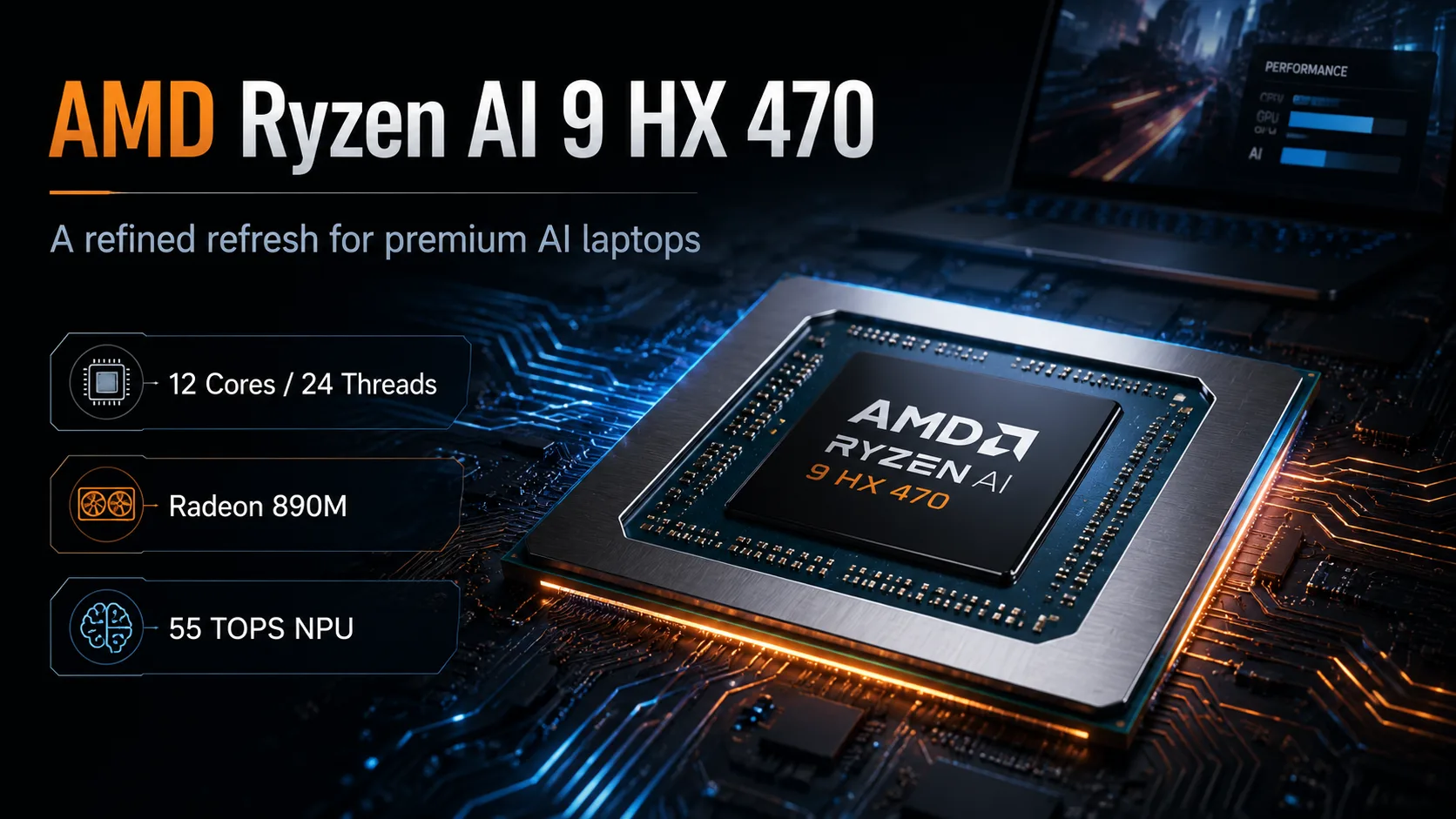
The Ryzen AI 9 HX 470 appears to be a new high-end model from AMD, but it is technically close to the Ryzen AI 9 HX 370/HX 375. The foundation is the same: 12 Zen 5/Zen 5c cores, 24 threads, Radeon 890M, and a Copilot+ PC-level NPU. The differences boil down to slightly increased base frequencies, support for faster memory, and an updated position in the Ryzen AI 400 lineup.
Thus, the main question is not how much faster the HX 470 is compared to the HX 370. The gain there is minimal. More important is how competitive this platform remains against Intel's Panther Lake and Apple's M5 Pro. Here, AMD still holds strong, especially in Windows laptops without a discrete graphics card.
Specifications of the Ryzen AI 9 HX 470
The Ryzen AI 9 HX 470 belongs to the Ryzen AI 400 series. It employs a hybrid architecture with 4 Zen 5 cores and 8 compact Zen 5c cores, totaling 12 cores and 24 threads. The maximum frequency reaches 5.2 GHz, the L3 cache is 24 MB, and the configurable TDP ranges from 15 to 54 W.
The integrated graphics is the Radeon 890M. This is not just a supplemental GPU but one of the main components of the platform. It features 16 RDNA 3.5 compute units and a frequency of up to 3.1 GHz. It is precisely the iGPU that makes the HX 470 particularly significant for laptops without a discrete graphics card.
The NPU delivers up to 55 TOPS, thus surpassing the Copilot+ PC threshold. The overall AI performance of the platform is rated up to 86 TOPS. The higher-end Ryzen AI 9 HX 475 primarily differs by having a 60 TOPS NPU. In terms of CPU and graphics, the difference between the HX 470 and HX 475 is minimal.
| Processor | Cores / Threads | Graphics | NPU | Position |
|---|---|---|---|---|
| Ryzen AI 9 HX 475 | 12 / 24 | Radeon 890M | 60 TOPS | High-end model in Ryzen AI 400 |
| Ryzen AI 9 HX 470 | 12 / 24 | Radeon 890M | 55 TOPS | Model below HX 475 |
| Ryzen AI 9 465 | 10 / 20 | Radeon 880M | 50 TOPS | Below in CPU and iGPU |
| Ryzen AI 7 / AI 5 | Up to 8 cores | Weaker than 890M | Lower | Mass market |
HX 470 vs HX 370: the difference exists, but it's small
The closest models in architecture to the Ryzen AI 9 HX 470 are the Ryzen AI 9 HX 370 and HX 375. They have the same platform configuration: hybrid Zen 5/Zen 5c cores, 12 cores, 24 threads, integrated Radeon 890M graphics, and a strong NPU.
The HX 470 has a higher maximum CPU frequency, a higher iGPU frequency, and supports faster LPDDR5x-8533 memory. On paper, this looks like a neat platform update, not a shift to a new generation.
Therefore, upgrading from HX 370 or HX 375 to HX 470 for just the processor seems of little value. The difference will depend on the specific laptop: cooling, power limits, memory, and manufacturer settings. In one case, the HX 470 may be faster; in another, it may not differ much from the older Ryzen AI 300.
The HX 470 is better considered as a foundation for new laptops rather than as a reason to urgently replace last year's Ryzen AI.
After Ryzen 7040 and 8040, the difference is more noticeable
Against the backdrop of Ryzen 7040 and Ryzen 8040, the shift to HX 470 appears more convincing. For instance, the Ryzen 9 7940HS and Ryzen 9 8945HS were 8-core Zen 4 processors with Radeon 780M graphics. For its time, this was a strong mobile platform, but the HX 470 offers greater core counts, a new architecture, faster iGPU, and a separate NPU.
It has 12 cores instead of 8, Zen 5/Zen 5c architecture instead of Zen 4, Radeon 890M graphics instead of Radeon 780M, and an NPU exceeding the Copilot+ PC threshold. Therefore, owners of laptops with Ryzen 7040/8040 gain not just a slight frequency boost, but a transition to a different class of AMD mobile APU.
The difference is especially noticeable in laptops without a discrete graphics card. Radeon 780M remains viable for light tasks but lags behind the Radeon 890M. If the laptop is used as a primary work and home machine, the transition to HX 470 already appears justified.
Benchmarks: high performance without aiming for absolute records
According to early public results, the Ryzen AI 9 HX 470 ranks at the top of AMD's mobile segment. In PassMark, it shows around 37,000 CPU Mark points, and in Geekbench 6, scores are around 3,000 points in Single-Core and about 16,000 in Multi-Core.
This is a high level for a mobile processor with a configurable TDP of up to 54 W, but the results depend on the specific laptop. In a thin model with strict limits, the HX 470 will throttle down frequencies sooner. In a larger system with normal cooling, it can maintain high performance for longer.
The main takeaway from the benchmarks is that the HX 470 is a high-performance high-end mobile Ryzen, but its strength does not lie in peak benchmark results. It is interesting as a balanced platform: fast CPU, Radeon 890M, a 55 TOPS NPU, and a configurable TDP of up to 54 W. If maximum multi-threaded performance is needed at any cost, it’s better to look at heftier H/HX platforms and laptops with discrete graphics.
Main competitor Intel - Panther Lake, not Lunar Lake
Comparing with Intel Core Ultra 9 288V is convenient for AMD but not the main focus anymore. Lunar Lake was important for thin AI laptops: good battery life, Arc 140V graphics, 48 TOPS NPU. But its CPU part is limited to 8 cores without Hyper-Threading; thus, in multi-threaded tasks, it lags behind the Ryzen AI 9 HX 470.
Much more important is the Intel Core Ultra X9 388H on Panther Lake. This is a new competitor for expensive Windows laptops without discrete graphics. It features 16 cores in a 4P + 8E + 4 LP-E configuration, new Arc B390 graphics, and around 50 TOPS NPU. It is against such processors that the HX 470 will have to compete in the upper segment of thin laptops.
AMD's strong points include the Radeon 890M, 24 CPU threads, and the already-tested Ryzen AI platform. Intel's strengths lie in the new Arc B390 graphics, a fresh manufacturing process, and a focus on energy efficiency. Therefore, the outcome will depend not only on the processor but also on the specific laptop model: cooling, memory, firmware, power limits, and price.
Core Ultra 9 285H represents a different type of competitor. It’s a more powerful and more power-hungry chip with a base TDP of 45 W and maximum consumption of up to 115 W. In large laptops, it may perform better in CPU tasks, but in terms of NPU, it falls short of the HX 470. They can be compared, but they are no longer the same class of devices.
Competitors to Apple: comparison not just by CPU
Direct comparisons with Apple are always conditional. The Ryzen AI 9 HX 470 is a processor for Windows laptops from various manufacturers. The Apple M5 and M5 Pro are part of a closed macOS platform with proprietary memory, media blocks, and different power consumption logic.
The basic Apple M5 is closer to thin premium laptops. It excels in battery life, single-thread performance, and tasks optimized for macOS. The Ryzen AI 9 HX 470 offers a greater number of threads, Radeon 890M, and compatibility with the Windows ecosystem, including games, x86 applications, and professional software for Windows.
The Apple M5 Pro is a more serious competitor. In its higher versions, it features more CPU and GPU cores, high bandwidth unified memory, and strong media blocks. In video editing, encoding tasks, and working with macOS software, it can be significantly stronger. However, this already belongs to a different price class and platform.
The correct conclusion is that the HX 470 competes with Apple not as "the same processor for another OS," but as an alternative for those who need a powerful Windows laptop. Apple excels in battery life and platform integration, while AMD offers a choice of models, compatibility, the Radeon 890M, and the familiar x86 environment.
Briefly on competitors
| Competitor | Main Advantage | Where it overlaps with Ryzen AI 9 HX 470 |
|---|---|---|
| Intel Core Ultra X9 388H | New Panther Lake platform and Arc B390 | Windows laptops without discrete graphics |
| Intel Core Ultra 9 285H | High CPU performance under large limits | Large powerful laptops |
| Intel Core Ultra 9 288V | Battery life and thin form factors | Compact AI laptops |
| Apple M5 | Battery life and macOS optimization | Thin premium laptops |
| Apple M5 Pro | CPU/GPU, unified memory, and media blocks | Expensive work laptops |
Where the Ryzen AI 9 HX 470 shines the most
The best scenario for the Ryzen AI 9 HX 470 is a thin or moderately thin laptop without a discrete graphics card. In such a device, the Radeon 890M serves as the main graphics. This is crucial for light gaming, older projects, esports disciplines, interface acceleration, photo/video editing, and some AI tasks.
Another favorable scenario is a versatile work laptop without a clear gaming focus. The HX 470 provides 24 threads, high single-thread performance, a 55 TOPS NPU, and graphics sufficient for more than just desktop use. Such a processor fits well in a laptop for browsing with dozens of tabs, programming, office tasks, photo editing, light video editing, and occasional gaming.
However, in models with discrete RTX, some of the advantage is lost. The Radeon 890M is no longer the main selling point there. The extra cost is justified only with a significant CPU load, a favorable laptop price, or a significantly better configuration. If the manufacturer equips the HX 470 solely for the higher index, a lower Ryzen AI might be more rational.
Conclusion
The AMD Ryzen AI 9 HX 470 is a strong revision of an already familiar platform. It does not significantly alter the formula of the Ryzen AI 9 HX 370/HX 375: 12 Zen 5/Zen 5c cores, 24 threads, Radeon 890M, fast LPDDR5x, and a 55 TOPS NPU. There is a difference, but it is specific.
For owners of laptops using HX 370 or HX 375, upgrading just for the processor seems a weak idea. For users of Ryzen 7040/8040, the transition is more interesting: more cores, stronger integrated graphics, a modern AI block, and a fresher platform.
The main essence of the HX 470 is the balance of CPU, iGPU, NPU, and power consumption. It is a processor for a powerful Windows laptop without a mandatory discrete GPU. Against the backdrop of Intel Panther Lake and Apple M5 Pro, it may not seem revolutionary, but it remains a competitive offering from AMD in the upper mobile segment.
CPU Comparison
Compare Ryzen AI 9 HX 470 with other CPUs
Basic
CPU Specifications
Memory Specifications
GPU Specifications
Miscellaneous
Benchmarks
Compared to Other CPU
Related CPU Comparisons


Share in social media
Or Link To Us
<a href="https://cputronic.com/cpu/amd-ryzen-ai-9-hx-470" target="_blank">AMD Ryzen AI 9 HX 470</a>