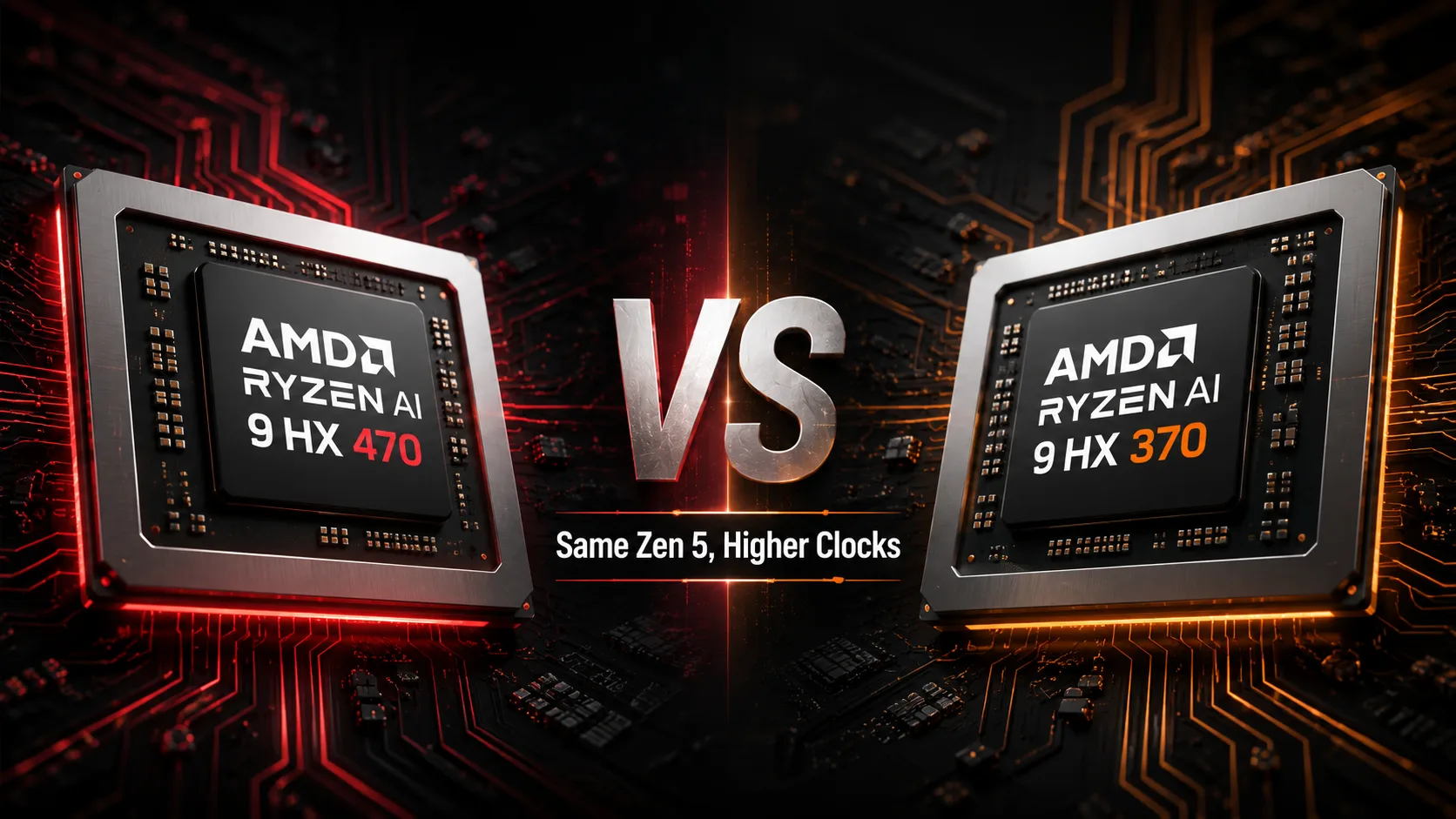
AMD Ryzen AI 9 HX 470
vs
AMD Ryzen AI 9 HX 370
CPU Comparison Result
Ryzen AI 9 HX 470 vs HX 370: AMD Changed the Number, But Not the Architecture
By its name, Ryzen AI 9 HX 470 appears to be a full-fledged successor to the HX 370. However, the differences in hardware are much more modest: the same Zen 5 and Zen 5c, 12 cores, Radeon 890M, and a 4nm platform. AMD mainly increased the frequencies, accelerated the memory, and slightly boosted the NPU. Therefore, the HX 470 is not a new architecture but rather an update of the platform that evolved from Strix Point.
Key Differences
| Specification | Ryzen AI 9 HX 470 | Ryzen AI 9 HX 370 |
|---|---|---|
| Series | Ryzen AI 400 | Ryzen AI 300 |
| Codename | Gorgon Point | Strix Point |
| CPU Architecture | 4× Zen 5 + 8× Zen 5c | 4× Zen 5 + 8× Zen 5c |
| Cores / Threads | 12 / 24 | 12 / 24 |
| Maximum Frequency | 5.2 GHz | 5.1 GHz |
| Maximum Frequency Zen 5c | 3.3 GHz | 3.3 GHz |
| L2 / L3 Cache | 12 / 24 MB | 12 / 24 MB |
| Process Technology | TSMC 4 nm | TSMC 4 nm |
| cTDP | 15-54 W | 15-54 W |
| Integrated Graphics | Radeon 890M, 16 CU | Radeon 890M, 16 CU |
| GPU Frequency | 3.1 GHz | 2.9 GHz |
| LPDDR5X | up to 8533 MT/s | up to 8000 MT/s |
| NPU | 55 TOPS | 50 TOPS |
| PCI Express | 4.0 | 4.0 |
There are more repeated specifications here than there are differences. The number of cores, CPU architecture, cache size, process technology, PCIe and power range remain unchanged. The main gains for the HX 470 come from increased CPU and GPU frequencies, faster memory, and an NPU rated at 55 TOPS.
Gorgon Point - The Evolution of Strix Point
The Ryzen AI 300 series appeared in 2024, bringing a combination of Zen 5, Zen 5c, RDNA 3.5, and XDNA 2. The Ryzen AI 400 family was released later, but AMD retained the same architectural foundation.
The closeness of the two platforms is also evident in public diagnostic data: Geekbench identifies the HX 370 and HX 470 as processors from the same AMD Family 26 Model 36 Stepping 0. This does not prove full identity of the chips, but it further emphasizes the closeness of the two platforms.
Even more indicative is the Ryzen AI 9 HX 375 - essentially an intermediate link between the HX 370 and HX 470. It already features the same 12 cores and 24 threads, Radeon 890M, and an NPU rated at 55 TOPS.
This creates a quite transparent evolution:
HX 370 → HX 375 → HX 470
Initially, AMD increased the NPU from 50 to 55 TOPS, then added another 100 MHz to the CPU, increased the Radeon 890M frequency from 2.9 to 3.1 GHz, and officially raised support for LPDDR5X to 8533 MT/s.
Thus, even the improvement of the AI block cannot be entirely credited to the new generation of Ryzen AI 400.
CPU Performance
In average Geekbench 6 results, the Ryzen AI 9 HX 470 scores about 2834 points in single-threaded tests and 14,814 in multi-threaded mode, while the HX 370 shows approximately 2689 and 13,515 points.
This results in about a 5% advantage in Single-Core and up to 10% in Multi-Core.
However, for mobile processors, such numbers should not be perceived as a guaranteed gap. Both chips operate within a wide cTDP range of 15-54 W, so laptop manufacturer settings can significantly alter the final results.
Geekbench 6.5 in Specific Laptops
| Laptop | Processor | Single-Core | Multi-Core |
|---|---|---|---|
| ASUS ExpertBook P5 G2 14 PM5406CGA | Ryzen AI 9 HX 470 | 3007 | 15,697 |
| Lenovo Legion 7 16AGP11 | Ryzen AI 9 HX 470 | 2968 | 16,022 |
| ASUS ROG Zephyrus G16 GA605WV | Ryzen AI 9 HX 370 | 2929 | 14,571 |
| ASUS ProArt P16 H7606WP | Ryzen AI 9 HX 370 | 2866 | 15,024 |
These are results from different laptops, so comparing rows like a lab test of two processors is not possible. However, the table illustrates the scale of the difference well: a powerful system with HX 370 can come quite close to HX 470.
This is why, when choosing a laptop, cooling and power limits may matter more than the numbers 370 and 470 in the name. Under prolonged loads, HX 370 in a laptop with powerful cooling can outperform HX 470 in a thinner chassis.
Radeon 890M: +200 MHz Without a New Architecture
Both processors use the Radeon 890M with 16 compute units of RDNA 3.5. The maximum frequency for the HX 470 is increased from 2.9 to 3.1 GHz - an increase of about 7%.
At the same time, LPDDR5X has accelerated from 8000 to 8533 MT/s. This is beneficial for integrated graphics, as the Radeon 890M uses system memory and is sensitive to its bandwidth.
However, the additional 200 MHz cannot automatically translate into a similar increase in FPS. The result depends on memory, cooling, and how much power the manufacturer allows the CPU and integrated graphics to utilize.
In laptops without discrete graphics cards, these changes matter. In gaming models with GeForce RTX, the difference between the two Radeon 890M options becomes secondary.
NPU: 55 vs. 50 TOPS
The XDNA 2 NPU in HX 470 delivers up to 55 TOPS compared to 50 TOPS in HX 370 - an increase of 10%.
The architecture remains the same, and HX 375 already offered the same 55 TOPS. Therefore, it’s not appropriate to consider the NPU as a significant advantage of HX 470 over the previous series.
For applications that actively utilize the local NPU, an additional 5 TOPS can provide a slight benefit. For regular tasks, gaming, browsing, and most traditional programs, this difference hardly affects laptop choice.
What This Means When Buying a Laptop
If two laptops are priced similarly, have comparable cooling, memory, display, and other specifications, HX 470 is preferable. It is slightly faster in CPU, has a higher frequency for the Radeon 890M, and supports faster LPDDR5X.
However, it makes little sense to pay a noticeable amount just for the jump from HX 370 to HX 470.
The HX 370 still has the same 12 cores of Zen 5/Zen 5c and very similar performance. A discount on a well-equipped laptop from the previous generation easily offsets all the technical advantages of HX 470.
This is especially true for models with discrete graphics: if a laptop with HX 370 offers a more powerful GeForce, better cooling, or more RAM for the same price, the new processor index becomes secondary.
Conclusion
The Ryzen AI 9 HX 470 is faster than the HX 370, but this is not a case where a new designation signals a new architecture.
AMD has retained the 12 cores of Zen 5/Zen 5c, 24 threads, Radeon 890M, XDNA 2, and a 4nm platform. The main changes are 100 MHz more for the CPU, 200 MHz for the integrated graphics, LPDDR5X-8533 support, and a 55 TOPS NPU, which essentially already appeared with HX 375.
For owners of laptops with HX 370, there's practically no reason to upgrade to HX 470.
When purchasing a new laptop, choose HX 470 not because it’s a “new generation,” but only if the laptop itself is not worse and the price difference is small. A good discount on a model with HX 370 can prove to be more valuable than all the improvements in Ryzen AI 400.
Advantages
- Higher Max Turbo Frequency: Up to 5.2 GHz (Up to 5.2 GHz vs Up to 5.1 GHz)
- Newer Launch Date: January 2026 (January 2026 vs July 2025)
Basic
CPU Specifications
Memory Specifications
GPU Specifications
Miscellaneous
Benchmarks
Related CPU Comparisons


Share in social media
Or Link To Us
<a href="https://cputronic.com/cpu/compare/amd-ryzen-ai-9-hx-470-vs-amd-ryzen-ai-9-hx-370" target="_blank">AMD Ryzen AI 9 HX 470 vs AMD Ryzen AI 9 HX 370</a>