AMD Ryzen 7 170
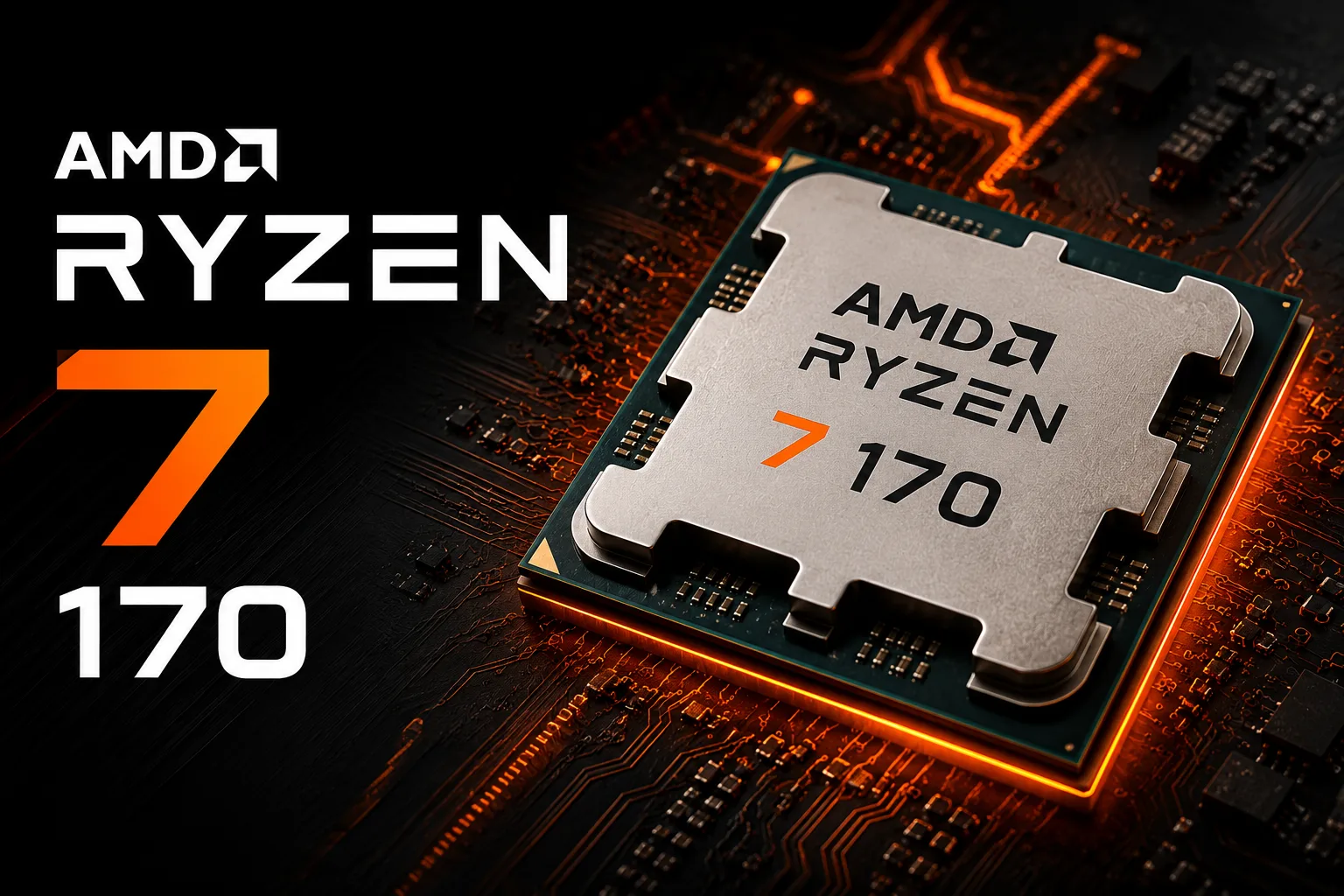
AMD Ryzen 7 170 for Laptops: An Old Familiar with a New Name
The AMD Ryzen 7 170 can easily be mistaken for a new mobile Ryzen, but it is not a new generation. Inside is the familiar Rembrandt-R architecture, closely related to the Ryzen 7 7735HS: 8 Zen 3+ cores, 16 threads, clock speeds up to 4.75 GHz, DDR5/LPDDR5 memory support, and integrated Radeon 680M graphics.
Therefore, it is more important to focus on the number 170 in the name, as well as the price and configuration of the laptop.
What Kind of Processor Is This?
The Ryzen 7 170 is built on the Zen 3+ architecture and is manufactured using TSMC's 6nm process. It features 8 full cores without a hybrid architecture like Intel's P-cores and E-cores. All cores support SMT, so the system recognizes 16 threads.
In everyday use, the Ryzen 7 170 does not feel weak: browsing, office tasks, video calls, light photo editing, and programming are not a problem for it.
Against the backdrop of the Ryzen 7 7840HS, Ryzen 7 8845HS, and more recent Zen 5 processors, this is no longer a cutting-edge platform, but a solid processor from the previous generation. Thus, a reasonable price is particularly important here.
Additionally, TDP is worth noting. This is not strictly a 35-watt processor; the standard TDP is 45 W, with a configurable range of 35-54 W. So, two laptops with the same Ryzen 7 170 may behave quite differently. One may operate more quietly and efficiently, while the other can maintain high frequencies longer.
CPU Performance
In terms of CPU, the Ryzen 7 170 stands at the level of a solid mobile Ryzen 7 from the previous generation. In short tasks, it performs well due to clock speeds of up to 4.75 GHz, while its 8-core/16-thread configuration assists in multi-threaded applications.
Approximate results in popular benchmarks:
| Benchmark | Approximate Score |
|---|---|
| Geekbench 6 Single-Core | around 2000-2050 |
| Geekbench 6 Multi-Core | around 10000-10200 |
| Cinebench 2024 Single-Core | around 85-90 |
| Cinebench 2024 Multi-Core | around 700-730 |
| PassMark CPU Mark | around 21900-22000 |
| PassMark Single Thread | around 3100-3200 |
For an all-purpose laptop, this is a good level: the Ryzen 7 170 holds up well in everyday tasks and performs decently in multi-threaded scenarios. However, in heavy rendering, compiling large projects, and professional video editing, it will lag behind more recent 45W and 55W processors.
Radeon 680M: The Main Argument Without a Discrete GPU
The most interesting part of the Ryzen 7 170 is the integrated Radeon 680M graphics. This iGPU is based on RDNA 2 architecture with 12 compute units and 768 shaders. For integrated graphics, this is still a good level, especially in laptops without a discrete GPU.
The Radeon 680M is significantly stronger than the older integrated Vega graphics. Esports games, older AAA projects, and lightweight modern games can run at Full HD on low or medium settings. In more demanding games, settings need to be lowered, FSR has to be used, or a lower resolution should be chosen.
In synthetic benchmarks, the performance is also clear: in 3DMark Time Spy Graphics, the Radeon 680M typically scores around 2000-2500 points, while in 3DMark Fire Strike Graphics, it reaches about 6200-7000 points in favorable configurations with a normal power limit and fast memory.
The key requirement is memory. The integrated graphics use the system's RAM, so fast dual-channel DDR5/LPDDR5 memory is critical for the Ryzen 7 170. If the manufacturer has cut costs on memory, the Radeon 680M can lose a significant portion of its performance.
A minimally reasonable amount of memory is 16 GB, but 32 GB is preferable, especially if the laptop is intended for several years of use.
Comparison with Similar Processors
| Processor | Key Points to Understand |
|---|---|
| Ryzen 7 7735HS | Practically the same class and very similar foundation |
| Ryzen 7 6800HS | Close predecessor, usually with slightly lower maximum clock speed |
| Ryzen 7 7840HS | Newer and faster in CPU, stronger platform-wise |
| Ryzen 7 8845HS | More modern option on Zen 4 with better efficiency |
| Intel Core i7-1260P | May be interesting in thin laptops, but the integrated graphics are usually weaker than the Radeon 680M |
| Intel Core i7-12700H | Faster in CPU tasks, especially in laptops with good cooling |
When comparing the Ryzen 7 170 with Intel processors, it is crucial to separate two scenarios. In laptops without a discrete GPU, the Radeon 680M is usually more interesting than Iris Xe. However, in models with RTX 3050, RTX 4050, or stronger GPUs, the weak integrated graphics from Intel become less significant: the discrete GPU handles the gaming, and processors like the Core i7-12700H can outperform in CPU tasks.
When to Consider a Laptop with Ryzen 7 170
The Ryzen 7 170 is worth purchasing not for its new name, but for its appealing price and reasonable configuration. It shines best in all-purpose laptops without a discrete GPU: 8 cores provide headroom for work, while the Radeon 680M allows for running less demanding games and graphics applications without a separate GPU.
A purchase is sensible if the laptop is significantly cheaper than models with Ryzen 7 7840HS, Ryzen 7 8845HS, Ryzen AI 300, or newer Core Ultra processors. In such cases, the Ryzen 7 170 provides a good balance of CPU performance and integrated graphics.
In gaming laptops, the logic is different. If it comes with an RTX 3050, RTX 4050, or more robust GPU, the Radeon 680M becomes almost irrelevant. Here, the Ryzen 7 170 should be evaluated like a regular 8-core processor: it is appropriate if the entire configuration is cheaper than similar models with newer Ryzen or Intel processors.
Before making a purchase, consider checking:
- Price relative to models with Ryzen 7 7840HS, Ryzen 7 8845HS, Ryzen AI 300, and Core Ultra;
- Power limit of the processor;
- Cooling system;
- Amount and type of RAM;
- Dual-channel memory configuration;
- Quality of the display;
- Battery capacity;
- Availability of a decent SSD;
- Noise level under load.
Be especially cautious with thin cases and cut-down configurations. If the cooling is weak, the processor may quickly drop frequencies. For the Radeon 680M, fast dual-channel DDR5/LPDDR5 may be more crucial than it appears from a single line in the specs.
When to Choose Another Processor
The Ryzen 7 170 should not be selected if the laptop costs nearly the same as models with Ryzen 7 7840HS, Ryzen 7 8845HS, Ryzen AI 300, or new Core Ultra processors. In that case, it would be better to opt for a more modern architecture.
Additionally, be wary of models that have skimped on memory, cooling, or display. A poor implementation can easily ruin the experience: frequencies may drop, the Radeon 680M may not perform well, and the overall configuration might turn out to be worse than anticipated from the Ryzen 7 name alone.
The main mistake is to buy the Ryzen 7 170 as a "new Ryzen 7." This is a solid older platform under a new name, and its advantages only come to light at the right price.
Conclusion
The AMD Ryzen 7 170 is a tried and tested Rembrandt-R platform under a new name: 8 Zen 3+ cores, DDR5/LPDDR5 support, and Radeon 680M graphics. There is no new architecture here, but the base itself is still strong.
The main advantage of the processor is balance. It is suitable for versatile laptops, handles everyday tasks well, excels in multitasking, and can manage light creative tasks, while the Radeon 680M allows for operation without a discrete GPU in less demanding games and light graphic tasks.
The main disadvantage is the age of the platform. Therefore, the Ryzen 7 170 should only be chosen in a balanced laptop: one with good memory, adequate cooling, and a price lower than that of models with newer Ryzen or Core Ultra processors.
CPU Comparison
Compare Ryzen 7 170 with other CPUs
Basic
CPU Specifications
Memory Specifications
GPU Specifications
Miscellaneous
Benchmarks
Compared to Other CPU
Related CPU Comparisons


Share in social media
Or Link To Us
<a href="https://cputronic.com/cpu/amd-ryzen-7-170" target="_blank">AMD Ryzen 7 170</a>