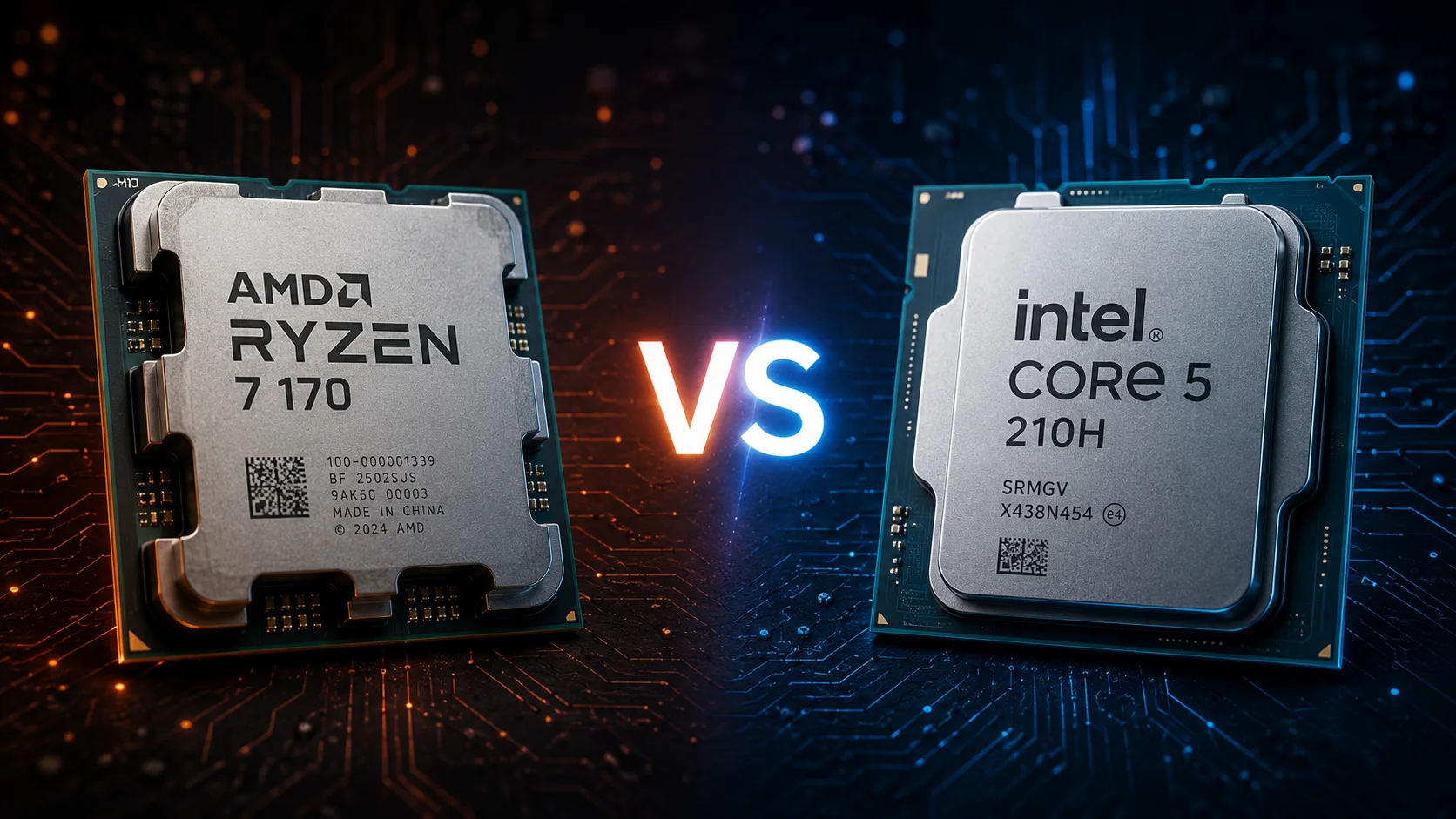
AMD Ryzen 7 170
vs
Intel Core 5 210H

CPU Comparison Result
AMD Ryzen 7 170 vs Intel Core 5 210H: Old Architectures Under New Names
AMD Ryzen 7 170 and Intel Core 5 210H appear to be fresh processors from new lines, but in both cases, they are more about repackaging already known architectures. Ryzen 7 170 is based on Rembrandt / Zen 3+ and is essentially close to Ryzen 7 7735HS. Core 5 210H is a mobile Raptor Lake-H under Intel’s new naming scheme.
Therefore, comparing them is more interesting not as "new vs new," but as two different approaches to notebook performance: AMD bets on 8 full cores and powerful integrated graphics, while Intel relies on a hybrid scheme, high frequencies, and a more flexible platform.
Key Differences
| Characteristic | AMD Ryzen 7 170 | Intel Core 5 210H |
|---|---|---|
| Architecture | Zen 3+ | Raptor Lake-H |
| Process Technology | TSMC 6 nm | Intel 7 |
| Cores / Threads | 8 / 16 | 8 / 12 |
| Core Configuration | 8 full Zen cores | 4 P-cores + 4 E-cores |
| Max Frequency | up to 4.75 GHz | up to 4.8 GHz |
| L3 Cache | 16 MB | 12 MB |
| Base Power | 45 W | 45 W |
| Turbo / Configurable Limit | 35-54 W | up to 115 W |
| Integrated Graphics | Radeon 680M | Intel Graphics 48 EU |
| Memory | DDR5 / LPDDR5 | DDR5, DDR4, LPDDR5/X, LPDDR4X |
| Max Memory Size | up to 64 GB | up to 96 GB |
| PCIe | PCIe 4.0 | up to PCIe 5.0 |
| USB4 / Thunderbolt | depends on the laptop | Thunderbolt 4 claimed |
Processor Part: AMD is Smoother, Intel is Sharper in Short Tasks
Ryzen 7 170 uses a classic scheme: 8 cores and 16 threads. All cores here are identical, without differentiation between performance and efficiency. This approach is well-suited for long multi-threaded tasks: rendering, compiling, archiving, video encoding, batch photo processing, and heavy multitasking.
Core 5 210H is arranged differently. It has 4 performance P-cores and 4 efficiency E-cores, totaling 8 cores and 12 threads. In light and moderate tasks, it may feel very fast, especially due to turbo frequency up to 4.8 GHz. However, under prolonged full loads, 12 threads against 16 on Ryzen is a noticeable limitation.
To simplify: Intel may be more agile in short single-thread bursts, while Ryzen looks stronger and more predictable in extended multi-threaded work.
Benchmark Performance
The results of mobile processors heavily depend on the specific laptop: cooling, power limits, memory, and manufacturer settings. Therefore, the numbers below should be taken as a guideline for performance class rather than a guaranteed result in every device.
| Test | AMD Ryzen 7 170 | Intel Core 5 210H | Observations |
|---|---|---|---|
| PassMark CPU Mark | around 22,000 | around 18,000 | Ryzen is noticeably stronger in overall ranking |
| Geekbench 6 Single-Core | slightly lower | slightly higher | Intel may be faster in single-thread |
| Geekbench 6 Multi-Core | slightly higher | slightly lower | Ryzen generally performs better in multi-thread |
| Cinebench 2024 Multi-Core | significantly higher | lower | 8 cores / 16 threads of AMD show stronger performance |
In Geekbench 6, the difference between the chips usually doesn’t seem dramatic: Intel might be a bit stronger in single-core, while Ryzen excels in multi-core. In Cinebench 2024, Ryzen’s advantage in multi-threading is more apparent due to its 8 full cores and 16 threads compared to Intel's 4 P-cores + 4 E-cores.
Integrated Graphics: The Main Advantage of Ryzen
The most significant practical difference between these processors lies not in the CPU but in the integrated graphics.
Ryzen 7 170 features Radeon 680M based on RDNA 2 architecture. It is one of the most successful integrated graphics of its generation: it is suitable not only for interfaces, video, and browsers but also for light gaming, esports projects, older AAA titles, and operation without a discrete graphics card.
The Core 5 210H features integrated Intel Graphics with 48 EUs. For office work, video, browsing, and basic multimedia, it is sufficient, but as a gaming solution, it is weaker than Radeon 680M.
This is why Ryzen 7 170 looks particularly good in laptops without discrete graphics cards. Such a laptop can be thinner, simpler, and more economical while still maintaining a reasonable graphics capacity. The Core 5 210H in this scenario appears more modest: its integrated graphics is more of a "just to have" rather than a significant strong point.
Platform: Intel Has More Flexibility
The Core 5 210H has an important platform advantage. It supports more types of memory: DDR5, DDR4, LPDDR5/X, and LPDDR4X. This is convenient for laptop manufacturers: the same processor can be found in both more affordable models and configurations with more modern memory.
Intel also has a stronger set of interfaces: PCIe 5.0 and Thunderbolt 4. For the average user, this is not always critical, but for work laptops, docking stations, fast external drives, and versatile Thunderbolt 4 ports can be significant advantages.
Ryzen 7 170 is simpler: DDR5 / LPDDR5, PCIe 4.0, and up to 64 GB of memory. This is sufficient for most laptops, but in terms of platform flexibility, Intel appears more interesting.
Power Consumption and Cooling
On paper, both processors are in the 45 W class, but their behavior is different.
Ryzen 7 170 generally appears more predictable: its power range is confined to 35-54 W. This does not make it automatically cool, but it reduces the likelihood of sharp consumption spikes and strong dependence on turbo modes.
The Core 5 210H, with a base power of 45 W, can spike up to 115 W in turbo. This does not mean it constantly consumes that much power, but under short loads, Intel can boost aggressively. In a good chassis with normal cooling, this helps performance. In a thin laptop, such a chip may hit temperature and power limits faster.
Conclusion
AMD Ryzen 7 170 appears to be a more practical choice for a versatile laptop without a discrete graphics card. Its strengths include 8 cores / 16 threads, solid multi-threaded performance, and significantly more powerful integrated graphics with Radeon 680M. For work, study, multitasking, light video editing, photos, browsing with many tabs, and gaming without a separate graphics card, this option looks very balanced.
Intel Core 5 210H is interesting in a different scenario. It shines better in laptops with good cooling, fast memory, and ideally, a discrete graphics card, where weak integrated graphics are less critical. Its advantages include high single-thread responsiveness, a flexible platform, Thunderbolt 4, and support for modern interfaces.
If you need a standalone laptop without discrete graphics, Ryzen 7 170 looks preferable. However, if considering a configuration with a separate graphics card and an emphasis on Intel’s platform capabilities, Core 5 210H may also be a very relevant option.
Advantages
- Larger L3 Cache: 16 MB (16 MB vs 12 MB shared)
- Higher Technology: TSMC 6nm FinFET (TSMC 6nm FinFET vs 10 nm)
- Newer Launch Date: October 2025 (October 2025 vs December 2024)
Basic
CPU Specifications
Memory Specifications
GPU Specifications
Interfaces and Ports
Miscellaneous
Benchmarks
Related CPU Comparisons


Share in social media
Or Link To Us
<a href="https://cputronic.com/cpu/compare/amd-ryzen-7-170-vs-intel-core-5-210h" target="_blank">AMD Ryzen 7 170 vs Intel Core 5 210H</a>