AMD Ryzen AI 7 345
AMD Ryzen AI 7 345
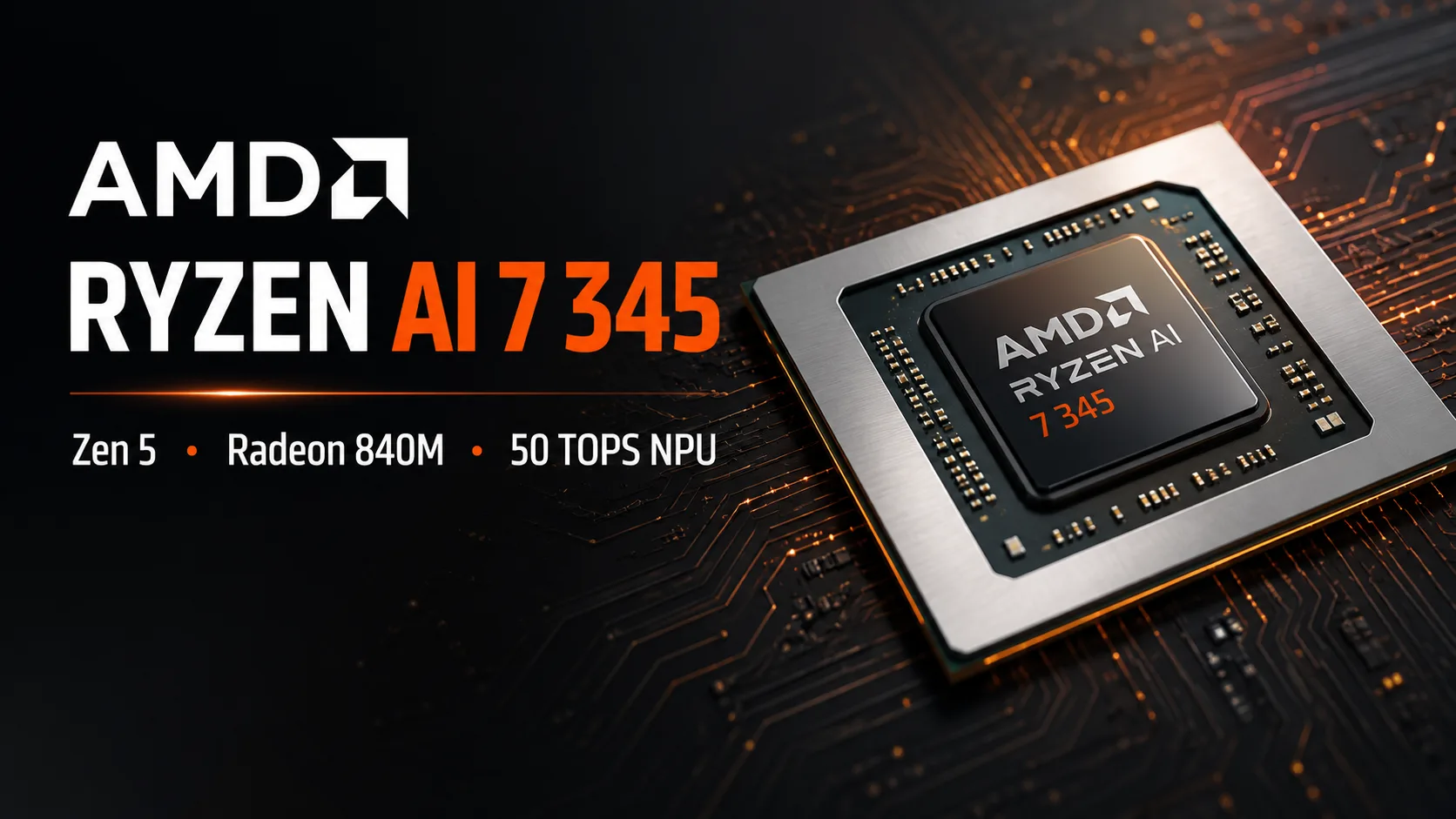
The AMD Ryzen AI 7 345 is a mid-range mobile processor designed for slim laptops and compact PCs. Its strengths include the Zen 5 architecture, a dedicated NPU for AI tasks, moderate power consumption, and integrated Radeon 840M graphics.
This is not a flagship processor for heavy multi-threading and gaming, but a balanced solution for work, study, browsing, video calls, office applications, light photo processing, and new AI features in Windows.
Positioning
The Ryzen AI 7 345 is positioned below the Ryzen AI 7 350 and the higher-end Ryzen AI 9 processors. It is essentially a practical processor for laptops where quiet operation, battery life, and a modern platform are prioritized over maximum performance at any cost.
Closest competitors:
- AMD Ryzen AI 5 340;
- AMD Ryzen AI 7 350;
- Intel Core Ultra 5 energy-efficient class;
- Some versions of Intel Core Ultra 7.
Compared to the Ryzen AI 7 350, the 345 model is simpler: it has 6 cores instead of 8 and the lower-end Radeon 840M graphics. However, this chip is easier to cool and simpler to use in thin chassis.
Architecture: 2 Zen 5 + 4 Zen 5c
The Ryzen AI 7 345 is built on the Krackan Point architecture and uses a hybrid configuration.
| Component | Configuration |
|---|---|
| Performance Cores | 2x Zen 5 |
| Efficient Cores | 4x Zen 5c |
| Total Cores | 6 |
| Threads | 12 |
| Max Clock Speed | up to 4.6 GHz |
| L3 Cache | 8 MB |
The fast Zen 5 cores are responsible for system responsiveness and single-threaded tasks, while the Zen 5c cores assist in multi-threaded workloads with moderate power consumption.
The main limitations are the 6 cores and 8 MB of L3 cache. In short bursts, the processor performs well, but under prolonged full load, 8-core and 12-core models will be faster.
Performance and Benchmarks
In everyday use, the Ryzen AI 7 345 is expected to be fast: browsing, documents, video calls, messaging, media content, and light development are its normal territory.
| Processor | Geekbench 6 Single-Core | Geekbench 6 Multi-Core | Multi-threading Difference |
|---|---|---|---|
| AMD Ryzen AI 7 345 | around 2517 | around 8639 | baseline level |
| Intel Core Ultra 7 155U | comparable level | about 10% higher | faster |
| AMD Ryzen 7 6800H | lower or similar | about 5% higher | slightly faster |
The single-threaded performance of the Ryzen AI 7 345 is strong thanks to Zen 5. This is important for interface responsiveness, application launches, and general tasks.
In multi-threaded workloads, the performance is more modest. The Ryzen AI 7 345 can lag behind the Core Ultra 7 155U by about 10%, and the Ryzen 7 6800H by about 5%. For a 6-core chip with moderate TDP, this is expected: it does not replace H/HX processors, but is better suited for lighter laptops.
Integrated Graphics Radeon 840M
Graphics are powered by the Radeon 840M with 4 GPU cores and clock speeds up to 2900 MHz. This is the lower-end iGPU in AMD's current lineup, so one shouldn't expect the performance level of Radeon 860M or Radeon 890M.
The Radeon 840M is suitable for:
- Windows interface;
- video and online services;
- working with multiple displays;
- older and simple games;
- esports titles at low or medium settings.
The limitations are obvious: in heavy games, resolution and graphics quality will need to be lowered. For stable Full HD gaming, it is better to choose a laptop with more powerful integrated graphics or a discrete graphics card.
AI Capabilities and NPU
The Ryzen AI 7 345 features an NPU with up to 50 TOPS performance. It is intended for local AI tasks that can be performed without continuously burdening the CPU and GPU.
The NPU can be used for:
- image processing from cameras;
- noise reduction;
- AI filters;
- some features of Copilot+ PC;
- local assistants;
- applications with neural network acceleration.
Important: The NPU does not accelerate regular games, archiving, or traditional rendering. Its purpose is energy-efficient processing of AI workloads.
Memory, Storage, and Connectivity
The Ryzen AI 7 345 supports fast memory and modern interfaces.
| Feature | Support |
|---|---|
| RAM | DDR5-5600 / LPDDR5X-8000 |
| Maximum RAM Capacity | up to 256 GB |
| Memory Mode | Dual Channel |
| Storage | NVMe via PCIe 4.0 |
| Modern Ports | USB4 |
Fast memory is especially important for the Radeon 840M, as integrated graphics use system RAM. Ultimately, performance also depends on the specific laptop: cooling, power limits, memory, and manufacturer settings.
Who is the Ryzen AI 7 345 suitable for?
A good choice if you need a laptop for:
- work and study;
- browsing and office applications;
- video calls;
- light programming;
- multimedia;
- local AI functions;
- travel and battery life.
Not the best choice for:
- heavy video editing;
- 3D graphics;
- long compilation of large projects;
- gaming at high settings;
- maximum multi-threaded performance.
In such scenarios, it is better to look at the Ryzen AI 7 350, Ryzen AI 9, Intel Core Ultra H-series, or a laptop with a discrete graphics card.
Conclusion
The AMD Ryzen AI 7 345 is a modern mobile processor designed not for record-breaking performance but for balanced laptops. It boasts good single-threaded performance, a fresh Zen 5 architecture, an NPU with up to 50 TOPS, support for fast memory, and moderate power consumption.
The downsides are the 6 cores, 8 MB of L3 cache, and the lower-end Radeon 840M. Therefore, the Ryzen AI 7 345 is best suited for a quiet and economical laptop with current AI features but not for heavy multi-threading and gaming.
CPU Comparison
Compare Ryzen AI 7 345 with other CPUs
Basic
CPU Specifications
Memory Specifications
GPU Specifications
Miscellaneous
Benchmarks
Compared to Other CPU
Related CPU Comparisons





Share in social media
Or Link To Us
<a href="https://cputronic.com/cpu/amd-ryzen-ai-7-345" target="_blank">AMD Ryzen AI 7 345</a>