AMD Ryzen 5 150
AMD Ryzen 5 150: Familiar 6-Core Ryzen for Budget Laptops
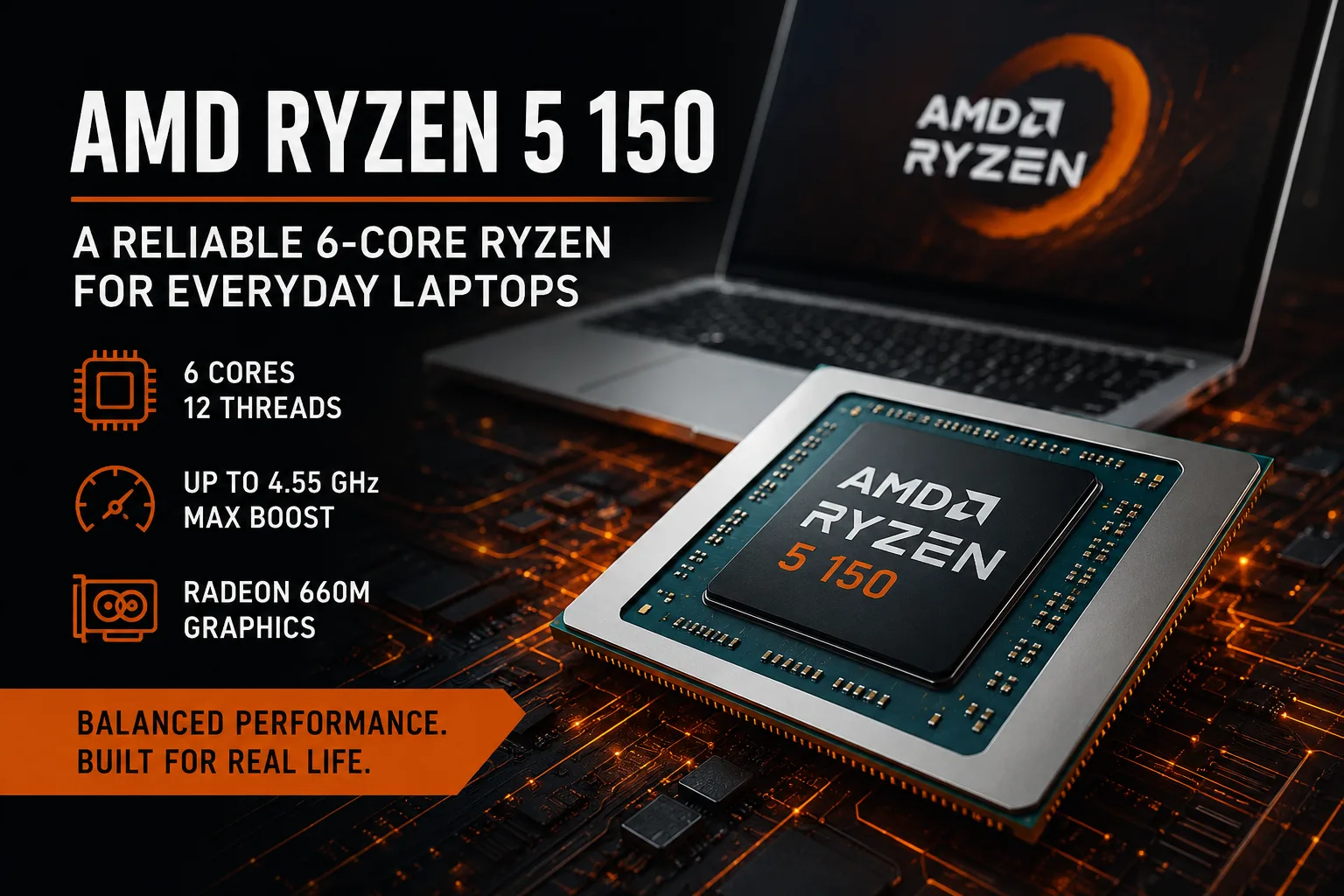
The AMD Ryzen 5 150 appears to be a new mobile processor, but in essence, it is a very close analog of the Ryzen 5 7535HS: featuring Zen 3+ architecture, 6 cores, 12 threads, a 6nm manufacturing process, and integrated Radeon 660M graphics. Thus, it should not be viewed as a new generation of Ryzen. Rather, it is a return of the tried-and-true Rembrandt platform in a more contemporary lineup.
The main appeal of the Ryzen 5 150 is not about records, but balance. It is designed for versatile laptops suitable for office work, studying, home use, browsing, multimedia, light photo editing, programming, and everyday multitasking. The value of the Ryzen 5 150 is revealed not in dry specifications, but in a successful laptop configuration: with a reasonable price, 16GB of RAM, a fast SSD, and without obvious compromises in cooling.
What's Inside
The Ryzen 5 150 is built on the Zen 3+ architecture. It has 6 cores and 12 threads, without any hybrid scheme or division into different types of cores. This is a classic configuration with six identical cores: no P and E clusters, but with clear performance for everyday tasks and multithreaded workloads.
The maximum frequency can reach 4.55 GHz. The nominal TDP is 45W, and the configurable range is 35-54W. In practice, this is important: the same Ryzen 5 150 can behave differently in various laptops. In a thin chassis, it will be quieter and more energy-efficient but will hit power limits faster. In a model with adequate cooling, the processor can maintain higher frequencies under load for longer.
One strong point is the integrated Radeon 660M graphics. For a budget or mid-range laptop without a discrete GPU, this is an important advantage.
Performance in Real Tasks
In everyday tasks, the Ryzen 5 150 should feel snappy. Six cores and twelve threads are sufficient for browsing with multiple tabs, office programs, video calls, study tasks, basic photo editing, and coding.
Compared to simple 4-core Ryzen 3 or older Core i3 CPUs, the surplus of threads is immediately noticeable: the system suffers less from performance dips when a browser, documents, messengers, music, and several background processes are open at the same time. For an ordinary home or work laptop, this level of performance seems entirely adequate.
However, the Ryzen 5 150 is not a processor for a heavy workstation. In prolonged rendering, complex editing, large projects, and tasks where maximum performance per core is essential, newer Ryzen CPUs on Zen 4/Zen 5 and current Intel Core/Core Ultra will be faster. It represents the normal mid-range, not a hidden flagship.
Radeon 660M - The Main Argument for Ryzen 5 150
The Radeon 660M doesn't turn a laptop into a gaming machine, but for integrated graphics, it is still a respectable solution. It is suitable for video, everyday graphics tasks, older games, online projects, and undemanding titles at low or medium settings.
The Ryzen 5 150 makes the most sense in laptops without discrete graphics. Users receive not only a decent 6-core CPU but also integrated graphics that are significantly more useful than basic solutions. For studying, home use, travel, and light gaming, this may be more important than a slight difference in CPU benchmarks.
For modern heavy games, the Radeon 660M is indeed underwhelming. If a gaming laptop is needed, it's better to look for models with a discrete GPU. However, if the goal is a versatile laptop without unnecessary noise, weight, and overpaying for a GPU, the Ryzen 5 150 is a fitting choice.
Competitors and Close Alternatives
| Processor | How It Differs | When It Might Be More Appealing |
|---|---|---|
| Ryzen 5 6600H | Close Rembrandt platform on Zen 3+ with Radeon 660M, but more common in older generation laptops and with different positioning | If the laptop is significantly cheaper and doesn’t compromise on screen, memory, and cooling |
| Ryzen 5 7530U | More economical U-class, but weaker integrated graphics and simpler platform | If a quiet office laptop is needed and graphics are not a priority |
| Ryzen 5 7640U / 8640U | Newer Zen 4 architecture, higher efficiency, and stronger CPU performance | If the price difference is small |
| Intel Core i5-1235U | Hybrid scheme 2P+8E, often found in thin office models | If battery life is more important, and the specific laptop is well-optimized by the manufacturer |
| Intel Core i5-1240P | Hybrid scheme 4P+8E, may be faster in multithreaded tasks | If the laptop has good cooling and stronger integrated AMD graphics are not required |
| Intel Core 5 120U / Core 5 210H | Different class models but may overlap with Ryzen 5 150 in budget laptops and mini-PCs | If a specific device is better in price, screen, build quality, or battery life |
The Ryzen 5 150 should not be chosen solely for its new name. It should be evaluated based on the price of the complete laptop and its overall configuration. If a model based on a newer architecture is available for nearly the same price, it makes sense to look towards the newer platform. However, if a laptop with the Ryzen 5 150 is significantly cheaper, the processor becomes much more interesting.
Where Ryzen 5 150 Performs Well
The Ryzen 5 150 is well-suited for:
- Universal laptops with 14-16 inch displays;
- Models without discrete graphics;
- Study, office, and home use;
- Browsing, documents, video calls, and multimedia;
- Light photo editing and basic coding work;
- Undemanding games on integrated graphics.
Less favorable is an expensive laptop that costs nearly the same as models on Zen 4, Zen 5, or Ryzen AI. In such cases, the appeal of the Ryzen 5 150 diminishes: the platform is no longer new, and overpaying for it isn’t justified.
Be cautious with configurations featuring 8GB of RAM without the possibility to upgrade. The processor itself is still quite decent, but a small amount of RAM can quickly spoil the experience, especially in browsing and multitasking.
Conclusion
The AMD Ryzen 5 150 is not a groundbreaking technological leap, but a steady return of the well-established Rembrandt platform. Its strengths lie in its 6 Zen 3+ cores, 12 threads, Radeon 660M, and good balance for budget laptops.
This processor shines in universal models without discrete graphics, where reasonable CPU performance, decent integrated graphics, and a fair price are important. For office work, studying, home use, multimedia, and light tasks, the Ryzen 5 150 is a suitable choice.
The key is not to overpay. At the right price, it is a sensible processor for a budget laptop. At an inflated price, it bears too much resemblance to an old platform in new packaging.
CPU Comparison
Compare Ryzen 5 150 with other CPUs
Basic
CPU Specifications
Memory Specifications
GPU Specifications
Miscellaneous
Benchmarks
Compared to Other CPU
Related CPU Comparisons


Share in social media
Or Link To Us
<a href="https://cputronic.com/cpu/amd-ryzen-5-150" target="_blank">AMD Ryzen 5 150</a>