AMD Ryzen 5 40
vs
AMD Ryzen 5 150
CPU Comparison Result
AMD Ryzen 5 40 vs Ryzen 5 150: Similar Names, Different Performance Classes
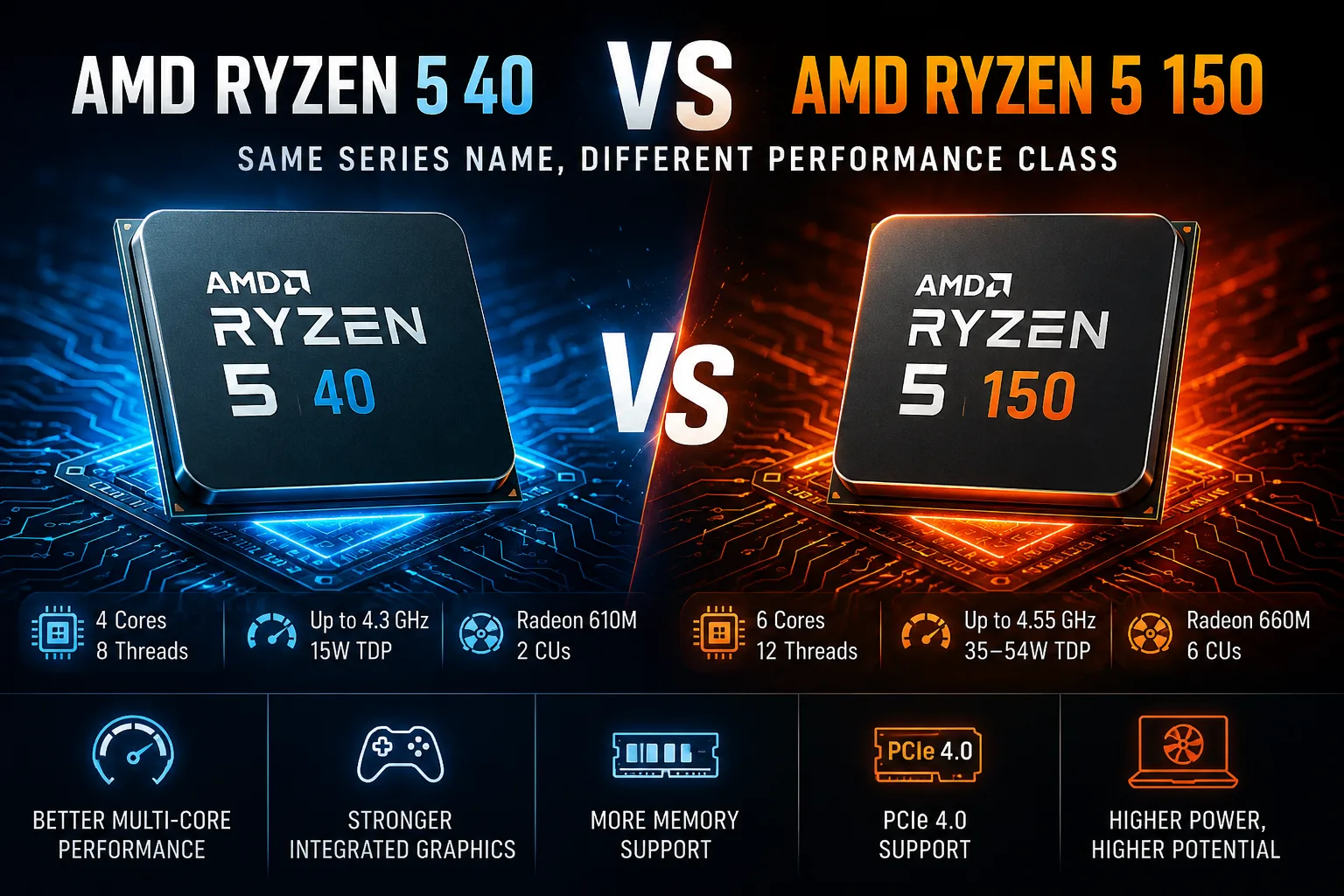
AMD Ryzen 5 40 and Ryzen 5 150 may appear to be neighboring models, but they are designed for different devices. The Ryzen 5 40 is aimed at budget-friendly thin laptops and compact computers with moderate power consumption. The Ryzen 5 150 is noticeably more powerful: it has more cores, a more modern architecture, faster integrated graphics, and broader platform capabilities.
Key Differences
| Specification | AMD Ryzen 5 40 | AMD Ryzen 5 150 |
|---|---|---|
| Architecture | Zen 2 | Zen 3+ |
| Cores / Threads | 4 / 8 | 6 / 12 |
| L3 Cache | 4 MB | 16 MB |
| TDP | 15 W | 35-54 W |
| Integrated Graphics | Radeon 610M | Radeon 660M |
| Maximum Memory Capacity | 16 GB | 64 GB |
The Ryzen 5 150 has two more cores and four more threads, and its L3 cache size is increased fourfold. Zen 3+ is also more efficient than Zen 2 at comparable frequencies. Therefore, the advantage of the higher model is determined not by a single parameter but by a combination of additional cores, a more efficient architecture, and a higher power limit.
Processor Performance
The Ryzen 5 40 is suitable for browsing, office applications, video calls, watching movies, and other everyday tasks. Four cores and eight threads are sufficient as long as the load remains moderate. However, when processing photographs, compiling, editing, or running multiple heavy programs simultaneously, the processor quickly reaches its limit.
The Ryzen 5 150 handles prolonged multi-threaded loads more confidently. Six cores and twelve threads give it an edge in rendering, archiving, development, and content creation. The larger cache also helps in gaming and applications sensitive to memory latency.
In multi-threaded tasks, the Ryzen 5 150 is typically significantly faster. The gap is explained not only by the two additional cores but also by the higher efficiency of the architecture, frequencies, and notably larger power consumption. The exact result depends on cooling and specific device settings, especially under prolonged load.
Radeon 610M vs Radeon 660M
The integrated graphics vary even more.
The Radeon 610M in the Ryzen 5 40 contains two compute units based on the RDNA 2 architecture. This is entry-level graphics suitable for operating system interfaces, video playback, and simple gaming. In older and less demanding projects, you will usually need to lower the resolution and quality settings.
The Radeon 660M features six compute units-three times more. It is better suited for competitive gaming, emulators, graphics applications, and accelerating certain media tasks.
The actual speed of both graphics cores depends on the memory bandwidth. Dual-channel DDR5 or LPDDR5 is especially important since integrated graphics do not have dedicated video memory. However, even with a less-than-ideal configuration, the Radeon 660M remains significantly faster than the Radeon 610M.
For modern demanding games, both models ideally require a discrete graphics card. The Ryzen 5 150 is better suited for such scenarios: its CPU part is less likely to become a limitation.
Power Consumption and Cooling
The main advantage of the Ryzen 5 40 is its low power consumption. With a TDP of 15 W, it allows for the use of compact cooling systems and reduces the thickness of the chassis. This processor is suitable for an inexpensive laptop for studying, traveling, and everyday work.
The Ryzen 5 150 operates within the range of 35-54 W. It consumes more power and requires more serious cooling; however, it maintains higher frequencies under load for longer. In a thin chassis, its performance may be limited by temperature, so the quality of the specific laptop is significant.
However, the Ryzen 5 40 does not necessarily guarantee better battery life. The runtime depends not only on the processor but also on the battery capacity, display, power settings, and the quality of device optimization.
Platform Capabilities
The Ryzen 5 40 supports up to 16 GB of RAM. This is sufficient for an office system, but the capacity for heavy multitasking and future upgrades is limited, especially if the memory is soldered to the motherboard.
The Ryzen 5 150 supports up to 64 GB, making it better suited for development, virtual machines, content processing, and multitasking. Its platform also provides greater possibilities for connecting fast SSDs and discrete graphics, although the specific configuration depends on the device manufacturer.
The Ryzen 5 40 is best for:
- An inexpensive laptop for study and documents;
- Browsing, video, and office applications;
- A compact computer with low heat output;
- Scenarios without heavy multi-threaded loads.
The Ryzen 5 150 is better suited for:
- Programming and active multitasking;
- Photo processing and simple editing;
- Gaming on integrated graphics;
- Systems with a discrete graphics card;
- Configurations with 32 or 64 GB of RAM.
Conclusion
The AMD Ryzen 5 150 is significantly stronger than the Ryzen 5 40. It offers more cores, a more modern architecture, a fourfold increase in L3 cache, three times more graphics cores, and a more functional platform.
The Ryzen 5 40 is justified at a considerably lower price and in clearly light usage scenarios. With a slight difference in cost, it makes more sense to choose the Ryzen 5 150: it is faster in work tasks and gaming, supports more memory, and significantly less restricts the capabilities of the computer.
Advantages
- More Total Cores: 6 (4 vs 6)
- Higher Max Turbo Frequency: Up to 4.55 GHz (Up to 4.3 GHz vs Up to 4.55 GHz)
- Larger L3 Cache: 16 MB (4 MB vs 16 MB)
- Newer PCI Express Version: PCIe® 4.0 (PCIe® 3.0 vs PCIe® 4.0)
Basic
CPU Specifications
Memory Specifications
GPU Specifications
Miscellaneous
Benchmarks
Related CPU Comparisons


Share in social media
Or Link To Us
<a href="https://cputronic.com/cpu/compare/amd-ryzen-5-40-vs-amd-ryzen-5-150" target="_blank">AMD Ryzen 5 40 vs AMD Ryzen 5 150</a>