AMD Ryzen 5 40
vs
Intel Core i5-1335U
CPU Comparison Result
AMD Ryzen 5 40 vs. Intel Core i5-1335U: CPU and integrated graphics performance
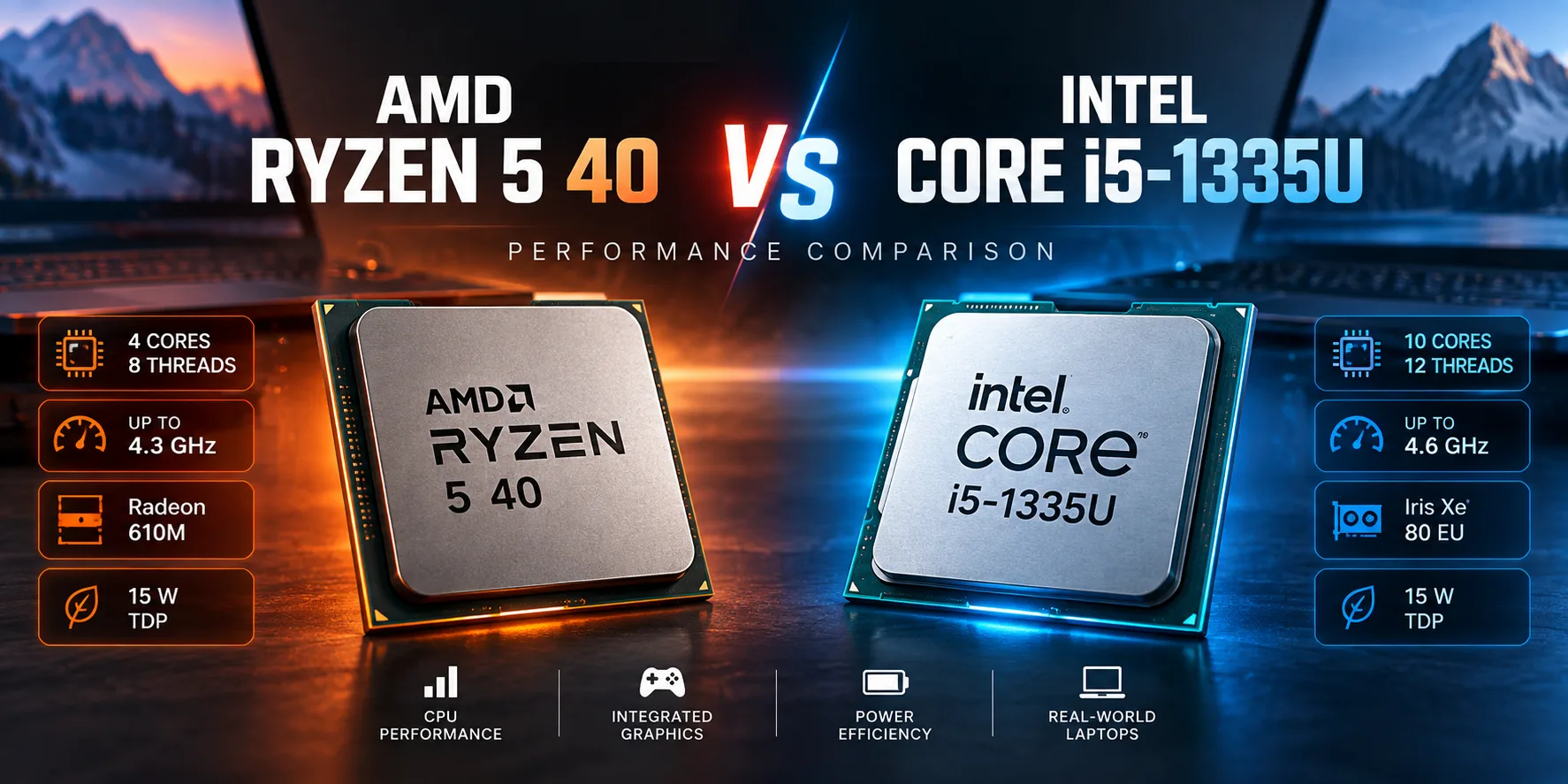
AMD Ryzen 5 40 and Intel Core i5-1335U are mobile processors with a base power of around 15 W, but they differ significantly in architecture, core count, and performance. The Ryzen 5 40 appeared in 2025 but is based on the Mendocino platform with four Zen 2 cores.
Key differences
| AMD Ryzen 5 40 | Intel Core i5-1335U | |
|---|---|---|
| CPU architecture | Zen 2 | Raptor Lake-U |
| Cores / threads | 4 / 8 | 10 / 12 |
| Configuration | 4 identical cores | 2 P-Cores + 8 E-Cores |
| Maximum frequency | 4.3 GHz | 4.6 GHz |
| L3 cache | 4 MB | 12 MB |
| Integrated graphics | Radeon 610M | Iris Xe 80 EU |
| Base power | 15 W | 15 W |
The difference is determined by the architecture and core count, not just the maximum frequency. The Ryzen 5 40 is built on Mendocino and is similar in configuration to the Ryzen 5 7520U. These processors are used mainly in inexpensive laptops.
The Core i5-1335U combines two performance cores with eight efficient cores. It has 10 cores and 12 threads in total, giving Intel an advantage in multithreaded tasks.
CPU performance
In the CPUTRONIC tests shown below, the Core i5-1335U is faster than the Ryzen 5 40.
| Processor | Geekbench 6 Single | Geekbench 6 Multi | PassMark Single | PassMark CPU |
|---|---|---|---|---|
| AMD Ryzen 5 40 | 1368 | 4102 | 2611 | 10081 |
| AMD Ryzen 5 7520U | 1183 | 3739 | 2518 | 9416 |
| Intel Core i3-1315U | 1914 | 5617 | 3554 | 12592 |
| Intel Core i5-1335U | 1957 | 6115 | 3540 | 16296 |
In Geekbench 6, the Core i5-1335U leads the Ryzen 5 40 by approximately 43% in the single-threaded test and 49% in the multithreaded test. In PassMark, the gap is around 36% for a single core and 62% for the overall CPU Mark score.
Even the Core i3-1315U is faster than the Ryzen 5 40. Despite its Ryzen 5 designation, this model trails six-core Ryzen 5 processors based on Zen 3 and Zen 4.
The Ryzen 5 7520U's results are close to those of the Ryzen 5 40, as expected from two processors based on the Mendocino platform. The small gap between them may be related to the specific laptops, power limits, and the selection of results.
Results in specific laptops
Fewer results are currently available for the Ryzen 5 40 in specific laptops than for the Core i5-1335U. Tests of the HP OmniBook 3 already allow it to be compared directly with Intel-based models.
| Laptop | Processor | Geekbench 6.7 Single | Geekbench 6.7 Multi | Cinebench R23 Single | Cinebench R23 Multi |
|---|---|---|---|---|---|
| HP OmniBook 3 17-dp0451ng | Ryzen 5 40 | 1405 | 4503 | 1150 | 4841 |
| Acer Swift Go 14 SFG14-71 | Core i5-1335U | 2236 | 8683 | 1532 | 7747 |
| HP EliteBook 1040 G10 818N7EA | Core i5-1335U | 2379 | 9282 | 1695 | 7440 |
The variation between the two laptops with the Core i5-1335U shows the impact of cooling and power settings. Results from one model therefore cannot be applied to all devices with the same processor.
The Ryzen 5 40 in the HP OmniBook 3 trails both Core i5-1335U models. The difference is especially large in sustained multithreaded workloads.
CPU performance in 3DMark
In the 3DMark CPU tests, the Core i5-1335U's advantage depends significantly on the power limits of the specific laptop.
| Laptop | Processor | 3DMark Time Spy CPU | Fire Strike Physics |
|---|---|---|---|
| HP OmniBook 3 17-dp0451ng | Ryzen 5 40 | 3378 | 11529 |
| HP EliteBook 1040 G10 818N7EA | Core i5-1335U | 4296 | 11762 |
| Acer Swift Go 14 SFG14-71 | Core i5-1335U | 5699 | 19093 |
In the Time Spy CPU test, the Ryzen 5 40 remains behind the Core i5-1335U. At the same time, the difference between the two Intel laptops is large: the Acer Swift Go 14 is noticeably faster than the HP EliteBook.
The variation is even more pronounced in Fire Strike Physics. The HP EliteBook is relatively close to the Ryzen 5 40, while the Acer Swift Go 14 pulls far ahead. This once again shows how strongly the performance of the mobile Core i5-1335U depends on power settings and cooling.
Integrated graphics
The Ryzen 5 40 is equipped with a Radeon 610M featuring two RDNA 2 compute units. This is one of AMD's lower-end integrated graphics configurations, aimed at everyday work, video playback, and undemanding games.
The Core i5-1335U uses Iris Xe with 80 execution units. The difference is clearly visible in 3DMark.
| Laptop | Integrated graphics | 3DMark Time Spy | 3DMark Fire Strike |
|---|---|---|---|
| HP OmniBook 3 17-dp0451ng | Radeon 610M | 565 | 1544 |
| HP EliteBook 1040 G10 818N7EA | Iris Xe 80 EU | 1407 | 3695 |
| Acer Swift Go 14 SFG14-71 | Iris Xe 80 EU | 1447 | 4163 |
In Time Spy, the laptops with Iris Xe score approximately 2.5 times more points than the HP OmniBook 3 with its Radeon 610M. In Fire Strike, the advantage also exceeds twofold.
The final results are affected by memory frequency, cooling, and the power limits of the specific laptop, but the gap between the Radeon 610M and Iris Xe remains large. The capabilities of RDNA 2 in the Ryzen 5 40 are severely limited by just two compute units.
Power consumption and cooling
Both processors have a specified base power of around 15 W, but their actual limits depend on the specific laptop.
In turbo mode, the Core i5-1335U can consume significantly more than 15 W, so its results depend more heavily on the cooling system. This is visible both in Cinebench R23 and in the 3DMark CPU tests.
The Ryzen 5 40 is more often installed in budget laptops with simpler cooling systems and strict power limits.
Which one to choose
The Ryzen 5 40 is aimed at inexpensive laptops for web browsing, office applications, video calls, and video playback. Its performance is close to that of the Ryzen 5 7520U.
The Core i5-1335U is faster in both single-threaded and multithreaded tasks, while the Iris Xe 80 EU is noticeably more powerful than the Radeon 610M. At a similar price, the Intel-based model offers higher CPU and integrated graphics performance.
The Ryzen 5 40 makes sense in less expensive laptops where the price difference compared with Core i5-1335U models is substantial.
Advantages
- Higher Technology: TSMC 6nm FinFET (TSMC 6nm FinFET vs Intel 7)
- Newer Launch Date: October 2025 (October 2025 vs January 2023)
- More Total Cores: 10 (4 vs 10)
- Higher Max Turbo Frequency: 4.60 GHz (Up to 4.3 GHz vs 4.60 GHz)
- Larger L3 Cache: 12 MB (4 MB vs 12 MB)
Basic
CPU Specifications
Memory Specifications
GPU Specifications
AI Specifications
Interfaces and Ports
Miscellaneous
Benchmarks
Related CPU Comparisons




Share in social media
Or Link To Us
<a href="https://cputronic.com/cpu/compare/amd-ryzen-5-40-vs-intel-core-i5-1335u" target="_blank">AMD Ryzen 5 40 vs Intel Core i5-1335U</a>