AMD Ryzen 5 PRO 9655

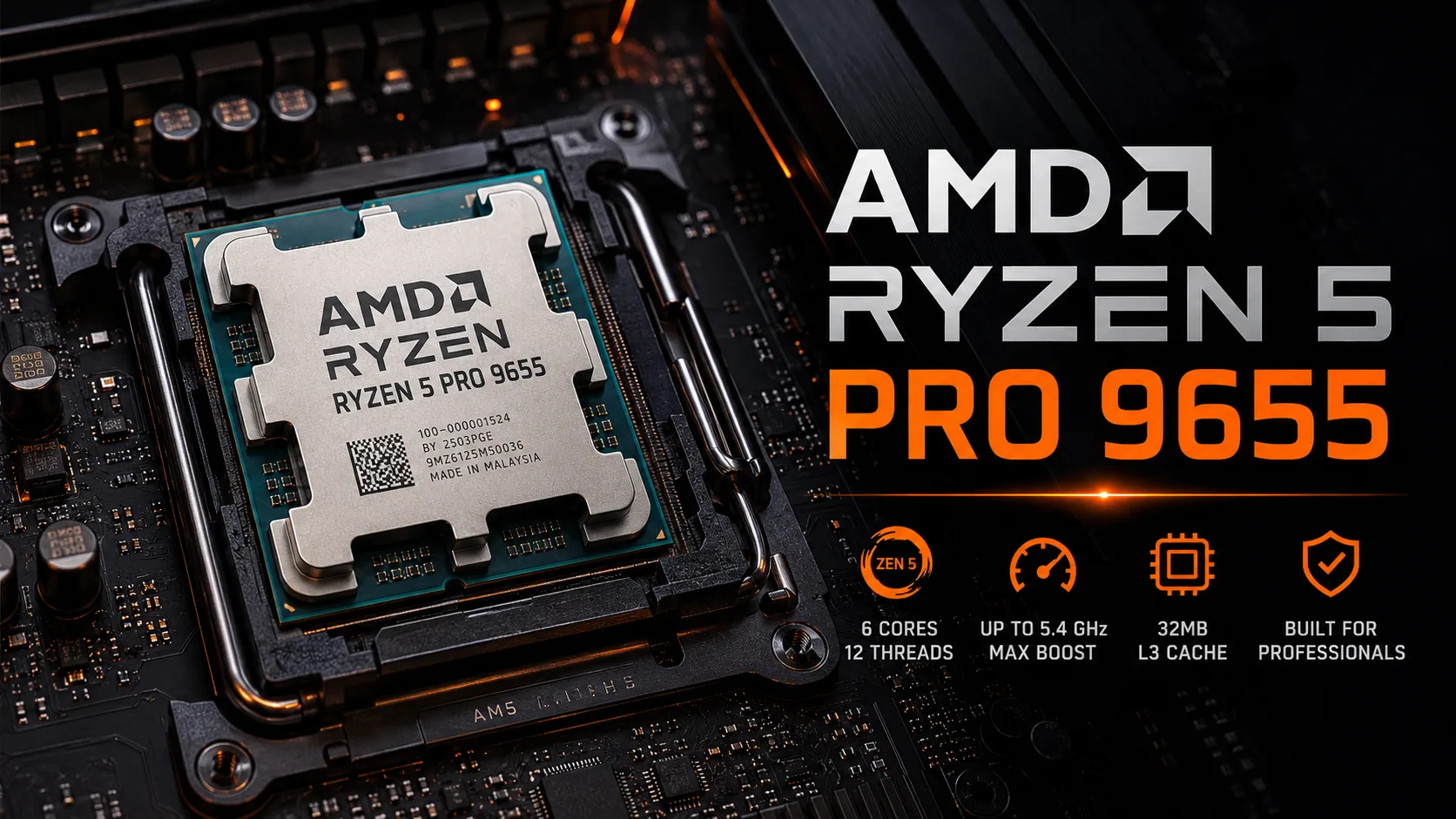
AMD Ryzen 5 PRO 9655: 6 Zen 5 Cores for High-Performance Business PCs
The AMD Ryzen 5 PRO 9655 is the entry-level, yet significant model in the Ryzen PRO 9000 lineup. Based on its specs, it is a 6-core Zen 5 processor with 12 threads, a frequency of up to 5.4 GHz, 32 MB of L3 cache, and a TDP of 120 W. Its purpose is not to replace the Ryzen 7 or Ryzen 9 in heavy workloads, but to provide high-performance business PCs with a modern AM5 platform, fast cores, and corporate features of AMD PRO.
While the Ryzen 7 PRO 9755 is aimed at more serious mixed workloads, and the Ryzen 9 PRO 9955 is targeted at multi-threaded workstations, the Ryzen 5 PRO 9655 fills a more accessible tier. It is suitable for professional workstations where 6 fast cores are adequate, but a margin for power, predictable operation, and support for corporate infrastructure is required.
Why This Processor is Interesting
The key feature of the Ryzen 5 PRO 9655 is the combination of 6 fast Zen 5 cores and a higher power limit of 120 W. For a 6-core processor, this is unusual: the closely related Ryzen 5 PRO 9645 has the same 6 cores and 12 threads, but belongs to the more energy-efficient 65-watt branch. Therefore, the Ryzen 5 PRO 9655 should be perceived as a more powerful version for systems with better cooling and longer workloads.
This can be useful in a professional PC. Not every workstation deals with rendering, complex simulations, or heavy editing. Often, it involves development, office multitasking, working with large spreadsheets, corporate applications, basic engineering tasks, light media processing, and a browser with many tabs. In such scenarios, not only the cores are important, but also high core speed, quick system response, and stable performance under load.
At the same time, this is not an X3D model and not a processor aimed at maximum multi-threaded performance. The Ryzen 5 PRO 9655 has the standard 32 MB of L3 cache, without 3D V-Cache. Its strength lies in classic versatility: fast Zen 5 cores, high boost, AM5, DDR5, PCIe 5.0, and AMD PRO features.
Performance and Benchmarks in PassMark
Currently, there are no direct public PassMark results for the Ryzen 5 PRO 9655. Therefore, it is useful to look at nearby models for reference: the Ryzen 5 PRO 9645 as a more economical PRO neighbor, the Ryzen 5 9600X as a retail 6-core equivalent, the Ryzen 7 PRO 9755 as a higher-tier model, and the Intel Core i5-14600K as an external Intel benchmark.
| Processor | CPU Mark | Single Thread | Comments |
|---|---|---|---|
| Intel Core i5-14600K | 38 447 | 4 268 | Strong Intel benchmark, more cores and a different platform |
| AMD Ryzen 7 PRO 9755 | 38 100 | 4 604 | 8-core PRO benchmark from a higher class |
| AMD Ryzen 5 PRO 9645 | 31 434 | 4 636 | Closest PRO model with a 65 W TDP |
| AMD Ryzen 5 9600X | 30 086 | 4 571 | Retail 6-core equivalent without PRO |
The table shows which processors to use as a reference when evaluating the Ryzen 5 PRO 9655. The closest logical neighbor is the Ryzen 5 PRO 9645: it has the same 6 cores, 12 threads, 32 MB L3, and boost up to 5.4 GHz, but a lower TDP. Therefore, it is reasonable to expect the Ryzen 5 PRO 9655 to perform better specifically in long-duration workloads if the system does not limit power and cooling.
The Ryzen 5 9600X serves as a retail benchmark without PRO positioning. In PassMark, it is close to the Ryzen 5 PRO 9645, meaning the Ryzen 5 PRO 9655 should be in the same class but with consideration for the higher power limit and specific OEM system configurations.
The Intel Core i5-14600K and Ryzen 7 PRO 9755 represent the upper limit for such a processor. They have more cores, so they appear stronger in multi-threaded synthetic tests. The Ryzen 5 PRO 9655 is not meant to compete directly with them: its job is to be a fast, manageable 6-core option for professional workstations.
How the Ryzen 5 PRO 9655 Differs from Ryzen 5 9600X
The Ryzen 5 PRO 9655 and the Ryzen 5 9600X are similar in their base architecture: both use Zen 5, have 6 cores, 12 threads, and 32 MB of L3 cache. However, their purposes differ.
The Ryzen 5 9600X is a retail processor for standard desktop PCs. It is suitable for home builds, mid-range gaming systems, and versatile computers. Its rationale is to provide high core speed, good energy efficiency, and user customization flexibility.
The Ryzen 5 PRO 9655 is designed for ready-made commercial systems. It features AMD PRO Technologies, security functions, remote management, and corporate support. Overclocking, AMD EXPO, Precision Boost Overdrive, and Curve Optimizer are officially disabled. For enthusiasts, this limitation is restrictive, but for a corporate fleet, such logic is understandable: less manual tuning leads to greater repeatability and predictability.
How It Differs from Ryzen 5 PRO 9645
The Ryzen 5 PRO 9645 and Ryzen 5 PRO 9655 are very close: both have 6 cores, 12 threads, Zen 5 architecture, 32 MB of L3 cache, and boost up to 5.4 GHz. The main difference is the power consumption class. The Ryzen 5 PRO 9645 belongs to the more economical 65-watt branch, while the Ryzen 5 PRO 9655 is rated at 120 W.
Because of this, the Ryzen 5 PRO 9645 appears to be a logical choice for compact, quiet, and energy-efficient business PCs. The Ryzen 5 PRO 9655 is better suited for workstations where not only energy efficiency but also headroom for sustained load is important.
To simplify, the Ryzen 5 PRO 9645 is a calm corporate 6-core processor, while the Ryzen 5 PRO 9655 is its more powerful version for systems with better cooling and more demanding tasks.
How It Differs from Ryzen 7 PRO 9755
The Ryzen 7 PRO 9755 is positioned higher in the lineup. It has 8 cores and 16 threads, so it should be significantly stronger in multi-threaded tasks. The Ryzen 5 PRO 9655 does not aim to replace the Ryzen 7: its task is to close the gap for professional systems where 6 cores are still sufficient.
For some workstations, this may be more sensible. If the workload mainly consists of office multitasking, development, browsing, corporate applications, light media processing, and occasional engineering software tasks, the Ryzen 5 PRO 9655 could prove adequate. However, if a user regularly runs virtual machines, heavy compiling, rendering, or more complex CAD/CAM scenarios, the Ryzen 7 PRO 9755 would be preferable.
Where the Ryzen 5 PRO 9655 Will Excel
The Ryzen 5 PRO 9655 is suitable for high-performance business PCs and entry-level professional workstations. This includes development, office multitasking, working with large documents and spreadsheets, corporate applications, light photo and video processing, basic engineering tasks, and running several applications simultaneously.
For heavy CPU rendering, it is better to look at the Ryzen 9 PRO. For a more versatile system with headroom for several years, the Ryzen 7 PRO 9755 is the logical choice. For compact and quiet office PCs, the Ryzen 5 PRO 9645 is sufficient. The Ryzen 5 PRO 9655 sits between these options: it is neither the most economical nor the most multi-core, but it offers a fast 6-core Zen 5 with an increased power limit.
Platform and Integrated Graphics
The processor uses the AM5 socket and supports DDR5, PCIe 5.0, up to 256 GB of memory, and ECC with motherboard support. For a work PC, this is an important set of features: performance depends not only on the CPU but also on RAM volume, storage speeds, graphics cards, and overall platform stability.
It also has integrated graphics - AMD Radeon Graphics with 2 graphics cores and a frequency of 2200 MHz. This is useful for image output, diagnostics, office work, and system maintenance but does not replace a discrete graphics card. In a professional system, the Ryzen 5 PRO 9655 can work with either a dedicated graphics card or without one, depending on whether the tasks require 3D acceleration.
Conclusion
The AMD Ryzen 5 PRO 9655 is a practical 6-core model for corporate PCs and entry-level professional workstations. It does not have a large number of cores like the Ryzen 7 and Ryzen 9 PRO, nor does it have 3D V-Cache like the X3D models. However, it features fast Zen 5 cores, 12 threads, 32 MB of L3 cache, a TDP of 120 W, AM5, DDR5, PCIe 5.0, and a set of AMD PRO functions.
The main idea of the Ryzen 5 PRO 9655 is to provide a business system with more headroom than the economical 65-watt model, but without stepping up to the more expensive Ryzen 7 class. It is not a processor for maximum rendering performance nor a gaming flagship, but a solid foundation for a high-performance workstation.
If a compact office machine is needed, the Ryzen 5 PRO 9645 will suffice. If significantly more multi-threaded power is required, it is better to look at the Ryzen 7 PRO 9755 or Ryzen 9 PRO. And if a modern, manageable, and sufficiently fast AM5 system for business is sought after, the Ryzen 5 PRO 9655 seems like a reasonable choice.
CPU Comparison
Compare Ryzen 5 PRO 9655 with other CPUs
Basic
CPU Specifications
Memory Specifications
GPU Specifications
Miscellaneous
Benchmarks
Compared to Other CPU
Share in social media
Or Link To Us
<a href="https://cputronic.com/cpu/amd-ryzen-5-pro-9655" target="_blank">AMD Ryzen 5 PRO 9655</a>