AMD Ryzen 5 7520U
AMD Ryzen 5 7520U: Four Zen 2 Cores Under the Ryzen 7000 Label
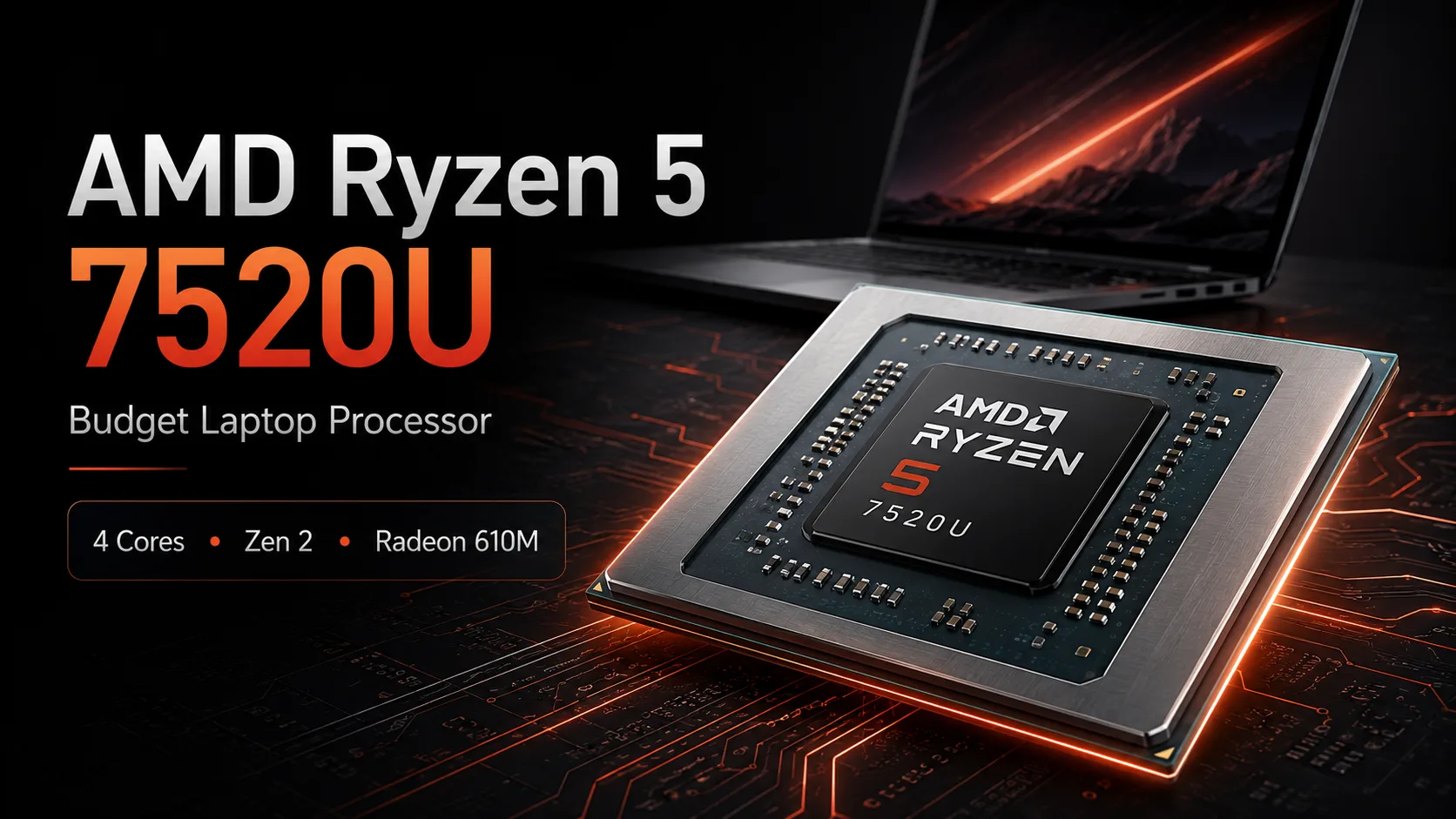
The AMD Ryzen 5 7520U is part of the Ryzen 7000 series; however, it features only four Zen 2 cores and entry-level Radeon 610M graphics. Laptops equipped with this processor are aimed at office applications, browsing, video calls, and video playback. When purchasing, it’s more important to consider memory size, screen quality, and the price of the specific model rather than focusing solely on the Ryzen 5 label.
The processor was released in September 2022 and belongs to the Mendocino family. It has four cores and eight threads, operates at a frequency range from 2.8 to 4.3 GHz, and has 4 MB of L3 cache. The chip is manufactured using TSMC’s 6nm process, with a standard TDP of 15W.
Ryzen 7000 with Zen 2 Cores
The Zen 2 architecture debuted in 2019. As a result, the Ryzen 5 7520U lags significantly behind the 7530U, 7535U, and 7640U models, despite all being in the Ryzen 7000 series.
Four cores are sufficient for browsing, office applications, and video calls. However, the lack of computational resources becomes apparent during video exporting, compiling, batch processing of photos, and when multitasking with several resource-intensive applications.
The platform only supports LPDDR5-5500 memory up to 16 GB. In most laptops, the memory is soldered, making it impossible to upgrade after purchase. Models with 8 GB are suitable for basic tasks, but when simultaneously using a browser, office applications, and video calls, the memory quickly becomes a limitation. For multitasking, it’s advisable to start with 16 GB.
Performance of Ryzen 5 7520U in Specific Laptops
Performance depends on power limits, cooling, temperature, and background processes. A single user benchmark does not reflect the results of all instances of the same model but gives a general idea of the processor’s performance level.
| Laptop | Geekbench 6, Single Core | Geekbench 6, Multi-Core |
|---|---|---|
| ASUS Vivobook Go 15 E1504FA | 1373 | 4234 |
| Lenovo V15 G4 AMN | 1347 | 3991 |
| HP Laptop 15-fc0xxx | 1336 | 4119 |
| Acer Aspire 3 A315-24P | 1291 | 3714 |
| Average Result | 1337 | 4015 |
The difference between the best and worst results is about 6% in single-threaded and 14% in multi-threaded tests. This is influenced by power limits, cooling efficiency, temperature, and system state during the Geekbench run.
The gap between models is small, so when choosing a laptop, memory size, screen quality, keyboard, and battery life are more important.
Radeon 610M: RDNA 2 in Minimal Configuration
The integrated Radeon 610M uses the RDNA 2 architecture but has only two compute units and operates at a frequency of up to 1.9 GHz. It is one of the entry-level configurations of integrated AMD graphics.
The Radeon 610M can easily handle Windows, video playback, and simple graphic applications. In modern games, it will be necessary to lower the resolution and settings, but even then, a stable frame rate may not be guaranteed.
For video editing, 3D graphics, and modern gaming, it’s better to choose a laptop with Radeon 660M, Radeon 680M, or a discrete graphics card.
How Ryzen 5 7520U Differs from Neighboring Models
The Ryzen 5 7520U is the higher-end model of the Mendocino family; however, other Ryzen 7000 processors may utilize entirely different cores and graphics.
- Ryzen 3 7320U has the same four Zen 2 cores and Radeon 610M. The Ryzen 5 7520U only stands out with slightly higher frequencies, so paying a premium for it is not justified.
- Ryzen 5 7530U has six cores and twelve threads. It is significantly faster in rendering, exporting, and other multi-threaded tasks.
- Ryzen 5 7535U employs Zen 3+ architecture and more powerful integrated Radeon 660M graphics.
Focusing solely on the processor number isn’t advisable; models within the same series can vary significantly in architecture and performance.
Comparison with Ryzen 5 5500U
The older Ryzen 5 5500U features six cores and twelve threads. In aggregated Geekbench 6 results, it scores around 5300 points in multi-threaded tests compared to approximately 4000 points for the Ryzen 5 7520U.
The difference can reach about 30%. The specific gap depends on the power limits and cooling of the laptop, but the advantage of the six-core model remains noticeable.
At a similar price, it’s better to choose a laptop with Ryzen 5 5500U, 5625U, or 7530U: the extra two cores aid in multitasking and offer greater performance headroom.
The main argument for the Ryzen 5 7520U is the low price of the finished laptop rather than the speed of the processor.
What to Look For When Buying
Consider purchasing a laptop with Ryzen 5 7520U if:
- It has 16 GB of RAM;
- It features a Full HD IPS display with adequate brightness;
- The SSD is at least 512 GB;
- The model is significantly cheaper than laptops with six-core Ryzen 5 processors;
- Its primary tasks are browsing, office applications, video calls, and video playback.
A slim body and touchscreen do not compensate for 8 GB of non-expandable memory and a dull display. In the budget segment, having 16 GB of RAM and a decent screen is more critical than a slight processor frequency advantage.
Conclusion
The Ryzen 5 7520U is justified only in affordable and balanced configurations. Four cores are sufficient for basic tasks, but the Radeon 610M and the cap of 16 GB of memory limit the laptop's capabilities.
Look for a model with 16 GB of memory, a Full HD IPS screen, and a 512 GB SSD. If the prices are similar, it’s better to choose a laptop with the six-core Ryzen 5 5500U, 5625U, or 7530U.
CPU Comparison
Compare Ryzen 5 7520U with other CPUs
Basic
CPU Specifications
Memory Specifications
GPU Specifications
Miscellaneous
Benchmarks
Compared to Other CPU
Related CPU Comparisons


Share in social media
Or Link To Us
<a href="https://cputronic.com/cpu/amd-ryzen-5-7520u" target="_blank">AMD Ryzen 5 7520U</a>