Qualcomm Snapdragon 7 Gen 3
vs
MediaTek Dimensity 6400

SoC Comparison Result
Dimensity 6400 vs Snapdragon 7 Gen 3: Budget 5G vs Mid-Range
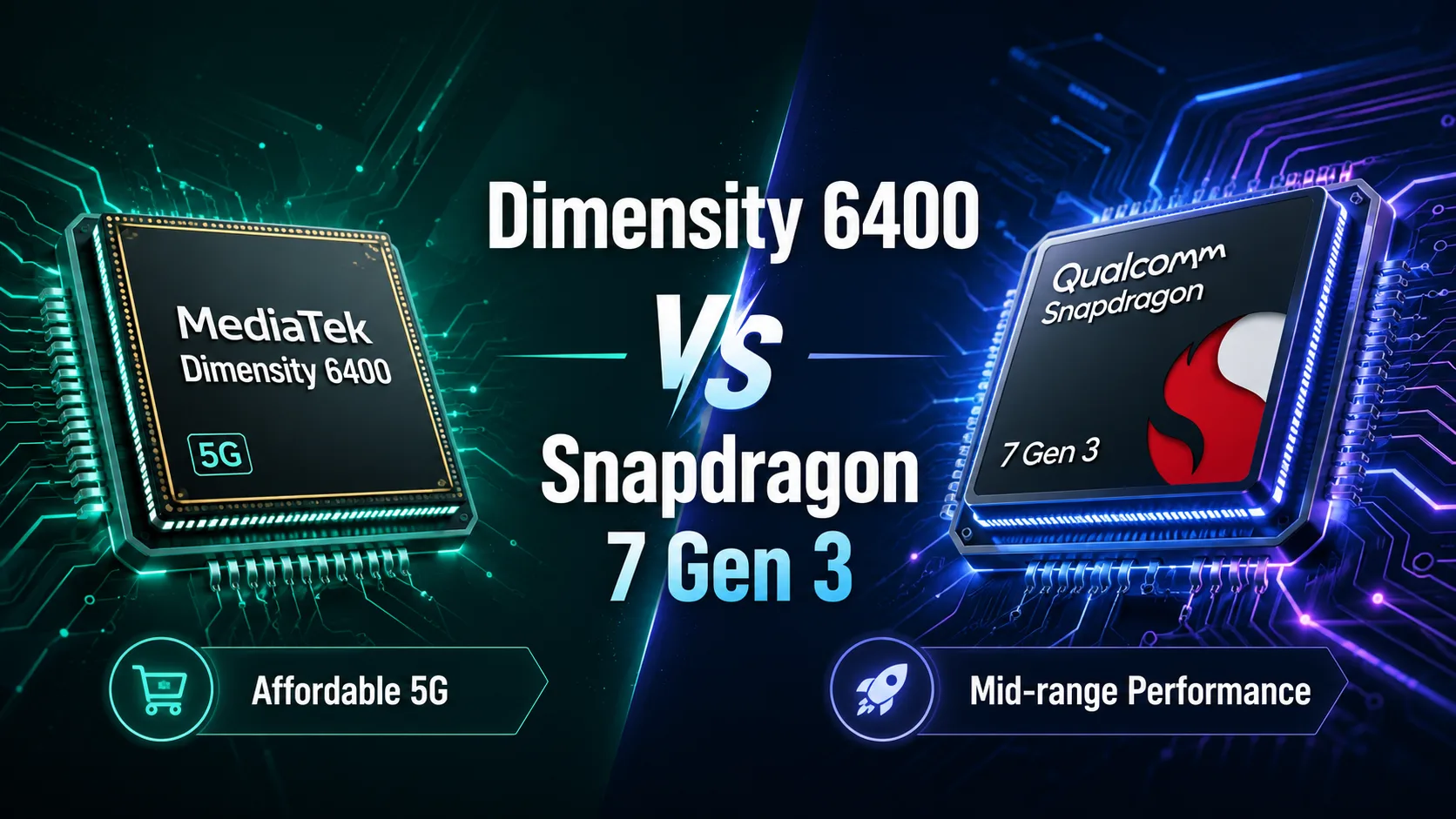
MediaTek Dimensity 6400 and Qualcomm Snapdragon 7 Gen 3 only appear similar at a glance: eight cores, 5G, and Android smartphones without a flagship price tag. In practice, they belong to different classes. The Dimensity 6400 is designed for affordable 5G models, while the Snapdragon 7 Gen 3 targets smartphones where gaming, camera capability, multitasking, and performance under load are crucial.
In a store card, two phones may look similar: 5G, a 120 Hz display, 8 GB of memory, and a large battery. However, these features do not reflect the GPU class, storage speed, ISP quality, and CPU headroom. Therefore, the differences between the smartphones can be much greater than what specifications suggest.
Differences in Positioning
The Dimensity 6400 is a chip for affordable 5G smartphones. It has two performance cores (Cortex-A76) up to 2.5 GHz and six energy-efficient cores (Cortex-A55) up to 2.0 GHz. This combination is suitable for browsing, video, messaging apps, navigation, banking applications, and light gaming.
The performance headroom is limited: the CPU is based on older cores, the GPU belongs to the basic level, and the memory and storage are typical for the budget segment. In ordinary tasks, this is sufficient, but under heavy load, the limitations become apparent more quickly.
The Snapdragon 7 Gen 3 belongs to a higher class. It features a more modern CPU configuration: one high-performance core up to 2.63 GHz, three performance cores up to 2.4 GHz, and four energy-efficient cores up to 1.8 GHz. Additionally, it utilizes a 4nm process, has an Adreno 720 GPU, and supports LPDDR5 and UFS 3.1.
The main question is not which chip is faster. The Snapdragon 7 Gen 3 is clearly faster. What matters more is how much cheaper a smartphone with Dimensity 6400 should be to make it a sensible choice.
Key Differences
| Specification | MediaTek Dimensity 6400 | Qualcomm Snapdragon 7 Gen 3 |
|---|---|---|
| Segment | affordable 5G smartphones | mid-range |
| Process Technology | 6 nm TSMC | 4 nm |
| CPU | 2× Cortex-A76 + 6× Cortex-A55 | 1× high-performance core + 3× performance + 4× energy-efficient |
| Max Clock Speed | up to 2.5 GHz | up to 2.63 GHz |
| GPU | Mali-G57 MC2 | Adreno 720 |
| Memory | LPDDR4X | LPDDR5 / LPDDR4X |
| Storage | UFS 2.2 | UFS 3.1 |
| Camera | up to 108 MP | up to 200 MP |
| Video | simpler than Snapdragon 7 Gen 3 | up to 4K HDR |
| Wi-Fi | Wi-Fi 5 | Wi-Fi 6 / 6E |
| Bluetooth | 5.2 | 5.4 |
The Dimensity 6400 meets basic requirements. The Snapdragon 7 Gen 3 surpasses it in almost every aspect of the platform: CPU, graphics, memory, storage, camera, and wireless interfaces. This impacts app launch times, gaming, photography, software updates, and multitasking.
Performance
In processor tests, the Snapdragon 7 Gen 3 usually outperforms the Dimensity 6400 by tens of percent. This is evident in demanding applications, task switching, photo processing, and interface speed. The Dimensity 6400 handles basic tasks but loses headroom under load more quickly.
Approximate results in popular tests:
| Test | Dimensity 6400 | Snapdragon 7 Gen 3 | What is evident |
|---|---|---|---|
| Geekbench 6 Single-Core | around 800 | around 1100-1200 | Snapdragon is faster in single-threaded tasks |
| Geekbench 6 Multi-Core | around 2000-2100 | around 3000+ | Snapdragon handles multitasking better |
| AnTuTu 10/11 | around 550K | around 950K-1.05M | The difference goes beyond the same class |
| 3DMark Steel Nomad Light | around 148 | around 480-525 | Adreno 720 is about 3 times faster than Mali-G57 MC2 |
The figures depend on the specific smartphone, cooling, and firmware, but the ratio remains consistent. In the CPU section, the Snapdragon 7 Gen 3 is faster by tens of percent, and the gap in graphics is even larger.
Graphics - The Main Gap
The Mali-G57 MC2 in the Dimensity 6400 is a basic GPU for affordable smartphones. It suffices for the interface, video, and light gaming. In demanding games, users will have to reduce graphics settings and cope with less stable FPS.
The Adreno 720 in the Snapdragon 7 Gen 3 is significantly more powerful. This is evident not only by the GPU name but also in 3DMark Steel Nomad Light: the Snapdragon 7 Gen 3 usually scores around 480-525 points, while the Dimensity 6400 hovers around 148 points. The difference is about threefold, so in games, this is no longer a minor advantage, but a different level of graphics.
This difference matters in the long run. As the requirements for applications and games grow, a weak GPU becomes outdated more quickly than a CPU. The Dimensity 6400 is suitable for occasional and simple games, while the Snapdragon 7 Gen 3 is better for regular gaming, although it doesn’t reach flagship levels.
Memory and Storage
The difference between LPDDR4X/UFS 2.2 and LPDDR5/UFS 3.1 is not always immediately obvious. However, it affects app launches, update installations, game loading, camera performance, and task switching.
The Dimensity 6400 has a simpler platform: LPDDR4X and UFS 2.2 correspond to the budget class. For everyday use, this is adequate, but the headroom is limited.
The Snapdragon 7 Gen 3 supports LPDDR5 and UFS 3.1. This speeds up app launching, game loading, updates, and handling large files. Thus, the difference is visible not only in CPU and GPU performance but also in the speed of the interface and applications.
Camera and Video
The Dimensity 6400 supports cameras up to 108 MP. For an affordable smartphone, this is sufficient, but the final quality still depends on the sensor, optics, and image processing.
The Snapdragon 7 Gen 3 offers more possibilities for processing photos and videos. With support for cameras up to 200 MP, a more serious ISP, and video capabilities up to 4K HDR, it is suitable for models where the camera should be one of the strong features of the smartphone.
This does not mean that any smartphone with the Snapdragon 7 Gen 3 will automatically take better photos. A weak sensor and simple optics will limit the results even with a more powerful chip. However, under equal conditions, Snapdragon provides manufacturers with more camera and video capabilities.
Connectivity
Both chips support 5G, but other interfaces differ. The Dimensity 6400 is limited to Wi-Fi 5 and Bluetooth 5.2, while the Snapdragon 7 Gen 3 supports Wi-Fi 6/6E, Bluetooth 5.4, and a more modern modem block. While this may not be evident in standard networks, for modern routers, wireless headphones, internet tethering, and large file transfers, the Snapdragon appears stronger.
Which One to Choose
The Dimensity 6400 should only be chosen when there is a significant price difference. It is suitable for basic tasks: communication, messaging, browsing, YouTube, maps, banking applications, and light gaming. In this scenario, display quality, battery life, memory capacity, interface, and price become more important.
The Snapdragon 7 Gen 3 is better suited for gaming, active multitasking, camera use, and a longer lifespan. It is faster in everyday operations, stronger in graphics, and better suited for a smartphone that is intended for long-term use.
A simple guideline is this: if a phone with the Dimensity 6400 is significantly cheaper, it can be considered as an affordable 5G option. If the prices are close, the Snapdragon 7 Gen 3 is more rational.
Conclusion
The Snapdragon 7 Gen 3 is significantly stronger than the Dimensity 6400: faster CPU, more powerful graphics, and more modern memory, storage, and wireless interfaces. This is not a comparison of equals but rather the difference between an affordable 5G chip and a mid-range one.
The Dimensity 6400 is justified only in a considerably cheaper smartphone. It is suitable for communication, browsing, video, and light gaming, but it quickly lags behind the Snapdragon 7 Gen 3 in graphics, demanding applications, camera capabilities, and long-term performance.
Advantages
- Higher Technology: 4 nm (4 nm vs 6 nm)
- Higher Frequency: 2630 MHz (2630 MHz vs 2500 MHz)
- Newer Launch Date: February 2025 (November 2023 vs February 2025)
Basic
3x 2.4 GHz – Cortex-A715
4x 1.8 GHz – Cortex-A510
GPU Specifications
Connectivity
Memory Specifications
Miscellaneous
Benchmarks
Comparison of Devices
Related SoC Comparisons




Share in social media
Or Link To Us
<a href="https://cputronic.com/soc/compare/qualcomm-snapdragon-7-gen-3-vs-mediatek-dimensity-6400" target="_blank">Qualcomm Snapdragon 7 Gen 3 vs MediaTek Dimensity 6400</a>