MediaTek Dimensity 6400
vs
MediaTek Helio G100
SoC Comparison Result
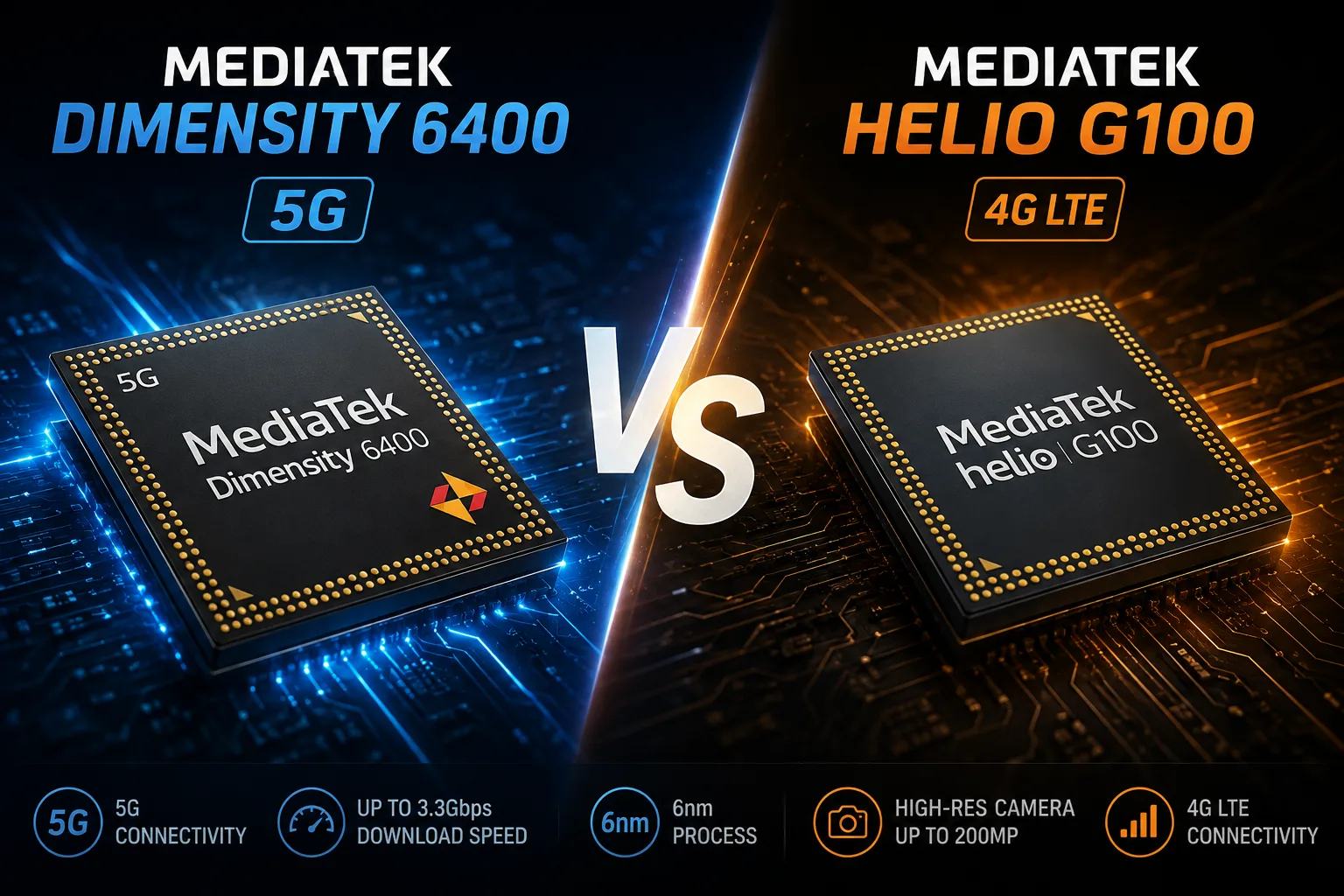
MediaTek Dimensity 6400 vs Helio G100: The Premium is for 5G, Not for Speed
MediaTek Dimensity 6400 looks more modern than Helio G100, but there isn't a noticeable leap in performance between them. The chips have the same cores, Mali-G57 MC2 graphics, LPDDR4X memory, and support for UFS 2.2. Dimensity has increased the clock speed of the performance cores and added a 5G modem, but in applications and games, the difference is usually small. Essentially, they are almost on the same performance level: Dimensity is intended for 5G smartphones, while Helio is for cheaper models with 4G.
Key Differences
| Characteristic | MediaTek Dimensity 6400 | MediaTek Helio G100 |
|---|---|---|
| Performance Cores | 2 × Cortex-A76, up to 2.5 GHz | 2 × Cortex-A76, up to 2.2 GHz |
| Efficiency Cores | 6 × Cortex-A55, up to 2.0 GHz | 6 × Cortex-A55, up to 2.0 GHz |
| Graphics | Mali-G57 MC2 | Mali-G57 MC2 |
| Process Technology | 6 nm | 6 nm |
| RAM | LPDDR4X | LPDDR4X |
| Storage | UFS 2.2 | UFS 2.2 |
| Mobile Network | 5G | 4G LTE |
| Maximum Camera Resolution | 108 MP | 200 MP |
Dimensity 6400 cannot be considered a full transition to a new generation of architecture. MediaTek retained the Cortex-A76 and Cortex-A55 cores, familiar from older budget platforms, but raised the clock speed of the two performance cores from 2.2 to 2.5 GHz. The main upgrade is not in the computing part, but in the modem.
Device Performance Results
| Device | Processor | RAM | AnTuTu 10 | Geekbench 6, Single Core | Geekbench 6, Multi-Core |
|---|---|---|---|---|---|
| TECNO POVA Slim 5G | Dimensity 6400 | 8 GB | 468,240 | 763 | 1,983 |
| Lenovo Idea Tab Plus | Dimensity 6400 | 8 GB | 430,344 | 761 | 2,002 |
| Xiaomi Redmi Note 14 Pro 4G | Helio G100 | 8 GB | 439,283 | 725 | 1,922 |
| Xiaomi Redmi Pad 2 4G | Helio G100 | 8 GB | 426,180 | 728 | 1,973 |
These are the results of smartphones and tablets, not laboratory figures for the processors themselves. Final scores are influenced by cooling, firmware, RAM capacity, storage speed, and background services. The difference of a few percentage points can easily vary from one device to another.
In single-threaded Geekbench, Dimensity 6400 outperforms Helio G100 by about 5%, which corresponds to the difference in frequency of the Cortex-A76. In the multi-core test, the gap narrows to about 2%, as the six efficiency cores run at the same frequency.
AnTuTu results vary more significantly, but here the influence of specific devices is particularly noticeable. The TECNO POVA Slim 5G scores around 468,000 points, while the Lenovo tablet with the same processor shows approximately 430,000. One high result cannot be transferred to all models with Dimensity 6400.
Everyday Use
Both processors handle browsers, messengers, social networks, navigation, and streaming video well. The interface can work smoothly on screens with a refresh rate of 90 or 120 Hz if the manufacturer has not overloaded the firmware and has equipped it with enough RAM.
Dimensity 6400 is slightly faster in tasks that depend on one or two performance cores: launching heavy apps, processing web pages, and performing individual operations with photos.
In practice, the amount of RAM, storage speed, and firmware quality have a greater impact on responsiveness than a slight CPU overclock. A well-optimized smartphone on Helio G100 can feel nicer to use than a cheap model with 5G, slow memory, and overloaded UI.
Gaming Performance
Both chips feature Mali-G57 MC2. The graphics become the main limiting factor in demanding games, so the increased CPU frequency does not give Dimensity 6400 a huge advantage.
Popular online projects and less demanding games run without major issues. In heavy titles, it will be necessary to reduce graphic quality, rendering resolution, or frame rates. Dimensity 6400 may slightly better maintain minimum FPS in CPU-dependent scenes, but switching to it for gaming does not make sense.
Both chips significantly lag behind platforms with more modern graphics. The Dimensity label alone does not turn a model into a gaming smartphone.
5G Support
The modem is the main and most noticeable advantage of Dimensity 6400. Helio G100 works only in 4G LTE networks, while Dimensity supports 5G.
In regions with good coverage, this can offer higher download speeds, and in a well-configured network, lower latency. If 5G is unavailable, poorly covers needed areas, or is not included in the tariff, the advantages of Dimensity almost disappear.
Thus, the premium for Dimensity 6400 should be justified not by a few percentage points in Geekbench, but by the next-generation mobile network.
Cameras
Helio G100 supports sensors with resolutions up to 200 MP, while Dimensity 6400 supports up to 108 MP. On paper, the advantage lies with Helio, but resolution alone says little about photo quality.
A smartphone with a 50 MP or 108 MP camera can take better pictures than a model with a 200 MP sensor due to better optics, stabilization, and image processing. Therefore, choosing between specific devices based on maximum camera resolution is not advisable.
What to Choose
At the same price, a smartphone with Dimensity 6400 is preferable. It is slightly faster in single-threaded tasks, supports 5G, and does not lag behind Helio G100 in graphics performance.
Helio G100 makes sense to choose when the device is significantly cheaper or offers a better screen, cameras, battery, body protection, or faster charging. Losing a few percentage points in CPU performance rarely outweighs a noticeable difference in features.
The conclusion is simple: Dimensity 6400 is not a significant step forward compared to Helio G100, but a similarly fast platform with a higher CPU frequency and a 5G modem. In 4G networks, the difference between them is almost cosmetic. When 5G is available, the choice of Dimensity becomes much more compelling.
Advantages
- Higher Frequency: 2500 MHz (2500 MHz vs 2200 MHz)
- Newer Launch Date: February 2025 (February 2025 vs August 2024)
Basic
GPU Specifications
Connectivity
Memory Specifications
Miscellaneous
Benchmarks
Comparison of Devices
Related SoC Comparisons


Share in social media
Or Link To Us
<a href="https://cputronic.com/soc/compare/mediatek-dimensity-6400-vs-mediatek-helio-g100" target="_blank">MediaTek Dimensity 6400 vs MediaTek Helio G100</a>