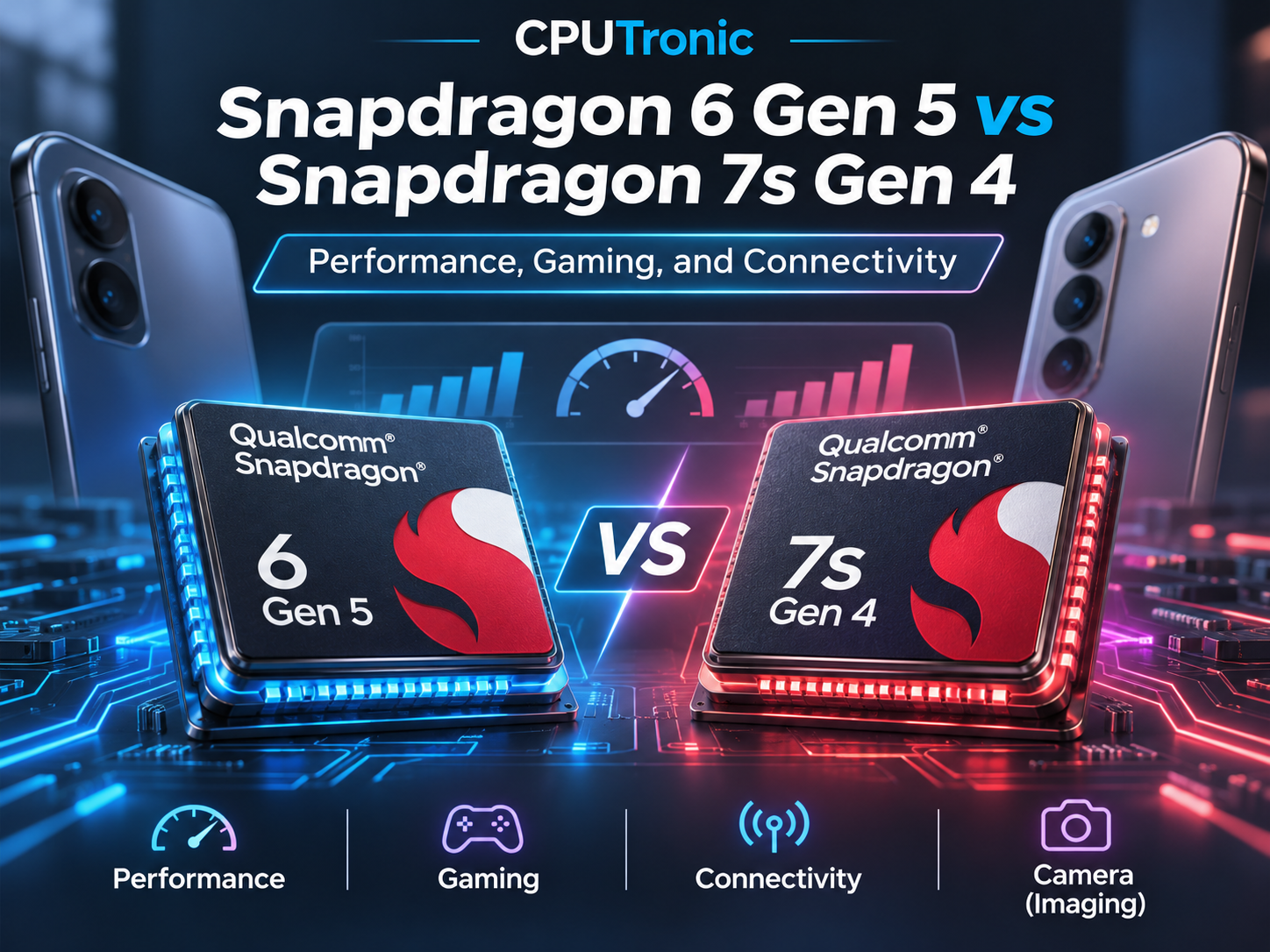
Qualcomm Snapdragon 6 Gen 5
vs
Qualcomm Snapdragon 7s Gen 4


SoC Comparison Result
Snapdragon 6 Gen 5 vs. Snapdragon 7s Gen 4: performance, gaming, and connectivity
Snapdragon 6 Gen 5 and Snapdragon 7s Gen 4 are designed for mid-range smartphones, but belonging to a higher-tier series does not guarantee higher performance. The smartphones tested in 3DMark achieved nearly identical results, while the balance of power in Geekbench 6 depends on the workload: the model with 7s Gen 4 is faster in the single-core test, while the 6 Gen 5 model is faster in the multi-core test. At the same time, the 6 Gen 5 supports newer wireless standards, whereas the 7s Gen 4 supports simultaneous image processing from three cameras instead of two.
| Parameter | Snapdragon 6 Gen 5 | Snapdragon 7s Gen 4 |
|---|---|---|
| CPU configuration | 4 performance cores up to 2.6 GHz + 4 efficiency cores up to 2.0 GHz | 1 Prime core up to 2.7 GHz + 3 performance cores up to 2.4 GHz + 4 efficiency cores up to 1.8 GHz |
| Wi-Fi supported by the platform | Wi-Fi 7 | Wi-Fi 6E |
| Bluetooth supported by the platform | 6.0, including Channel Sounding | 5.4 |
| Image processing | Two ISPs; two cameras with resolutions up to 16 MP each, with ZSL | Three ISPs; three cameras with resolutions up to 21 MP each, with ZSL |
ISP means image signal processor, and ZSL means zero-shutter-lag capture. The table lists the platforms’ capabilities; a smartphone manufacturer may implement only some of them.
Performance: results from specific smartphones
The table contains the results of four smartphones in AnTuTu 11 and Geekbench 6. The overall AnTuTu score takes CPU, GPU, memory, and system performance into account, so it does not replace separate processor and graphics tests. Results depend on the firmware, memory configuration, and power mode.
| Smartphone | Chip | AnTuTu 11 | Geekbench 6 Single-Core | Geekbench 6 Multi-Core |
|---|---|---|---|---|
| Honor X9e Pro | Snapdragon 6 Gen 5 | 979,936 | 1,104 | 3,390 |
| iQOO Z11 5G, Snapdragon version | Snapdragon 7s Gen 4 | 1,178,399 | 1,247 | 3,171 |
| Vivo V70 Lite 5G | Dimensity 7400 Turbo | 969,420 | 928 | 2,814 |
| Realme P3 Ultra | Dimensity 8350 Ultra | 1,155,267 | 1,280 | 4,240 |
The iQOO Z11 outperforms the Honor X9e Pro by approximately 20% in AnTuTu and 13% in the single-core Geekbench test. In the multi-core test, however, the Honor is approximately 7% faster. This ratio applies to the models tested.
The Honor and Vivo achieve nearly identical AnTuTu scores, although the Honor is noticeably faster in Geekbench. The Realme P3 Ultra outperforms both Snapdragon smartphones in the multi-core test but trails the iQOO in the overall AnTuTu score. A high overall score does not mean an advantage in every task.
Graphics and gaming
In 3DMark Steel Nomad Light, the Honor X9e Pro scored 438 points, while the Indian version of the Motorola Edge 70 Fusion with Snapdragon 7s Gen 4 scored 434. The measurements were taken in different reviews, so the four-point difference should not be considered an advantage for either chip. For comparison, the Realme P4 Pro with Snapdragon 7 Gen 4 scored 682 points-approximately 57% more than the Motorola.
On the Motorola tested, Call of Duty: Mobile offered low graphics settings capped at 90 FPS and high settings capped at 60 FPS. During testing in both modes, the game ran smoothly. The stated 60 and 90 FPS are settings caps, not measured average values. In Genshin Impact, even the low settings did not provide smooth performance.
The Honor X9e Pro achieved 99.3% stability in the Steel Nomad Light stress test: the best run scored 438 points, while the worst scored 435. Under sustained load in this test, graphics performance barely declined. However, stability does not compensate for the GPU’s limited speed in demanding games.
These tests do not allow the chips’ energy efficiency to be compared. Battery life should be evaluated for specific smartphones, as it is also affected by the battery, display, and usage pattern.
Connectivity, cameras, and AI
Snapdragon 6 Gen 5 supports Wi-Fi 7 and Bluetooth 6.0, but they can be used only if the smartphone itself and the connected equipment support these standards. The chip’s capabilities are not always implemented in full. For example, the Malaysian version of the iQOO Z11 with 7s Gen 4 is listed as supporting Wi-Fi 6 and Bluetooth 5.2, although the platform supports Wi-Fi 6E and Bluetooth 5.4.
The 7s Gen 4’s three ISPs allow it to process images from three cameras simultaneously. Photo quality also depends on the sensors, optics, and software processing. Both platforms support cameras of up to 200 MP and 4K HDR recording at 30 FPS. The 7s Gen 4 does not support 4K recording at 60 FPS.
For the Snapdragon 7s Gen 4, Qualcomm specifies a Hexagon NPU and support for local generative models, including Llama 1B and Qwen 1B. The practical benefit depends on the available applications, supported languages, and whether the required functions can be used without an internet connection.
Which chip should you choose?
- For processor-intensive tasks, the advantage depends on the workload: the iQOO with 7s Gen 4 is faster in the single-core test, while the Honor with 6 Gen 5 is faster in the multi-core test.
- For gaming, paying extra for the Snapdragon 7s Gen 4 is not always justified: in Steel Nomad Light, the results of the smartphones considered differ by less than 1%.
- For wireless connectivity, the 6 Gen 5 supports newer standards, but their availability must be checked in the phone’s specifications.
- For photos and video, the 7s Gen 4 allows simultaneous image processing from three cameras. This expands shooting capabilities but does not guarantee better photo quality.
At a comparable price, a smartphone with Snapdragon 7s Gen 4 has no unconditional advantage. Choosing it is justified if the specific model is faster in the applications you need or offers the required features. If a Snapdragon 6 Gen 5 device is cheaper and meets your expectations for display and camera quality, as well as software support duration, the tests provide no reason to reject it solely because of its series number.
Advantages
- Newer Launch Date: May 2026 (May 2026 vs August 2025)
- Higher Frequency: 2700 MHz (2.6 GHz vs 2700 MHz)
Basic
GPU Specifications
Connectivity
Memory Specifications
Miscellaneous
- AIFF
- CAF
- MP3
- MP4
- WAV
- H.265
- VP9
Benchmarks
Comparison of Devices
Related SoC Comparisons





Share in social media
Or Link To Us
<a href="https://cputronic.com/soc/compare/qualcomm-snapdragon-6-gen-5-vs-qualcomm-snapdragon-7s-gen-4" target="_blank">Qualcomm Snapdragon 6 Gen 5 vs Qualcomm Snapdragon 7s Gen 4</a>