Qualcomm Snapdragon 4 Gen 4

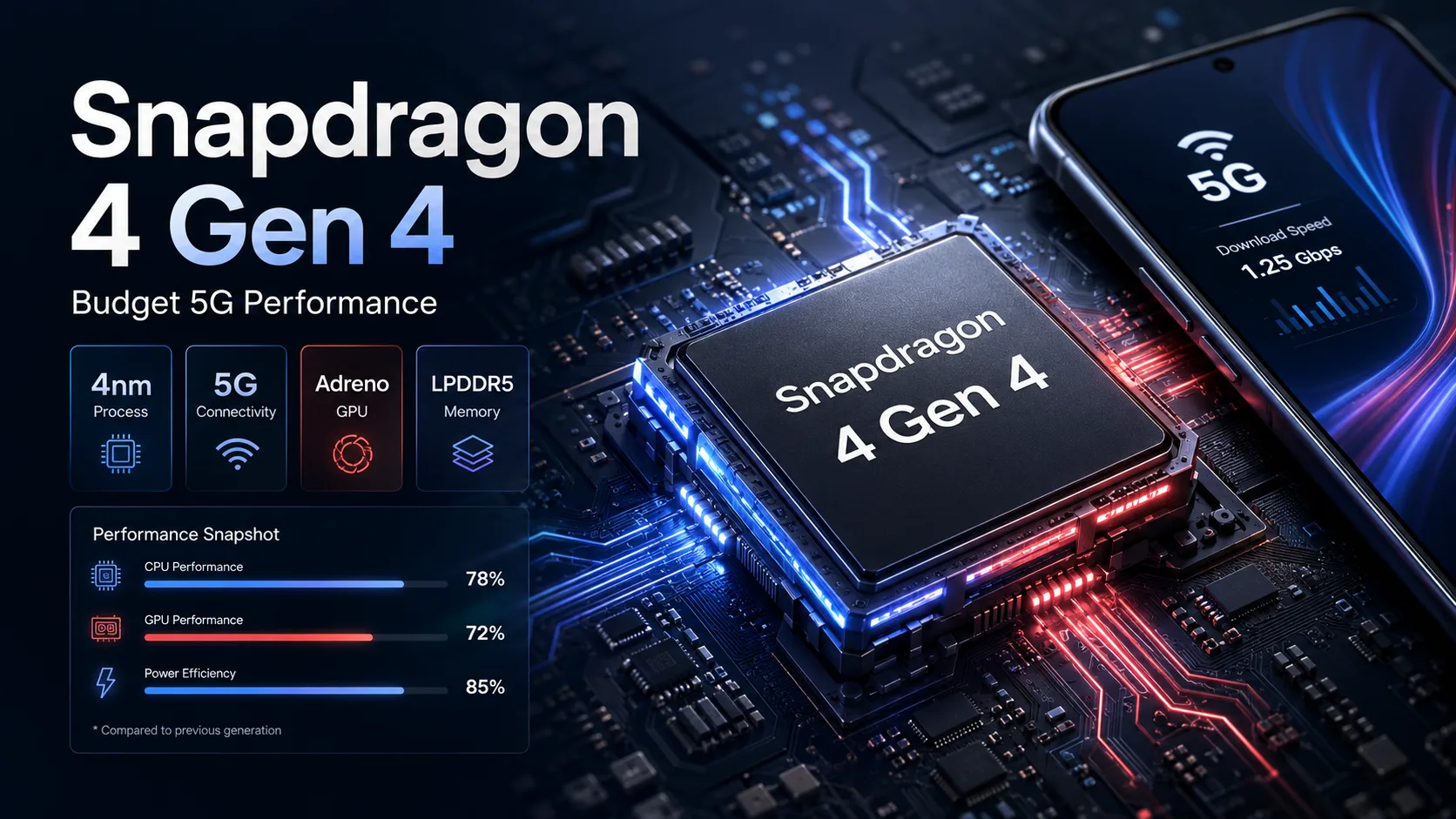
Qualcomm Snapdragon 4 Gen 4: Performance and Benchmarks in Real Smartphones
Qualcomm Snapdragon 4 Gen 4 is a budget 5G platform without a noticeable performance leap compared to its predecessor. The chip is primarily aimed at affordable smartphones, where energy consumption and stable performance are more important.
Snapdragon 4 Gen 4 is already used in smartphones from Redmi, POCO, and Honor, making it possible to assess its capabilities on specific devices rather than just through claimed specifications.
Snapdragon 4 Gen 4 in Real Smartphones
The performance results of Snapdragon 4 Gen 4 vary slightly depending on the memory, cooling, and specific settings of each smartphone. The variation is modest: the tested models score about 920-950 points in Geekbench 6 Single-Core and 2150-2330 in Multi-Core.
| Smartphone | Geekbench 6 Single | Geekbench 6 Multi | AnTuTu 11 | 3DMark Wild Life |
|---|---|---|---|---|
| POCO M8 Power 5G | 952 | 2 269 | 625 331 | - |
| Redmi Note 17 5G, 8 GB | 950 | 2 324 | - | - |
| Honor 600 Smart 5G, 4/128 GB | 927 | 2 205 | 570 353 | - |
| Honor X7e Plus 5G, 8/256 GB | 917 | 2 148 | - | 780 |
The POCO M8 Power scores 952/2269 in Geekbench 6 and 625,331 in AnTuTu 11. The Redmi Note 17 5G is nearly at the same level with 950/2324 points.
Honor 600 Smart and X7e Plus lag slightly behind, but the difference remains within a few percentage points. The typical result for Snapdragon 4 Gen 4 is about 930-950 points in Geekbench 6 Single-Core and 2200-2300 in Multi-Core.
The AnTuTu result is more dependent on memory, storage, and software, so the variation among smartphones is greater here.
CPU: No Significant Performance Boost over Snapdragon 4 Gen 2
The CPU segment includes two performance cores clocked up to 2.3 GHz and six efficiency cores up to 2.0 GHz.
In terms of CPU performance, the Snapdragon 4 Gen 4 only slightly outperforms Snapdragon 4 Gen 2. The results of the two chips in real-world tests differ insignificantly, so switching from a smartphone with Snapdragon 4 Gen 2 to a model with Snapdragon 4 Gen 4 solely for CPU performance does not make sense.
Around 2200-2300 points in Geekbench 6 Multi-Core is sufficient for browsing, messaging, navigation, streaming video, and typical multitasking.
In photo processing, video editing, and other resource-intensive tasks, Snapdragon 4 Gen 4 significantly lags behind chips from the Snapdragon 6 and especially 7 series.
Adreno 613 - The Main Limitation of Snapdragon 4 Gen 4
Qualcomm refers to the graphics simply as Adreno, while diagnostic tools in finished smartphones identify it as Adreno 613.
Support for Full HD+ displays at 120 Hz does not mean that heavy games can run at 120 FPS.
The Honor X7e Plus scores around 780 points in 3DMark Wild Life, which is entry-level mobile graphics.
However, under prolonged load, performance hardly decreases: in stress tests, the score remains in the range of 774-777 points with stability around 99.6%. The temperature remains about 36-37 °C.
The Adreno 613 handles simple games without issues. In modern heavy projects, users will have to set low graphics settings and sometimes reduced rendering resolution.
LPDDR5 and UFS 3.1 Are in Specifications, But Not in Every Smartphone
Snapdragon 4 Gen 4 supports LPDDR5 up to 3200 MHz, LPDDR4X up to 2133 MHz, and UFS 3.1 storage.
However, support for LPDDR5 and UFS 3.1 from the SoC does not mean that the manufacturer will install them in a specific smartphone. In budget models, LPDDR4X and UFS 2.2 are often used.
Therefore, two smartphones based on Snapdragon 4 Gen 4 can significantly differ in application launch speed, file handling, and overall system responsiveness, even if CPU test results are nearly identical.
When choosing a specific model, the type of memory and storage is as important as the processor name.
Camera and Connectivity: 5G is Available, But Wi-Fi 5 and 1080p Indicate Budget Class
Snapdragon 4 Gen 4 supports 5G Sub-6 with download speeds up to 2.5 Gbps, Wi-Fi 5, and Bluetooth 5.1.
The ISP supports cameras with resolutions up to 108 MP. When shooting without shutter lag, the maximum configuration is 36 MP for a single camera or 16+16 MP for dual cameras.
The maximum video recording resolution is 1080p at 60 frames per second. There is no support for 4K.
Wi-Fi 5, Bluetooth 5.1, and the lack of 4K video recording clearly demonstrate the class of the platform: in the Snapdragon 6 series, connectivity and multimedia capabilities are usually broader.
Snapdragon 4 Gen 5 Promises Significantly Faster Graphics
Qualcomm has already announced Snapdragon 4 Gen 5, and the main improvement in the new generation addresses the weak point of 4 Gen 4 - graphics.
In internal tests, Qualcomm Snapdragon 4 Gen 5 shows up to 77% higher GPU performance. The company also claims a 43% speedup in application launches and approximately 25% fewer UI stutters.
In serial smartphones, the difference may be different, but the trend is clear: the GPU in Snapdragon 4 Gen 4 will quickly become its weak point.
Conclusion
Snapdragon 4 Gen 4 itself does not provide smartphones with a noticeable advantage over competitors. Its CPU is only slightly faster than the previous generation, and the graphics remain the main limitation for gaming.
In the tested smartphones, the chip operates steadily under prolonged load, and the CPU performance is sufficient for browsing, messaging, navigation, and typical multitasking.
Choosing a smartphone with Snapdragon 4 Gen 4 is primarily about price, battery life, display, or the device's specific features, not the processor itself.
If a model with a Snapdragon 6 series chip costs only a little more, the extra cost is usually justified.
SOC Comparison
Compare Snapdragon 4 Gen 4 with other SOCs
Basic
6x 2 GHz – Cortex-A55
GPU Specifications
Connectivity
Memory Specifications
Miscellaneous
- AIFF
- CAF
- MP3
- MP4
- WAV
- H.265
- VP9
Benchmarks
Compared to Other SoC
Related SoC Comparisons


Share in social media
Or Link To Us
<a href="https://cputronic.com/index.php/soc/qualcomm-snapdragon-4-gen-4" target="_blank">Qualcomm Snapdragon 4 Gen 4</a>