Qualcomm Snapdragon 685
vs
Qualcomm Snapdragon 4 Gen 4


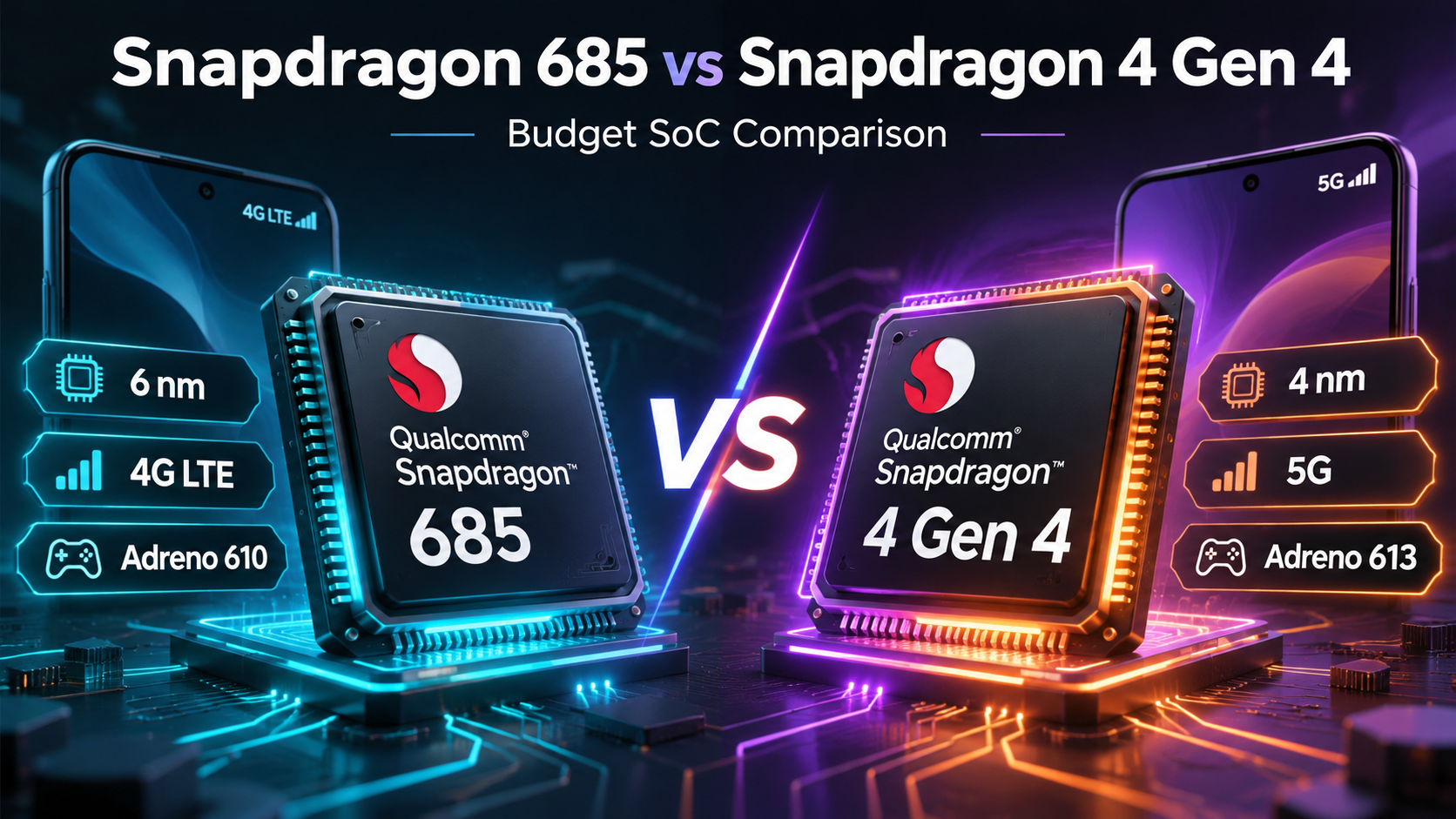
SoC Comparison Result
Snapdragon 685 vs. Snapdragon 4 Gen 4: Performance, Graphics, and Features Compared
The Qualcomm Snapdragon 4 Gen 4 nearly doubles the Snapdragon 685's score in the single-threaded Geekbench 6 test and leads by approximately 49% in the multi-threaded test. This advantage comes from a more modern CPU architecture, even though the newer chip has a lower maximum clock speed. The difference is considerably smaller in graphics tests. In addition, the Snapdragon 4 Gen 4 supports 5G, faster RAM, and faster storage, but its actual capabilities depend on the specific smartphone.
Architecture and Key Differences
| Specification | Snapdragon 685 | Snapdragon 4 Gen 4 |
|---|---|---|
| Release date | March 2023 | December 2025 |
| Performance cores | 4 × Cortex-A73, 2.8 GHz | 2 × Cortex-A78, 2.3 GHz |
| Efficiency cores | 4 × Cortex-A53, 1.9 GHz | 6 × Cortex-A55, 2.0 GHz |
| Process technology | 6 nm, TSMC | 4 nm, Samsung |
| Graphics | Adreno 610 | Adreno 613 |
| RAM | LPDDR4X, up to 2133 MHz | LPDDR5 up to 3200 MHz, LPDDR4X |
| Storage | UFS 2.2 | UFS 2.2, UFS 3.1 |
| Mobile connectivity | 4G LTE | 4G LTE, 5G |
| Maximum download speed | 390 Mb/s | 2.5 Gb/s |
| Bluetooth | 5.2 | 5.1 |
| Fast charging | Quick Charge 3 | Quick Charge 4+ |
The main change is the move from Cortex-A73 to Cortex-A78. Despite its lower clock speed, the Cortex-A78 delivers significantly higher per-core performance. The gap is smaller in the multi-threaded test: the four Cortex-A73 cores in the Snapdragon 685 partially offset the advantage of the Snapdragon 4 Gen 4's two more powerful Cortex-A78 cores.
Performance in Geekbench 6 and AnTuTu
| Benchmark | Snapdragon 685 | Snapdragon 4 Gen 4 | Advantage |
|---|---|---|---|
| Geekbench 6 Single-Core | 475 | 949 | +100% |
| Geekbench 6 Multi-Core | 1 517 | 2 254 | +49% |
| AnTuTu 11 | 476 175 | 593 849 | +25% |
The table shows approximate processor results. Scores on specific smartphones may differ because of cooling, memory configuration, and system settings.
The most noticeable gap appears in the single-threaded Geekbench 6 test. High single-core performance is useful when loading web pages, executing JavaScript, and running applications whose workloads are not distributed evenly across all cores. However, a twofold difference in scores does not mean that a smartphone will perform every everyday task twice as quickly.
In AnTuTu 11, the advantage falls to 25% because the overall score takes into account not only the CPU, but also graphics, memory, and other system components.
Benchmarks on Specific Smartphones
Six devices were used for the comparison-three with each processor. All AnTuTu results are from version 11, while the Geekbench scores are from version 6.
| Smartphone | Processor | Geekbench 6 Single | Geekbench 6 Multi | AnTuTu 11 |
|---|---|---|---|---|
| Xiaomi Redmi Note 12 4G | Snapdragon 685 | 469 | 1 484 | 496 286 |
| Honor X7c | Snapdragon 685 | 463 | 1 463 | 483 206 |
| Realme C67 4G | Snapdragon 685 | 465 | 1 412 | 437 619 |
| Xiaomi Redmi Note 17 5G | Snapdragon 4 Gen 4 | 900 | 2 178 | 593 849 |
| Honor 600 Smart | Snapdragon 4 Gen 4 | 927 | 2 205 | 570 353 |
| POCO M8 Power | Snapdragon 4 Gen 4 | 952 | 2 328 | 611 651 |
In the single-threaded Geekbench 6 test, smartphones with the Snapdragon 685 score 463-469 points, while devices with the Snapdragon 4 Gen 4 score 900-952. The advantage also persists in the multi-threaded test: 1 412-1 484 versus 2 178-2 328 points.
The difference between devices is smaller in AnTuTu 11. For example, the Redmi Note 12 4G scores 496 thousand points, while the Honor 600 Smart scores 570 thousand, corresponding to an advantage of approximately 15%.
The range of results shows why a processor should not be judged solely by its overall AnTuTu score. Storage speed and memory configuration also affect the final score.
Graphics Performance and Gaming
The Snapdragon 685 uses the Adreno 610, while smartphones with the Snapdragon 4 Gen 4 are equipped with the Adreno 613. The 3DMark results from two devices are suitable for comparing their graphics performance.
| 3DMark | Redmi Note 12 4G (Adreno 610) | Redmi Note 17 5G (Adreno 613) | Difference |
|---|---|---|---|
| Wild Life | 644 | 773 | +20% |
| Wild Life Extreme | 135 | 187 | +39% |
In Wild Life, the newer graphics accelerator is approximately 20% faster, while in the more demanding Wild Life Extreme, it is 39% faster. These are results from specific smartphones, not a guaranteed GPU improvement across all devices.
Absolute scores remain low. In the Wild Life graphics test, the Redmi Note 12 4G delivers approximately 4 FPS, while the Redmi Note 17 5G delivers approximately 5 FPS. In Wild Life Extreme, both devices operate at around 1 FPS.
Therefore, the Snapdragon 4 Gen 4 offers an advantage in graphics workloads, but both processors are primarily aimed at undemanding games. In modern, demanding titles, graphics quality will need to be reduced, and stable 60 FPS at high settings should not be expected.
Memory, Connectivity, and Power Efficiency
The Snapdragon 4 Gen 4 supports LPDDR5 at up to 3200 MHz and UFS 3.1 storage. Compared with the Snapdragon 685, which is designed for LPDDR4X and UFS 2.2, this gives manufacturers more options.
However, support for a newer standard does not guarantee that it will be used. The Redmi Note 17 5G and POCO M8 Power are equipped with LPDDR4X and UFS 2.2. Therefore, when choosing a smartphone, it is important to consider the memory actually installed, not just the processor's specifications.
Another significant difference is 5G support. The Snapdragon 4 Gen 4 modem provides a theoretical download speed of up to 2.5 Gb/s, while the Snapdragon 685 is limited to LTE with a maximum of 390 Mb/s. Actual speeds depend on the mobile network and reception conditions.
Both platforms support Wi-Fi 5 and photography at resolutions of up to 108 MP, as well as video recording at up to 1080p and 60 FPS. Neither platform supports 4K recording.
The more modern 4 nm process creates the potential for better power efficiency in the Snapdragon 4 Gen 4. However, comparing battery life based solely on process technology is incorrect: power consumption is also affected by the display, battery, system settings, and workload.
Which Processor Should You Choose?
The Snapdragon 4 Gen 4 is preferable for a new budget smartphone, especially if CPU performance and 5G support are important. It significantly outperforms the Snapdragon 685 in Geekbench 6 and achieves higher results in graphics tests.
The Snapdragon 685 remains sufficient for messaging, video playback, navigation, and other simple tasks. However, its Cortex-A73 architecture is noticeably inferior to Cortex-A78 in computing performance.
If smartphones are similarly priced, choosing the Snapdragon 4 Gen 4 is justified. But if the newer model is significantly more expensive, it is also worth comparing the display, memory capacity, storage, and cameras. In the budget segment, these specifications may prove more important than the difference between the processors.
Advantages
- Higher Frequency: 2800 MHz (2800 MHz vs 2300 MHz)
- Higher Technology: 4 nm (6 nm vs 4 nm)
- Newer Launch Date: December 2025 (March 2023 vs December 2025)
Basic
6x 2 GHz – Cortex-A55
GPU Specifications
Connectivity
Memory Specifications
Miscellaneous
- AIFF
- CAF
- MP3
- MP4
- WAV
- H.265
- VP9
Benchmarks
Related SoC Comparisons



Share in social media
Or Link To Us
<a href="https://cputronic.com/index.php/soc/compare/qualcomm-snapdragon-685-vs-qualcomm-snapdragon-4-gen-4" target="_blank">Qualcomm Snapdragon 685 vs Qualcomm Snapdragon 4 Gen 4</a>