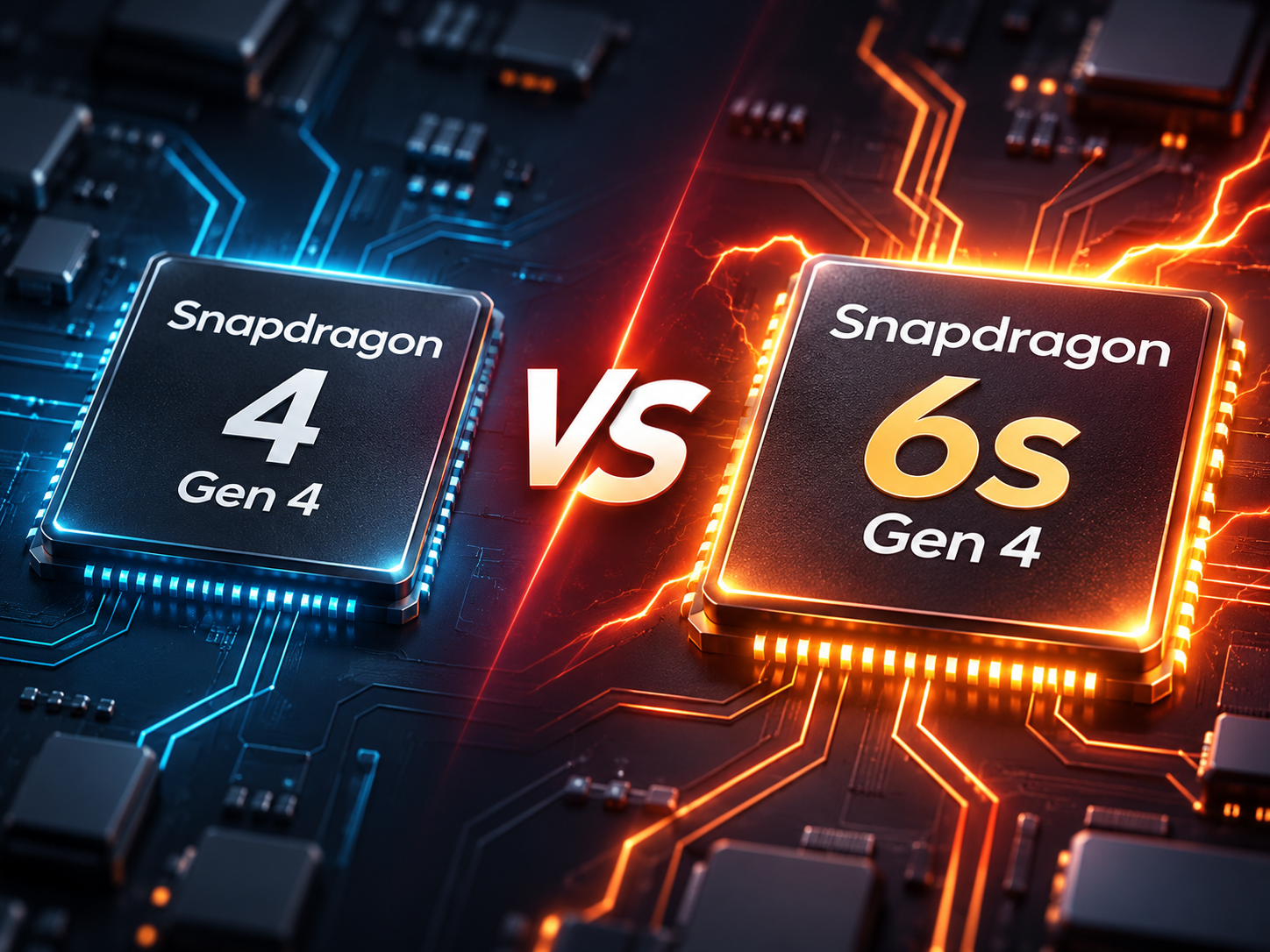
Qualcomm Snapdragon 4 Gen 4
vs
Qualcomm Snapdragon 6s Gen 4

SoC Comparison Result
Snapdragon 4 Gen 4 vs Snapdragon 6s Gen 4: CPU and Graphics Performance Comparison
In tests of four smartphones, the Snapdragon 6s Gen 4 was, on average, 30% faster than the Snapdragon 4 Gen 4 in the multi-core Geekbench 6 test. In 3DMark Wild Life, the Motorola Moto G57 Power scored almost four times as many points as the POCO M8 Power 5G. The main differences are four Cortex-A78 performance cores instead of two and significantly more powerful graphics.
Both processors are manufactured using Samsung’s 4 nm process and support 5G. They are used in budget smartphones, but the Snapdragon 6s Gen 4 is noticeably faster in multi-core workloads and graphics tests.
Key Differences
| Specification | Snapdragon 4 Gen 4 | Snapdragon 6s Gen 4 |
|---|---|---|
| Performance cores | 2 × Cortex-A78, 2.3 GHz | 4 × Cortex-A78, 2.4 GHz |
| Efficiency cores | 6 × Cortex-A55, 2.0 GHz | 4 × Cortex-A55, 1.8 GHz |
| Graphics | Adreno 613 | Adreno 710 |
| Wi-Fi | Wi-Fi 5 | Wi-Fi 6E |
| Bluetooth | 5.1 | 5.4 |
| 5G download speed | Up to 2.5 Gbit/s | Up to 2.9 Gbit/s |
| Maximum photo sensor resolution | 108 MP | 200 MP |
The maximum frequency of the performance cores differs by only 100 MHz. At the same time, the Snapdragon 6s Gen 4 has four Cortex-A78 cores, giving it an advantage in parallel workloads.
Support for Wi-Fi 6E and Bluetooth 5.4 does not guarantee that these features will be available in a finished smartphone. For example, the POCO X8 with the Snapdragon 6s Gen 4 is equipped with Wi-Fi 5 and Bluetooth 5.1. The device manufacturer independently determines which interfaces are available.
Geekbench 6 and AnTuTu 11: Smartphone Comparison
Four smartphones with different hardware configurations were selected for comparison. This avoids counting closely related Xiaomi models multiple times when they are sold under different names.
| Smartphone | Processor | Geekbench 6 Single | Geekbench 6 Multi | AnTuTu 11 |
|---|---|---|---|---|
| POCO M8 Power 5G | Snapdragon 4 Gen 4 | 952 | 2 328 | 611 651 |
| Honor 600 Smart | Snapdragon 4 Gen 4 | 927 | 2 205 | 570 353 |
| Motorola Moto G57 Power | Snapdragon 6s Gen 4 | 1 009 | 2 892 | 829 894 |
| POCO X8 | Snapdragon 6s Gen 4 | 1 019 | 2 981 | 889 090 |
Average results for the selected devices:
| Benchmark | Snapdragon 4 Gen 4 | Snapdragon 6s Gen 4 | Advantage |
|---|---|---|---|
| Geekbench 6 Single-Core | 940 | 1 014 | +8% |
| Geekbench 6 Multi-Core | 2 267 | 2 937 | +30% |
| AnTuTu 11 | 591 002 | 859 492 | +45% |
In Geekbench 6 Single-Core, the difference is around 8%. The performance-core frequencies differ by 4.3%, but the test results also depend on processor settings, firmware, and testing conditions.
In the multi-core Geekbench 6 test, the Snapdragon 6s Gen 4’s advantage grows to 30% because it has four Cortex-A78 cores instead of two.
In AnTuTu 11, the difference reaches 45%. In addition to the CPU and GPU, this test evaluates memory and other smartphone components. For example, the devices in the table use LPDDR4X, but they may differ in RAM capacity and storage specifications. Therefore, AnTuTu results reflect the performance of complete devices, not just their processors.
Graphics Performance and Gaming
The Snapdragon 4 Gen 4 uses the Adreno 613, while the Snapdragon 6s Gen 4 uses the Adreno 710. The difference is clearly demonstrated by two 3DMark tests.
| Smartphone | Processor | Wild Life | Wild Life Extreme |
|---|---|---|---|
| POCO M8 Power 5G | Snapdragon 4 Gen 4 | 777 | 188 |
| Motorola Moto G57 Power | Snapdragon 6s Gen 4 | 2 926 | 774 |
The results were obtained in separate smartphone tests. Wild Life and Wild Life Extreme are different tests, so their scores cannot be compared with each other.
In the standard Wild Life test, the Moto G57 Power scores 3.8 times higher, while in Wild Life Extreme it scores 4.1 times higher. This is significantly more than the difference in CPU compute performance.
Results in Real Games
Published gaming tests show how the processors handle different workloads.
| Smartphone | Game | Settings | Average FPS |
|---|---|---|---|
| POCO M8 Power 5G | BGMI | Smooth | 39.5 |
| POCO M8 Power 5G | Genshin Impact | High | 19.6 |
| Motorola Moto G57 Power | BGMI | HDR + Extreme | Around 60 |
| Motorola Moto G57 Power | Call of Duty Mobile | Low + Ultra | Around 90 |
Measurements were taken in different reviews. The BGMI settings do not match, so the FPS values are not intended for direct comparison.
The POCO M8 Power 5G handles BGMI at low settings, but in Genshin Impact with high graphics quality, the average frame rate is below 20 FPS. The settings will have to be lowered for smoother gameplay.
The Motorola Moto G57 Power delivers around 60 FPS in BGMI and up to 90 FPS in Call of Duty Mobile at the specified settings. This confirms that the Snapdragon 6s Gen 4 is noticeably better suited to mobile gaming, although the available modes depend on the specific game and smartphone.
Everyday Use and Battery Life
Both processors are sufficient for browsing, messaging, navigation, and watching videos. The Snapdragon 6s Gen 4 has an advantage when processing photos and running several demanding tasks simultaneously.
The same 4 nm process does not mean equal power consumption. Battery life is affected by the display, battery, and system settings. Therefore, the Snapdragon 4 Gen 4 will not necessarily provide longer battery life between charges.
Which Processor Should You Choose in 2026?
The Snapdragon 4 Gen 4 is suitable for a budget smartphone used primarily for social media, watching videos, navigation, and simple games.
The Snapdragon 6s Gen 4 is preferable if:
- You frequently play games on your smartphone.
- You use several demanding apps simultaneously.
- You want higher graphics performance.
- You are choosing between smartphones at roughly the same price.
When buying a budget smartphone, it is also worth considering the Snapdragon 4 Gen 5. This processor is already used in the Redmi 17 5G and POCO M8x 5G. According to Qualcomm, its graphics accelerator provides up to a 77% performance increase over the Snapdragon 4 Gen 4. This is the manufacturer’s figure, not the result of a direct comparison between devices in 3DMark.
The availability of a newer processor expands the range of options, so when buying, it is worth comparing not only the Snapdragon 4 Gen 4 and Snapdragon 6s Gen 4, but also smartphones from the next generation.
Conclusion
The Snapdragon 6s Gen 4 significantly outperforms the Snapdragon 4 Gen 4 in graphics performance and is approximately 30% faster in multi-core Geekbench 6 based on the selected smartphones. It is better suited to gaming and multitasking.
The Snapdragon 4 Gen 4 handles everyday tasks, but when buying a new smartphone, it is also worth considering models powered by the Snapdragon 4 Gen 5.
Advantages
- Newer Launch Date: December 2025 (December 2025 vs October 2025)
- Higher Frequency: 2400 MHz (2300 MHz vs 2400 MHz)
Basic
6x 2 GHz – Cortex-A55
GPU Specifications
Connectivity
Memory Specifications
Miscellaneous
- AIFF
- CAF
- MP3
- MP4
- WAV
- AIFF
- CAF
- MP3
- MP4
- WAV
- H.265
- VP9
- H.265
- VP9
Benchmarks
Related SoC Comparisons



Share in social media
Or Link To Us
<a href="https://cputronic.com/index.php/soc/compare/qualcomm-snapdragon-4-gen-4-vs-qualcomm-snapdragon-6s-gen-4" target="_blank">Qualcomm Snapdragon 4 Gen 4 vs Qualcomm Snapdragon 6s Gen 4</a>