MediaTek Helio P35
MediaTek Helio P35: Eight Cores, but Not a Single Powerful One
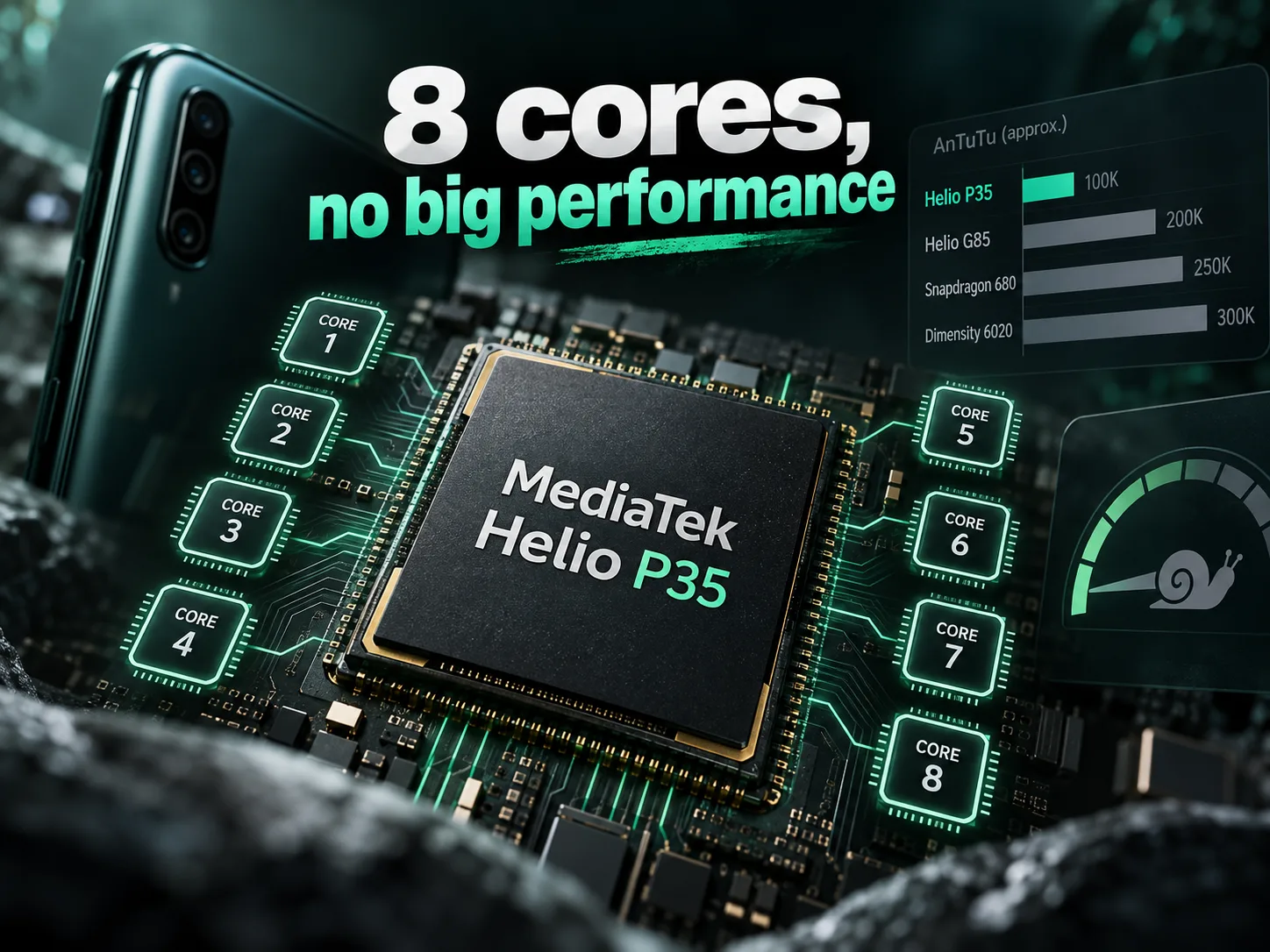
The MediaTek Helio P35 was released in December 2018 with eight Cortex-A53 cores: four run at up to 2.3 GHz, while the other four run at up to 1.8 GHz. Despite its higher maximum clock speed, the Helio P35 falls behind the Helio G85, whose two performance Cortex-A75 cores run at 2.0 GHz. In single-threaded Geekbench 6, the G85’s advantage reaches 42%, while in the 3DMark graphics test, the gap exceeds threefold. In the first case, the advantage comes from the more powerful CPU architecture; in the second, from the significantly more powerful GPU.
The Helio P35 was used in the Samsung Galaxy A12, Galaxy A04, and Oppo A54 4G. Some of these smartphones are still in use in 2026, although their performance now noticeably limits the choice of apps and usage scenarios.
Architecture: Why 2.3 GHz Loses to 2.0 GHz
The Helio P35 (MT6765) is manufactured by TSMC using a 12 nm process. Its eight cores are divided into two clusters:
- 4 × Cortex-A53 cores clocked at up to 2.3 GHz.
- 4 × Cortex-A53 cores clocked at up to 1.8 GHz.
Both clusters use identical Cortex-A53 cores and differ only in clock speed.
For comparison, the Helio G85 has two Cortex-A75 cores clocked at up to 2.0 GHz and six Cortex-A55 cores clocked at up to 1.8 GHz. Despite the lower maximum clock speed, the Cortex-A75 executes more instructions per clock cycle and handles single-threaded tasks noticeably faster than the Cortex-A53 in the Helio P35.
Interestingly, the later Helio G35 received the same Cortex-A53 architecture, a maximum clock speed of 2.3 GHz, and a PowerVR GE8320 GPU clocked at 680 MHz. Despite belonging to the gaming-oriented G series, it did not deliver a fundamental performance improvement over the P35.
Benchmarks: Falling Behind the Helio G85 and G99
The comparison includes four smartphones with three processors. The Helio G85 shows what changed with the move to Cortex-A75, while the Helio G99 illustrates how far inexpensive octa-core chips with Cortex-A76 have advanced.
| Smartphone | Geekbench 6 Single | Geekbench 6 Multi | AnTuTu 11 |
|---|---|---|---|
| Samsung Galaxy A12 (Helio P35) | 300 | 824 | 204 161 |
| Oppo A54 4G (Helio P35) | 300 | 816 | 191 639 |
| Xiaomi Redmi 12C (Helio G85) | 426 | 1297 | 362 896 |
| Samsung Galaxy A15 4G (Helio G99) | 708 | 1862 | 522 075 |
The table lists published results from specific smartphones. The Geekbench 6 and AnTuTu 11 figures are based on user measurements and may vary depending on the memory configuration, firmware, and testing conditions. The AnTuTu 11 sample for the Helio P35 is limited, so individual results should not be treated as stable averages.
The Redmi 12C outperforms the Galaxy A12 by 42% in the single-threaded Geekbench 6 test and by 57% in the multi-threaded test. Both processors have eight cores and are manufactured using a 12 nm process, but the difference in architecture gives the G85 a substantial advantage.
The Galaxy A15 4G with the Helio G99 is even more telling. Its Single-Core result is 2.36 times higher, while its overall AnTuTu 11 score is 2.56 times higher. Moreover, the G99’s maximum clock speed is 2.2 GHz, which is even slightly lower than that of the P35.
PowerVR GE8320 Graphics: The Difference Is Even Greater
The Helio P35 is equipped with a PowerVR GE8320 clocked at up to 680 MHz. The 3DMark Sling Shot Extreme test (OpenGL ES 3.1) was used to evaluate the GPU, as it is suitable for comparing older mobile platforms.
| Smartphone | 3DMark, points | Graphics Score | Graphics Test 1, FPS |
|---|---|---|---|
| Samsung Galaxy A12 (Helio P35) | 418 | 355 | 2 |
| Oppo A54 4G (Helio P35) | 457 | 388 | 2 |
| Xiaomi Redmi 12C (Helio G85) | 1406 | 1261 | 9 |
| Samsung Galaxy A15 4G (Helio G99) | 2441 | 2319 | 15 |
The table shows median results from UL Benchmarks. FPS refers to the first 3DMark graphics test, not to real-world games.
In terms of Graphics Score, the Helio G85 GPU outperforms the Galaxy A12 by approximately 3.6 times, while the Helio G99 GPU is 6.5 times faster. The gap is significantly larger than in the CPU tests.
The PowerVR GE8320 can handle simple 2D games, but demanding 3D graphics quickly expose its limitations. Older games may run at low settings, while modern resource-intensive titles place excessive demands on the GPU.
HD+ displays, which are installed in most inexpensive smartphones with the P35, reduce the load on the GPU but do not compensate for its low performance.
Memory and Storage: A Second Source of Delays
The Helio P35 supports LPDDR3 and LPDDR4X, as well as eMMC 5.1 storage. Smartphones based on it often come with 3-4 GB of RAM.
In 2026, that amount of RAM is not always enough to run a browser, messaging apps, and other applications simultaneously. Android unloads background processes more often, and when users return to them, the apps have to be launched again.
eMMC storage also affects responsiveness. Installing and updating apps, loading files, and reading large numbers of small data items can take longer than on smartphones with UFS storage. Combined with a weak CPU, this makes delays especially noticeable.
Cameras, Video, and Connectivity
The Helio P35’s integrated ISP is designed to process images from a single camera of up to 25 MP or from two 13 MP cameras in standard modes. Smartphones with this chip also used higher-resolution sensors, but their implementation depends on the camera design chosen by the manufacturer.
The processor supports video recording at up to 1080p and 30 frames per second. 4K recording is not supported, and processing complex night shots and HDR images may take noticeable time.
The Helio P35 supports 4G LTE, Wi-Fi 5, Bluetooth 5.0, and the main satellite navigation systems. These capabilities are still sufficient for calls, messaging, and video playback. There is no 5G support.
Conclusion: Should You Use the Helio P35 in 2026?
The Helio P35 shows why core count and clock speed do not determine a processor’s real-world speed. Despite its lower maximum clock speed, the Helio G85 delivers a 42% advantage in single-threaded Geekbench 6 and outperforms the P35 by more than three times in 3DMark graphics performance.
A smartphone with the Helio P35 can still be used for calls, messaging, music, and other simple tasks. However, buying such a device as a primary phone in 2026 is not advisable, especially with a configuration featuring 2-3 GB of RAM. Even inexpensive models with the Helio G85 or G99 deliver significantly higher performance.
SOC Comparison
Compare Helio P35 with other SOCs
Basic
4x 1.8 GHz – Cortex-A53
GPU Specifications
Connectivity
Memory Specifications
Miscellaneous
Benchmarks
Compared to Other SoC
Related SoC Comparisons


Share in social media
Or Link To Us
<a href="https://cputronic.com/index.php/soc/mediatek-helio-p35" target="_blank">MediaTek Helio P35</a>