MediaTek Helio P22
MediaTek Helio P22 in 2026: Why Eight Cortex-A53 Are Already Too Slow
MediaTek Helio P22 was released in 2018 and has become widely used in budget Android smartphones. Formally, the chip offers eight processor cores and a 12nm manufacturing process, but all cores are based on the old Cortex-A53 architecture. The main limitation today is the low single-thread performance. This is noticeable when launching applications, loading heavy web pages, and switching between programs.
Helio P22 in Real Smartphones: Geekbench 5 Results
The results for the same SoC vary depending on the firmware, memory configuration, temperature, and background load.
| Smartphone | RAM | Geekbench 5 Single-Core | Geekbench 5 Multi-Core |
|---|---|---|---|
| Alcatel 1S (2020) | 3 GB | 136 | 794 |
| Alcatel 3L (2020) | 4 GB | 147 | 863 |
| Sony Xperia L4 | 3 GB | 150 | 883 |
| Blackview A80 Plus | 4 GB | 155 | 869 |
Despite the variation in results, all four devices remain in the same performance class: around 140-155 points in Single-Core and 800-880 points in Multi-Core.
The eight cores help with multi-threaded tasks, but the low performance of Cortex-A53 slows down application launches and the operation of the interface.
Note: Geekbench 5 was chosen due to the broader sample of results for smartphones with Helio P22.
Eight Cortex-A53 Do Not Compensate for Weak Single-Thread Performance
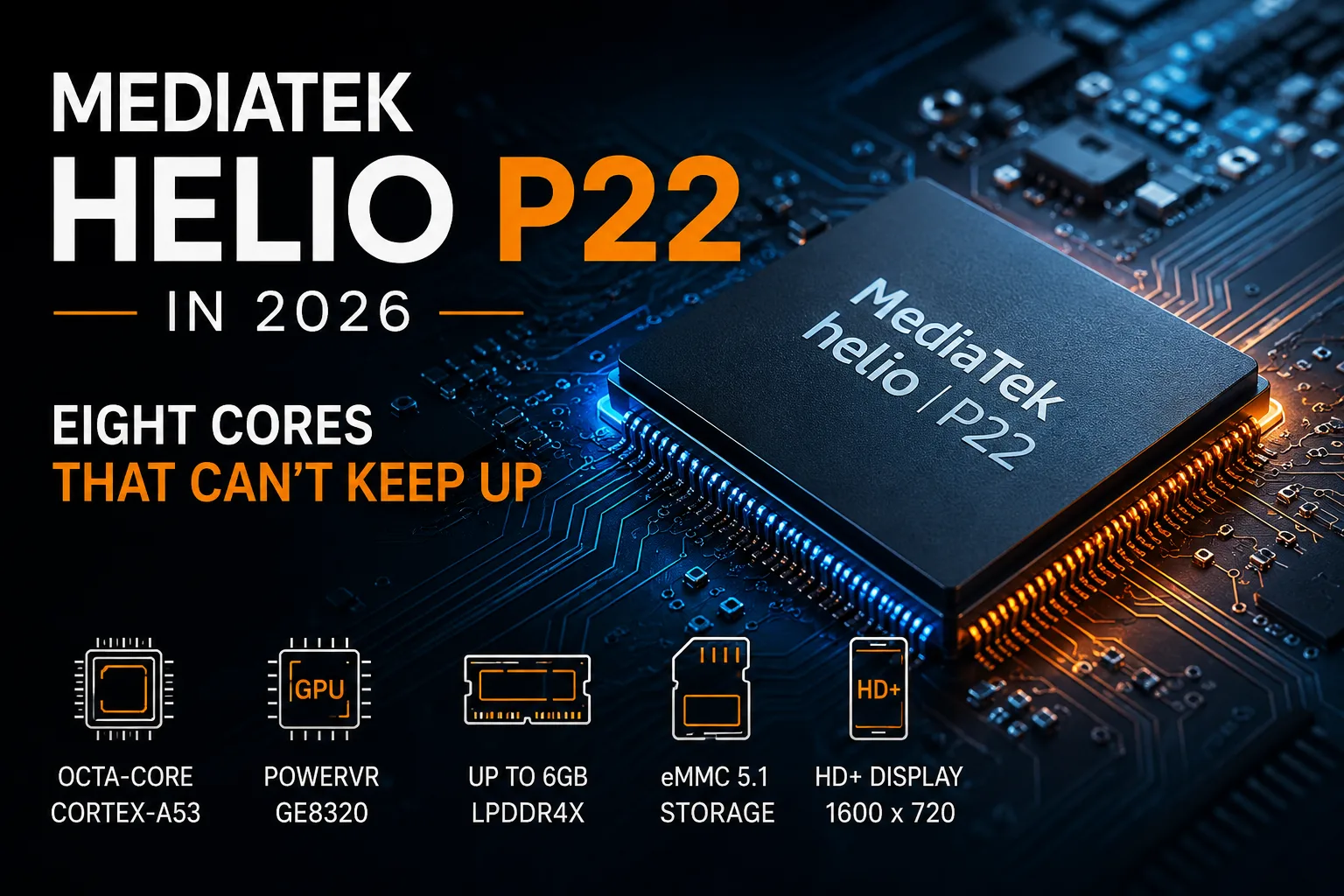
The Helio P22 features eight Cortex-A53 cores clocked up to 2.0 GHz and lacks a separate cluster of high-performance cores.
In 2018, such a configuration provided acceptable performance with low power consumption. But modern Android versions and applications require significantly higher single-core speed.
For calls, messaging apps, music, navigation, and other simple tasks, the performance is still sufficient. In heavier scenarios, the interface and applications feel noticeably sluggish.
PowerVR GE8320: Modern Games Are Too Demanding
The graphics are handled by the PowerVR GE8320 running at up to 650 MHz. The platform supports displays with a resolution of up to 1600 × 720 pixels, which corresponds to typical HD+ screens on devices with Helio P22.
The HD+ resolution reduces the load on the GPU, but the PowerVR GE8320 is still too weak for modern heavy games.
In the Xiaomi Redmi 6, the GE8320 graphics show the following results:
| Test | Result |
|---|---|
| GFXBench Manhattan 3.0 Onscreen | ~17 FPS |
| GFXBench Manhattan ES 3.1 | ~11 FPS |
| GFXBench Car Chase | ~4.8 FPS |
Simple and older games still perform adequately. In modern heavy games, even minimal settings often do not provide stable FPS.
eMMC 5.1 Becomes Another Bottleneck
The Helio P22 supports LPDDR3 and LPDDR4X. The maximum memory size is up to 4 GB for LPDDR3 and up to 6 GB for LPDDR4X.
For storage, eMMC 5.1 is used. There is no support for UFS.
The slow eMMC is particularly noticeable when installing and updating applications, booting the system, copying files, and working with a nearly full storage.
A smartphone with 4 GB of RAM will handle multitasking significantly better than a version with 2 GB, but the additional memory does not eliminate the limitations of the CPU and eMMC itself.
Cameras and Connectivity: A Typical Set for a 2018 Budget Device
The Helio P22 supports cameras up to 21 MP or a dual configuration of up to 13 + 8 MP. Video recording is limited to 1080p at 30 frames per second.
Wireless interfaces include Wi-Fi 5, Bluetooth 5.0, LTE, and basic satellite navigation systems.
For a budget SoC from 2018, the specifications were competitive. Now, these capabilities do not compensate for the slow CPU, weak GPU, and eMMC 5.1.
Is It Worth Buying a Smartphone with Helio P22 in 2026?
For a primary smartphone, the MediaTek Helio P22 is already too slow. The main issue lies not in the number of cores, but in the architecture: eight Cortex-A53 do not compensate for low single-thread performance.
A smartphone on the P22 is still suitable as a secondary device, a navigator, or for messaging and other simple tasks. The purchase is justified only at a very low price and minimal speed requirements.
For modern Android, a few fast cores are more important than eight old Cortex-A53 - and Helio P22 demonstrates this well.
SOC Comparison
Compare Helio P22 with other SOCs
Basic
4x 1.5 GHz – Cortex-A53
GPU Specifications
Connectivity
Memory Specifications
Miscellaneous
Benchmarks
Compared to Other SoC
Related SoC Comparisons


Share in social media
Or Link To Us
<a href="https://cputronic.com/index.php/soc/mediatek-helio-p22" target="_blank">MediaTek Helio P22</a>