MediaTek Dimensity 8350
MediaTek Dimensity 8350: a new number without new hardware
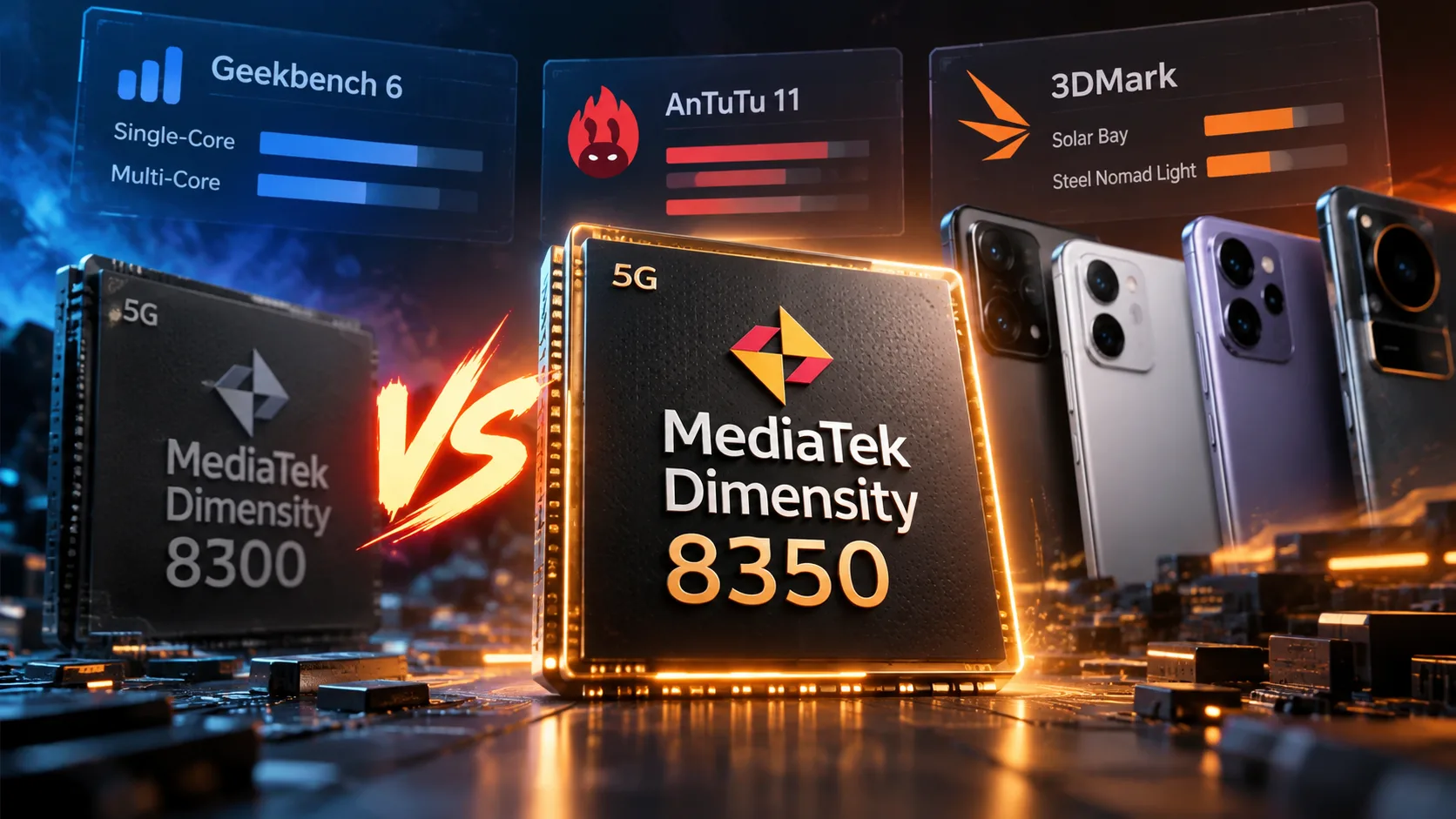
MediaTek Dimensity 8350 was released in November 2024, but its hardware specifications are practically identical to those of the Dimensity 8300. It has the same Cortex-A715 cores, Mali-G615 MC6 graphics, and 4-nm process. Even the POCO X6 Pro with the older Dimensity 8300 Ultra outperforms four smartphones powered by the 8350 in multi-core Geekbench 6.
The update mainly consists of software optimizations. At the same time, the differences between individual smartphones proved more noticeable than the changes between the processors themselves.
What changed compared with Dimensity 8300
Dimensity 8350 is manufactured by TSMC using a 4-nm process. The CPU configuration remains unchanged:
- 1 × Cortex-A715 clocked at up to 3.35 GHz;
- 3 × Cortex-A715 clocked at up to 3.2 GHz;
- 4 × Cortex-A510 clocked at up to 2.2 GHz.
The L3 cache capacity remains 4 MB, as do the Mali-G615 MC6 graphics, support for LPDDR5X at up to 8533 Mbit/s per pin, and UFS 4.0 storage.
MediaTek emphasized gaming optimizations, including its StarSpeed Engine technology. The company claims up to 10% lower power consumption and a 5% improvement in touch-control latency in supported games.
However, these percentages do not confirm a corresponding advantage over the Dimensity 8300. Moreover, StarSpeed Engine had already been mentioned in MediaTek’s Chinese materials about the previous processor, where adaptive management of gaming workloads was described.
Thus, even the software differences between the two platforms are not as obvious as the marketing materials might suggest. The manufacturer has not disclosed convincing data demonstrating a performance increase for the Dimensity 8350 directly over the 8300 under identical testing conditions.
The Dimensity 8350 Ultra and Ultimate versions also retain the same CPU and GPU architecture. Their additional designations do not indicate a transition to newer cores.
Geekbench 6 and AnTuTu 11: the older processor outperforms the newer one
Let’s compare four smartphones with the Dimensity 8350 and the POCO X6 Pro with the Dimensity 8300 Ultra.
| Smartphone | Processor | Geekbench 6 Single | Geekbench 6 Multi | AnTuTu 11 |
|---|---|---|---|---|
| OPPO Reno13 5G | Dimensity 8350 | 1416 | 4311 | 1,727,874 |
| OPPO Reno13 Pro 5G | Dimensity 8350 | 1432 | 4258 | 1,662,456 |
| Realme P3 Ultra 5G | Dimensity 8350 Ultra | 1216 | 4012 | 1,662,214 |
| Infinix Note 50 Pro+ 5G | Dimensity 8350 Ultimate | 1216 | 3896 | 1,775,645 |
| POCO X6 Pro | Dimensity 8300 Ultra | 1370 | 4509 | 1,604,305 |
The POCO X6 Pro scores 4509 points in the multi-core Geekbench 6 test-more than all four smartphones with the Dimensity 8350. Its advantage over the OPPO Reno13 Pro is about 6%, and over the Infinix Note 50 Pro+, almost 16%.
In the single-core test, the POCO trails both OPPO models but outperforms Realme and Infinix. The OPPO Reno13 Pro delivers the best result with 1432 points, approximately 4.5% higher than the POCO’s score.
There is no consistent advantage for the newer generation in Geekbench.
In AnTuTu 11, the Infinix Note 50 Pro+ leads with a score of 1.78 million points, despite recording the lowest Geekbench Multi result among the devices tested.
In AnTuTu’s memory section, the Infinix scores 324,889 points versus 285,213 for the OPPO Reno13. This helps it take the lead in the overall ranking, even though OPPO’s graphics score is slightly higher.
The results show how heavily a comprehensive benchmark depends on the entire system rather than just the CPU cores.
Mali-G615 MC6 graphics: a difference of more than 50% in 3DMark
The situation is the opposite in graphics tests. The Realme P3 Ultra with the Dimensity 8350 Ultra significantly outperforms the POCO X6 Pro.
| Smartphone | Processor | Solar Bay | Steel Nomad Light |
|---|---|---|---|
| OPPO Reno13 5G | Dimensity 8350 | 4852 | 1184 |
| OPPO Reno13 Pro 5G | Dimensity 8350 | 4723 | 1174 |
| Realme P3 Ultra 5G | Dimensity 8350 Ultra | 5310 | 1319 |
| Infinix Note 50 Pro+ 5G | Dimensity 8350 Ultimate | 4757 | 1188 |
| POCO X6 Pro | Dimensity 8300 Ultra | 3458 | 852 |
The Realme P3 Ultra scores 54% more in Solar Bay and 55% more in Steel Nomad Light than the POCO X6 Pro.
The difference is substantial, but it cannot be attributed to a new graphics architecture: both chips use the Mali-G615 MC6.
Drivers, power settings, and testing conditions all affect the results. Without additional measurements, it is impossible to determine what portion of the gap is caused by the processors themselves.
The 3DMark data confirms that specific smartphones perform better in these tests, but it does not prove that the Dimensity 8350’s GPU is 50% faster than the Dimensity 8300’s GPU.
In addition, peak scores do not show performance consistency. Assessing gaming capabilities requires results from sustained workloads and FPS stability.
Why results depend on the smartphone
Dimensity 8350 supports LPDDR5X and UFS 4.0, but manufacturers install different components.
For example, the OPPO Reno13 Pro comes with LPDDR5 and UFS 3.1, while the Infinix Note 50 Pro+ uses LPDDR5X and UFS 4.0.
Faster memory and storage can improve the results of individual tests and speed up data handling. However, they do not change the CPU architecture.
Cooling is equally important. A smartphone with higher peak performance may reduce its clock speeds more quickly as it heats up and lose to a competitor during a prolonged gaming session.
Therefore, comparing the Dimensity 8300 and 8350 solely by using results from different smartphones is insufficient for determining the performance gain of the chip itself.
Other platform capabilities
The Dimensity 8350 retains the NPU 780, 14-bit Imagiq 980 ISP, support for cameras of up to 320 MP, 4K video recording at 60 frames per second, Wi-Fi 6E, and Bluetooth 5.4.
The new processor is also practically identical to the Dimensity 8300 in these specifications. MediaTek has not introduced any significant hardware updates.
Conclusion
The Dimensity 8350 is essentially a re-release of the Dimensity 8300 under a new number. The architecture, CPU frequencies, graphics, memory, and core multimedia capabilities remain unchanged. The claimed gaming optimizations are not accompanied by convincing evidence of an advantage over the predecessor.
The Geekbench results are particularly revealing: the POCO X6 Pro with the Dimensity 8300 Ultra outperforms all four tested smartphones with the 8350 in the multi-core test. The newer models perform better in 3DMark, but the available data does not make it possible to attribute this gap to an upgrade of the GPU itself.
If a smartphone with the Dimensity 8300 already meets your needs, switching to the 8350 for performance reasons makes little practical sense. Buyers do not get a more modern architecture or a guaranteed faster processor.
At the same price, the choice should be based on the quality of the smartphone itself. There is simply no reason to pay extra just for the 8350 designation instead of the 8300.
SOC Comparison
Compare Dimensity 8350 with other SOCs
Basic
GPU Specifications
Connectivity
Memory Specifications
Miscellaneous
- FLAC
- HE-AACv1
- HE-AACv2
- MP3
- H.265
- AV1
- VP9
Benchmarks
Phones with Dimensity 8350




Tablets with Dimensity 8350

Comparison of Devices with Dimensity 8350
Compared to Other SoC
Related SoC Comparisons


Share in social media
Or Link To Us
<a href="https://cputronic.com/index.php/soc/mediatek-dimensity-8350" target="_blank">MediaTek Dimensity 8350</a>