MediaTek Dimensity 7400X
MediaTek Dimensity 7400X: 100 MHz More Per Generation and the Same Graphics
The MediaTek Dimensity 7400X appeared in February 2025 and became the foundation of the Motorola Razr 60, a foldable smartphone with a starting price of $699.99 in the US. The processor itself belongs to the mid-range segment: four Cortex-A78 cores, four Cortex-A55 cores, and a dual-core Mali-G615 MC2 GPU. Compared with the Dimensity 7300X, the CPU clock speed increased by just 100 MHz. MediaTek also claims improvements in graphics and AI performance, but real-world results show how minor the upgrade actually was.
Architecture: Cortex-A78 on a 4-nm Process
The Dimensity 7400X contains four high-performance Cortex-A78 cores clocked at up to 2.6 GHz and four power-efficient Cortex-A55 cores clocked at up to 2.0 GHz. Its predecessor used the same configuration, but the clock speed of the performance cores was limited to 2.5 GHz.
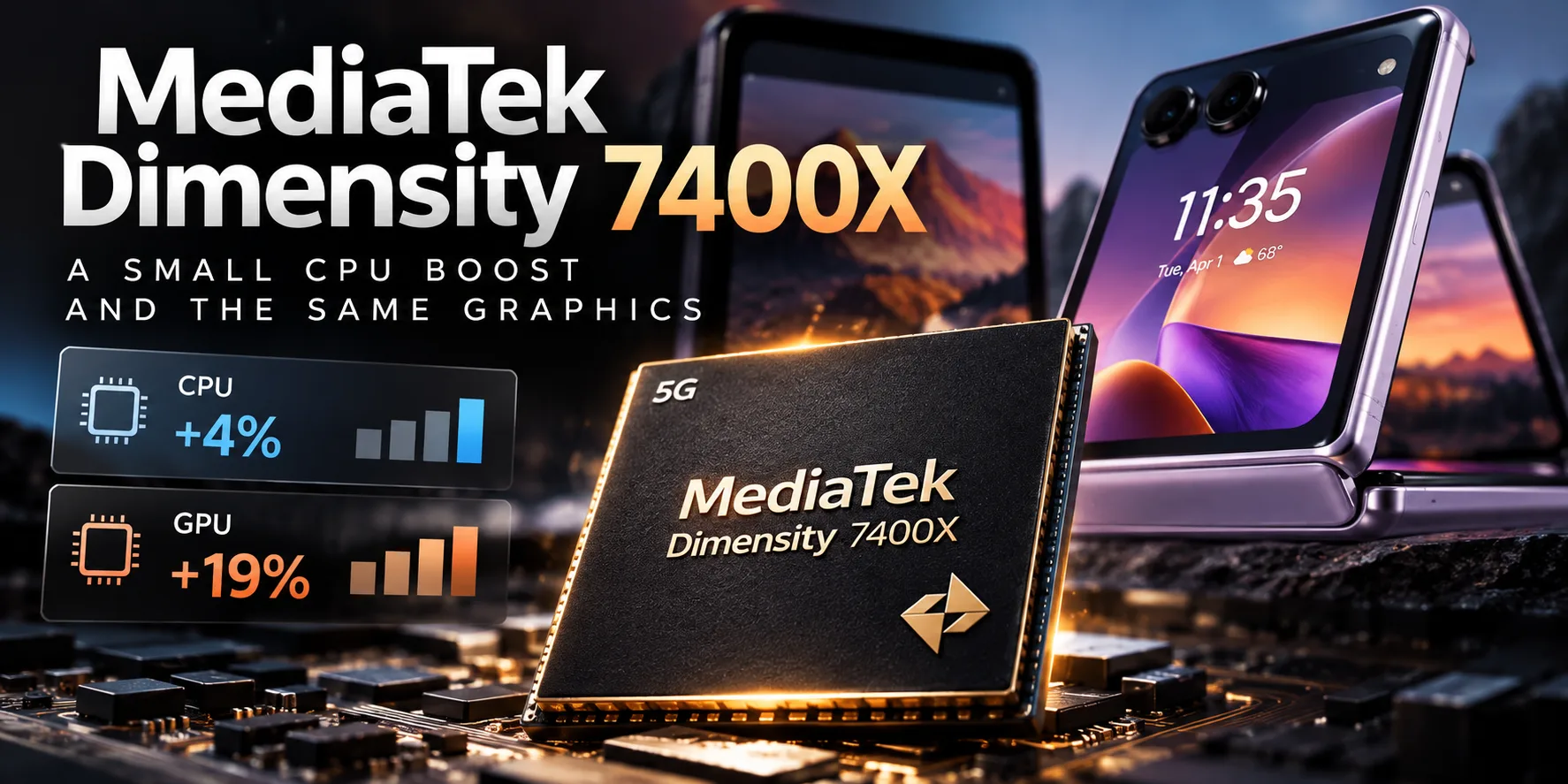
The 4% frequency increase does not offset the age of the architecture. The Cortex-A78 cores trail modern performance cores, while retaining the same CPU configuration limits the gains in multithreaded performance.
The Dimensity 7400 and 7400X have identical CPU and GPU configurations. The X version adds dedicated support for the two displays used by foldable smartphones. This capability was already present in the Dimensity 7300X, so this is a continuation of the specialization rather than a new feature.
Benchmarks: Minimal CPU Gains
The table shows the results of five foldable smartphones in GSMArena tests.
| Smartphone / processor | AnTuTu 10 | Geekbench 6 Single | Geekbench 6 Multi | 3DMark Wild Life Extreme |
|---|---|---|---|---|
| Motorola Razr (2025) / Dimensity 7400X | 676,899 | 1,090 | 2,974 | 1,020 |
| Motorola Razr 50 / Dimensity 7300X | 657,381 | 1,065 | 3,016 | 856 |
| Infinix Zero Flip / Dimensity 8020 | 821,111 | 757 | 2,550 | 1,261 |
| Motorola Razr 50 Ultra / Snapdragon 8s Gen 3 | 1,140,567 | 1,866 | 4,441 | 2,567 |
| Samsung Galaxy Z Flip5 / Snapdragon 8 Gen 2 for Galaxy | 1,467,524 | 1,978 | 5,369 | 3,816 |
Motorola Razr (2025) is the North American name for the Razr 60.
In Geekbench 6, the new Razr beats its predecessor by just 2.3% in the single-core test, while trailing it by 1.4% in the multicore test. The difference in AnTuTu 10 is around 3%.
In Wild Life Extreme, the Razr 2025’s advantage reaches 19%: 1,020 versus 856 points. Both processors use the Mali-G615 MC2, but the result is also affected by GPU clock speeds, cooling, and the smartphone’s settings. MediaTek claims a 10% increase in graphics performance over the previous generation, but that figure cannot be directly equated with the difference between the two Motorola models.
The Infinix Zero Flip with its older Dimensity 8020 trails the Razr 2025 in CPU performance but outperforms it by 24% in the graphics test thanks to a more powerful GPU configuration.
Graphics: A More Noticeable Upgrade Than the CPU
Despite the improvements, the Mali-G615 MC2 remains the main limitation of the Dimensity 7400X in demanding games. The Motorola Razr 50 Ultra with its Snapdragon 8s Gen 3 scores 2,567 points in Wild Life Extreme-2.5 times more than the Razr 2025.
The clamshell design also affects performance under sustained loads. In GSMArena testing, the Razr 2025’s CPU performance, after an initial drop, remained at approximately 60% of its starting level. Its graphics performance was more stable.
NPU, Cameras, and Memory
The Dimensity 7400X is equipped with the NPU 655 neural processor. MediaTek claims up to a 15% increase in AI performance compared with the previous generation, although the NPU designation has not changed.
The Imagiq 950 image processor supports 12-bit HDR, cameras of up to 200 MP, and 4K video recording at 30 frames per second. 4K60 recording is not supported.
The chip is compatible with LPDDR4X and LPDDR5 memory, as well as UFS 2.2 and UFS 3.1 storage. The Motorola Razr 2025 uses LPDDR4X and UFS 2.2, so it does not take advantage of the platform’s maximum capabilities.
Wireless interfaces include 5G with download speeds of up to 3.27 Gbps, Wi-Fi 6E, and Bluetooth 5.4.
Why a Mid-Range Processor Is Used in a $700 Smartphone
The Motorola Razr 2025 went on sale in the US for $699.99. For a comparable price, conventional smartphones can offer significantly more powerful processors.
The foldable OLED display, hinge, and external screen all increase the device’s cost. Using a mid-range processor makes it possible to avoid raising the price even further.
In 2026, Motorola introduced the Razr 2026 (Razr 70) with the Dimensity 7450X, making the Razr 60 a previous-generation device. When buying a new device, it is worth considering the current price, warranty, battery life, and remaining software support. For a used unit, the condition of the flexible display and hinge is especially important.
Conclusion
The Dimensity 7400X made virtually no difference to computing performance compared with the Dimensity 7300X. The 100 MHz increase delivered only a few percent in CPU tests, while the Motorola Razr 2025 produced noticeably higher graphics results than its predecessor.
In 2026, the main reasons to choose the Razr 60 are its foldable design and current price. The Dimensity 7400X handles everyday tasks, but offers no noticeable advantage over the previous generation and falls well behind more powerful processors in games.
SOC Comparison
Compare Dimensity 7400X with other SOCs
Basic
GPU Specifications
Connectivity
Memory Specifications
Miscellaneous
Benchmarks
Phones with Dimensity 7400X


Comparison of Devices with Dimensity 7400X
Compared to Other SoC
Related SoC Comparisons


Share in social media
Or Link To Us
<a href="https://cputronic.com/index.php/soc/mediatek-dimensity-7400x" target="_blank">MediaTek Dimensity 7400X</a>